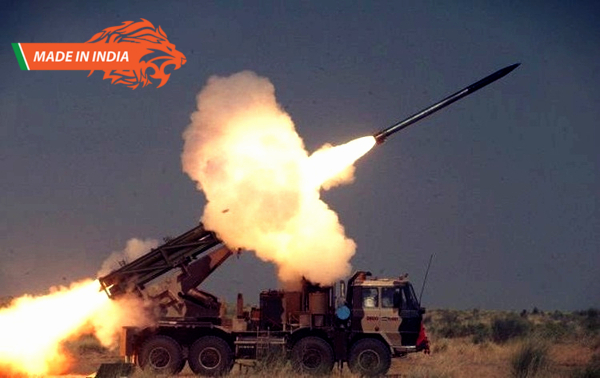
Haryana-based private defence manufacturer SG Defence Private Limited has secured an order to manufacture rocket nozzles for India’s indigenous Pinaka Mk-I rocket system. The development marks an important step in the company’s expansion into specialised defence component manufacturing and highlights the increasing participation of smaller Indian enterprises in major indigenous military programmes.
The Panchkula-based company announced the development through its corporate communication, describing the order as another milestone in its manufacturing journey. SG Defence stated that the opportunity would allow it to contribute to an established indigenous defence programme while strengthening its expertise in precision engineering and specialised component production.
SG Defence Enters the Pinaka Rocket Manufacturing Supply Chain
The new order provides SG Defence with an opportunity to participate in the manufacturing supply chain supporting the Pinaka Mk-I rocket system developed by the Defence Research and Development Organisation (DRDO).
SG Defence operates in the specialised engineering and defence component manufacturing sector, with activities involving precision machining and components used in weapons and ammunition systems.
The company stated that its latest manufacturing order represents an opportunity to expand its capabilities while contributing directly to India’s indigenous defence manufacturing ecosystem.
The Pinaka programme involves collaboration between defence research laboratories, public-sector enterprises, major private manufacturers and specialised component suppliers. Companies producing individual components play an important role in supporting the manufacturing and maintenance of complex military equipment.
For SG Defence, participation in the Pinaka programme offers an opportunity to strengthen its industrial expertise and establish a wider presence in the domestic rocket propulsion component supply chain.
Rocket Nozzles Play a Critical Role in Propulsion Systems
Rocket nozzles are essential components of solid-propellant rocket motors. They control and direct the flow of high-temperature gases produced during propellant combustion, converting thermal and pressure energy into the high-velocity exhaust that generates thrust.
The nozzle assembly plays an important role in determining the performance and reliability of a rocket propulsion system. Its internal geometry, structural integrity and thermal characteristics must meet demanding engineering requirements.
During operation, rocket nozzles are exposed to extremely high temperatures, pressure and thermal stresses. Manufacturing these components therefore requires specialised materials, precision machining, appropriate thermal protection and stringent quality assurance procedures.
According to DRDO’s official technical documentation, the Pinaka Mk-I rocket system incorporates a convergent-divergent nozzle assembly as part of its propulsion architecture.
The convergent-divergent configuration helps accelerate exhaust gases and supports the efficient generation of thrust during rocket-powered flight.
The manufacturing order secured by SG Defence is therefore associated with an important subsystem of the indigenous Pinaka rocket.
Pinaka Mk-I: India’s Indigenous Rocket Artillery System
The Pinaka multi-barrel rocket launcher system was developed by DRDO to provide the Indian Army with an indigenous rocket artillery capability.
The development programme was led by the Armament Research and Development Establishment (ARDE), Pune, with contributions from other DRDO laboratories and Indian industrial partners.
The original Pinaka Mk-I rocket system has an operational range of approximately 37.5 kilometres and is designed to deliver concentrated artillery fire against designated battlefield targets.
Each launcher carries 12 rockets that can be fired in a rapid salvo, enabling the Indian Army to deliver substantial firepower within a short period.
The system is mounted on a high-mobility vehicle platform and supports rapid deployment, firing and relocation. This mobility helps artillery units operate across different battlefield environments while reducing their exposure after firing.
Over the years, the Pinaka programme has expanded to include enhanced-range and guided rocket variants, supporting the modernisation of India’s rocket artillery capabilities.
Indigenous Pinaka Production Expands Across Indian Industry
The Pinaka programme has become an important example of collaboration between Indian defence research organisations and domestic manufacturers.
Several companies participate in the production of rockets, launchers, command systems and associated equipment. These include private-sector manufacturers such as Larsen & Toubro, Tata Advanced Systems and Solar Defence and Aerospace.
The development of an indigenous manufacturing ecosystem allows Indian industry to contribute specialised engineering capabilities across multiple stages of defence production.
In February 2025, the Ministry of Defence signed contracts worth approximately ₹10,147 crore for the procurement of Pinaka rocket ammunition.
The contracts were awarded to Economic Explosives Limited, a subsidiary of Solar Industries India Limited, and Munitions India Limited.
They covered Area Denial Munition Type-1 and High Explosive Pre-Fragmented Mk-I Enhanced rockets intended to strengthen the Indian Army’s artillery firepower.
These procurement programmes demonstrate the scale of industrial activity associated with the Pinaka system and the importance of establishing reliable domestic supply chains for rocket components.
The SG Defence announcement concerns a separate component manufacturing order. The company has not identified whether its contract is directly associated with any of these larger ammunition procurement agreements.
Growing Role of Smaller Private Defence Manufacturers
India’s defence manufacturing industry increasingly includes specialised private companies operating alongside established defence contractors and public-sector enterprises.
Complex military systems depend on numerous individual components and subassemblies. Their manufacture often requires expertise in metallurgy, precision engineering, industrial machining, electronics and specialised materials.
Smaller enterprises with relevant technical capabilities can participate in this industrial ecosystem by supplying components to larger manufacturing organisations.
Such participation broadens the domestic supplier base and creates opportunities for Indian companies to develop expertise in demanding military manufacturing applications.
SG Defence’s entry into the Pinaka rocket supply chain illustrates this process. Although the company has not disclosed the financial scale of the order, the contract provides an opportunity to undertake specialised manufacturing work associated with an operational Indian Army weapon system.
The company’s ability to execute the order according to the required quality standards and delivery specifications will be important to the development of its defence manufacturing business.
Pinaka Development Continues with Advanced Rocket Variants
DRDO continues to develop improved versions of the Pinaka rocket system, incorporating advances in range, precision and propulsion technology.
The development of enhanced and guided variants has expanded the capabilities associated with the original rocket artillery platform.
On 8 July 2026, DRDO successfully conducted a flight test of the Pinaka Long Range Guided Rocket at the Integrated Test Range, Chandipur, Odisha.
According to the Ministry of Defence, the rocket was tested at a user-defined minimum range of 60 kilometres and successfully completed its planned in-flight manoeuvres before striking the designated target.
The rocket was launched using an in-service Pinaka launcher, demonstrating the ability of the existing platform to accommodate different rocket variants.
The test represented another development in India’s indigenous rocket artillery programme.
Although SG Defence’s latest order specifically concerns the Pinaka Mk-I system, continued development of the broader Pinaka family demonstrates the importance of maintaining a capable domestic industrial base for rocket propulsion components and associated technologies.
Strengthening India’s Indigenous Rocket Manufacturing Ecosystem
The manufacturing order secured by SG Defence represents an encouraging development for India’s expanding private-sector defence industry.
By participating in the production of rocket nozzles for the Pinaka Mk-I system, the Panchkula-based company is entering a specialised segment of the domestic military manufacturing supply chain.
The order also highlights how indigenous defence programmes can create opportunities for smaller engineering companies possessing relevant technical capabilities.
As India’s defence industry expands its manufacturing expertise, the participation of specialised component suppliers will remain important to strengthening domestic production capacity and industrial self-reliance.
SG Defence’s latest order reflects the growing contribution of Indian private enterprises to indigenous defence programmes and marks another step in the development of a broader, more capable national defence manufacturing ecosystem.
You may also like
-
Voltas and Atomberg Sign ₹200 Crore Joint Venture Agreement for Indigenous AC Compressors
-
Sunita Tools Secures Defence Licence for 81–155 mm Artillery Shells, Reports ₹550 Crore Order Book
-
Rossell Techsys Secures ₹50 Crore-Plus Overseas Order for Satellite Electrical Systems
-
SSS Defence Emerges as Lowest Bidder for Indian Army Counter-Drone Shotgun Procurement
-
India’s Core Industries Grow 10.9% in October, Led by Iron Ore, Coal and Power
