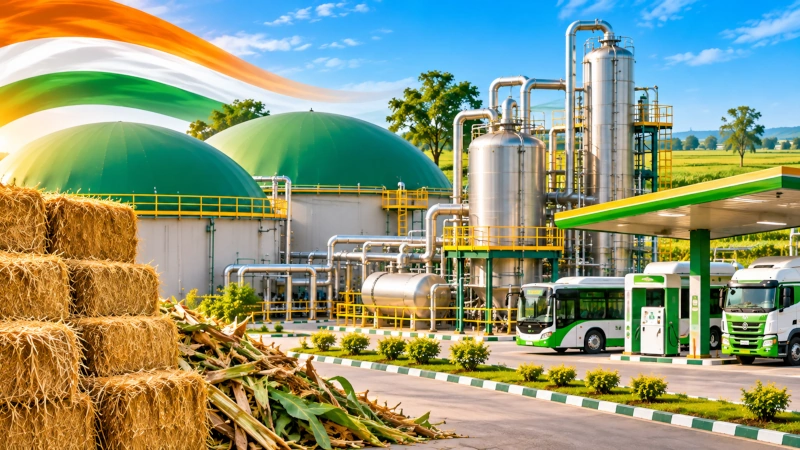
Reliance Industries Limited has outlined plans to invest approximately ₹15,000 crore in establishing a nationwide network of around 100 compressed biogas plants by 2030, marking a major proposed expansion of its renewable gas business. The investment programme is intended to convert agricultural residues into compressed biogas, strengthen India’s domestic energy production and expand the commercial utilisation of agricultural waste.
The expansion plans were disclosed on November 17, 2026, by Vikas Rathi, Chief Financial Officer of Reliance Industries’ Bio Energy Business, during an industry event. According to the company executive, Reliance aims to produce approximately five million cubic metres of gas daily by 2030 using agricultural residues as a principal feedstock.
The proposed investment builds upon Reliance’s existing compressed biogas operations, which currently comprise 45 plants across 10 Indian states. These facilities are producing approximately 350 tonnes of biogas per day while operating below their full production capacity. The company intends to expand its manufacturing and processing infrastructure in regions where agricultural residues are readily available, connecting agricultural waste management with renewable energy production.
Reliance Targets 100 Compressed Biogas Plants by 2030
Reliance Industries plans to expand its compressed biogas network to approximately 100 plants by 2030 through an investment estimated at ₹15,000 crore, equivalent to around USD 1.6 billion. The proposed expansion represents a substantial commitment to developing renewable gas production infrastructure using agricultural residues and other suitable organic feedstocks.
The company already operates 45 compressed biogas plants in 10 states, providing an established operational foundation for its expansion programme. These plants process organic materials to produce methane-rich gas that can be upgraded and compressed for use as an alternative to conventional natural gas.
Reliance has identified the availability of agricultural residues as an important consideration in selecting locations for additional facilities. Establishing plants near agricultural production centres can support feedstock collection, reduce transportation requirements and enable the commercial utilisation of biomass that might otherwise remain unused or be disposed of through less productive methods.
The proposed network would significantly expand Reliance’s presence in India’s emerging compressed biogas industry. However, the investment and plant targets remain part of a planned development programme, with their implementation dependent on project execution, feedstock arrangements, infrastructure development and commercial conditions.
Ten Additional Plants Planned by March 2027
As an intermediate milestone, Reliance intends to add 10 compressed biogas plants by the end of March 2027, expanding its network from 45 to approximately 55 facilities.
The company expects the additional plants and higher utilisation of existing capacity to raise production to approximately 1,100 tonnes per day. This compares with the current reported production of around 350 tonnes daily and represents a significant planned increase in operational output.
According to the company’s November 17 statement, the targeted production level would be equivalent to approximately 1.5 million to two million cubic metres of gas per day. The precise relationship between gas volume and compressed biogas tonnage depends on gas composition and measurement conditions.
The planned increase reflects Reliance’s intention to scale its renewable gas operations through a combination of additional processing facilities and higher utilisation of installed capacity.
The company has already established commercial supply arrangements through which compressed biogas is sold to gas distribution companies supplying households and small industrial consumers. The planned expansion would provide an opportunity to increase renewable gas availability within these distribution networks.
Agricultural Residues to Become a Major Source of Renewable Energy
Agricultural residues form the foundation of Reliance Industries’ compressed biogas expansion strategy. These materials include crop stalks, straw, husks and other organic by-products generated during agricultural production and processing.
India produces substantial quantities of agricultural residues across its major farming regions. While a portion is already utilised for animal feed, soil management, industrial applications and other purposes, additional biomass resources can be used for renewable energy production where collection and processing are commercially viable.
Compressed biogas production provides a mechanism for converting suitable organic feedstocks into methane-rich fuel through biological processing. In anaerobic digestion, microorganisms break down biodegradable organic matter in an oxygen-free environment, producing biogas containing methane and carbon dioxide.
The raw biogas is subsequently purified to remove carbon dioxide and other impurities, producing a methane-rich gas suitable for compression and use in compatible energy applications.
The resulting compressed biogas can serve as a renewable alternative to conventional compressed natural gas in vehicles and may also be supplied to industrial and commercial consumers through appropriate gas distribution systems.
By developing production facilities close to agricultural regions, Reliance aims to connect renewable fuel manufacturing with the availability of domestic biomass resources.
Understanding Compressed Biogas Technology
Compressed biogas is a renewable gaseous fuel produced by processing biodegradable organic materials such as agricultural residues, livestock waste, food waste and certain industrial organic by-products.
The process generally begins with the collection and preparation of suitable feedstocks, which are introduced into anaerobic digestion systems. Within these controlled environments, microorganisms break down organic material and release biogas.
Raw biogas typically contains methane, carbon dioxide and smaller quantities of other gases and impurities. To produce compressed biogas suitable for commercial energy applications, the gas undergoes purification and upgrading to increase its methane concentration.
After purification, the gas is compressed for storage, transportation and distribution. Depending on applicable quality specifications and infrastructure arrangements, compressed biogas can be used in vehicles, industrial facilities and gas distribution networks.
An additional product of anaerobic digestion is digestate, the residual material remaining after the biological conversion process. When appropriately processed and tested, digestate can be utilised as an agricultural soil amendment or fertiliser product.
The technology therefore offers opportunities to produce renewable fuel while recovering value from organic agricultural materials.
Reliance Supplies Renewable Gas to Distribution Companies
Reliance Industries currently sells compressed biogas to gas distribution companies serving households and small industries. These arrangements provide a commercial route through which renewable gas produced at the company’s facilities can reach downstream consumers.
City gas distribution networks play an important role in supplying compressed natural gas for transportation and piped natural gas for domestic, commercial and industrial requirements. Compressed biogas that meets the applicable technical and quality standards can contribute to these supply networks.
The expansion of domestic compressed biogas production provides opportunities to diversify the sources of methane-rich gas available to distribution companies.
Unlike conventional natural gas, which is extracted from underground fossil fuel reserves, compressed biogas is produced from renewable organic feedstocks. Its environmental performance depends on factors such as feedstock sourcing, methane leakage, processing energy requirements and the management of residual materials.
The expansion of commercially viable biogas production can nevertheless contribute to the development of alternative domestic energy sources and support the productive utilisation of agricultural residues.
Reliance’s existing supply arrangements provide a foundation for connecting additional production capacity with downstream gas markets as its planned facilities are developed.
Expansion Could Create New Opportunities for Farmers
The proposed compressed biogas network has important implications for the agricultural sector because the availability of crop residues is central to Reliance’s production strategy.
Farmers generate agricultural by-products during harvesting and crop processing, and these materials can have commercial applications when suitable collection and purchasing arrangements are established.
The development of compressed biogas plants near agricultural production centres can create additional markets for eligible residues. This could provide farmers and agricultural enterprises with opportunities to supply biomass to renewable energy producers.
Such supply chains require collection systems, transportation arrangements, storage facilities and mechanisms for maintaining feedstock quality. The development of this infrastructure can support rural economic activity associated with agricultural waste management and biomass logistics.
The use of crop residues for energy production can also provide an alternative to open-field burning in regions where residue disposal is a recurring challenge. However, the extent of this benefit depends on the availability of practical collection arrangements and the economics of alternative residue uses.
Reliance’s proposed expansion could therefore strengthen connections between agricultural production and renewable energy manufacturing, creating opportunities for biomass suppliers, transport operators and rural service providers.
Bioenergy Development Supports India’s Domestic Energy Requirements
India’s growing energy requirements have increased the importance of developing a diverse portfolio of domestic energy sources, including renewable electricity, biofuels, compressed biogas and other alternatives to imported fossil fuels.
Natural gas is used in transportation, fertiliser production, industrial processes, household cooking and commercial applications. Expanding domestic sources of methane-rich gas can contribute to diversification within the country’s gaseous fuel supply system.
The Indian government has identified an increase in the share of natural gas in the country’s energy mix to 15% by 2030 as a policy objective. Renewable gaseous fuels such as compressed biogas can contribute to broader efforts to diversify energy supply, although the scale of their eventual contribution will depend on production growth and integration with existing distribution infrastructure.
Reliance’s planned investment of ₹15,000 crore represents a substantial proposed private-sector commitment to the renewable gas industry.
By targeting five million cubic metres of daily gas production by 2030, the company is seeking to establish a larger role in domestic bioenergy production while creating additional commercial applications for agricultural residues.
Reliance Expands Its Integrated Renewable Energy Business
Reliance Industries has been developing renewable energy operations across several technologies, including solar power, battery storage, hydrogen and bioenergy.
Within this broader energy portfolio, compressed biogas occupies a distinct position because it produces gaseous fuel from organic feedstocks rather than generating electricity directly from solar or wind resources.
The company’s compressed biogas activities have moved beyond pilot-scale development into commercial production. Its existing facilities provide practical experience in biomass procurement, biological processing, gas purification and fuel distribution.
Reliance’s FY 2025-26 corporate disclosures identified compressed biogas as an important component of its developing energy business and outlined plans to increase the number of operating facilities and expand production capacity.
The November 17 announcement builds upon those earlier objectives by outlining a larger investment programme extending towards 2030.
The expansion reflects the company’s intention to develop an integrated renewable gas business supported by domestic agricultural feedstocks, processing infrastructure and commercial fuel distribution arrangements.
India’s Bioenergy Industry Gains a Major Private-Sector Investment Proposal
The proposed ₹15,000 crore investment by Reliance Industries represents an important development for India’s emerging compressed biogas sector.
The company’s existing network of 45 operational facilities across 10 states demonstrates that it has already established a commercial production base. Its plans to reach approximately 55 plants by March 2027 and around 100 plants by 2030 outline the intended scale of further development.
The investment programme also highlights the growing industrial importance of agricultural residues, which can be converted into commercially useful fuels through appropriate processing technologies.
Successful expansion of compressed biogas production requires coordinated development across several activities, including feedstock procurement, plant construction, biological processing, gas purification, distribution and long-term commercial supply.
Reliance’s plans bring these activities together within a proposed nationwide bioenergy production network.
The initiative creates opportunities to strengthen domestic renewable gas manufacturing, support agricultural biomass markets and expand the contribution of private industry to India’s energy diversification.
Towards a Larger Domestic Compressed Biogas Industry
Reliance Industries’ announcement on November 17, 2026, marks an important step in the proposed expansion of India’s compressed biogas production infrastructure.
With an investment plan of approximately ₹15,000 crore and a target of around 100 facilities by 2030, the company intends to build upon its existing operational network and increase the commercial production of renewable gas from agricultural residues.
The planned expansion to 55 facilities by March 2027 provides an intermediate milestone, while the longer-term target of five million cubic metres of gas daily reflects the scale of the company’s ambitions in renewable energy manufacturing.
Beyond fuel production, the initiative offers opportunities to develop agricultural residue supply chains, strengthen rural biomass collection systems and increase the productive use of organic resources.
Although the proposed investments and future production targets remain dependent on implementation, Reliance’s existing commercial operations provide an established foundation for further growth.
The programme highlights the increasing importance of bioenergy in India’s industrial development and demonstrates how agricultural resources, advanced processing technologies and private-sector investment can contribute to building a more diversified, resource-efficient and self-reliant domestic energy economy.
You may also like
-
Dynamatic Technologies Strengthens Global Aerospace Engagement with Canadian Defence Delegation and French Manufacturer Mecachrome
-
Vasmat Haldi – The Golden Agricultural Heritage of Maharashtra’s Marathwada Region
-
Glenmark’s Innovation Arm Submits US FDA Application for Experimental Cancer Immunotherapy ISB 2301
-
IN-SPACe Selects Three Indian Space Companies to Develop Indigenous Satellite-Based 3D City Mapping Technology
-
Aether Industries Partners with Baker Hughes to Establish India’s First Dedicated Drag-Reducing Agents Manufacturing Facility
