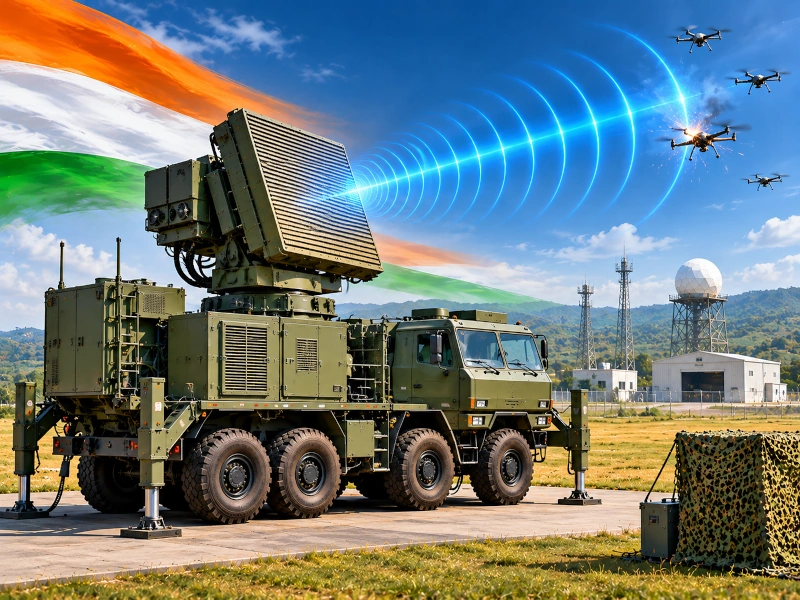
The Defence Research and Development Organisation (DRDO) has initiated a process to identify an Indian industry partner for the development, production and integration of its indigenous BHEDAK high-power radio-frequency directed-energy weapon system. The initiative is being undertaken by the Microwave Tube Research & Development Centre (MTRDC), Bengaluru, and represents an important step in expanding domestic capabilities in advanced electromagnetic weapon technologies.
The laboratory issued an Expression of Interest (EoI) on November 12, 2026, inviting eligible Indian companies to participate in the programme as a Development-cum-Production Partner (DcPP). The selected partner will be associated with system realisation, integration, testing and field trials, bringing specialised industrial expertise into the development of the directed-energy weapon system.
The programme is particularly relevant to India’s efforts to develop indigenous technologies for countering unmanned aerial systems and other electronics-dependent threats. High-power radio-frequency weapons represent a category of directed-energy technology designed to affect electronic equipment through concentrated electromagnetic energy rather than conventional projectiles or explosive warheads.
BHEDAK: An Indigenous High-Power Radio-Frequency Weapon
BHEDAK is a high-power radio-frequency directed-energy weapon programme being developed by DRDO’s Microwave Tube Research & Development Centre. The technology is associated with the generation and application of high-power electromagnetic energy for defence purposes.
Unlike conventional kinetic weapons that physically intercept targets using projectiles or missiles, high-power radio-frequency systems are intended to interfere with or damage vulnerable electronic components through electromagnetic effects. Their potential applications include countering unmanned aerial vehicles, electronic equipment and other systems dependent upon sensitive circuitry.
Modern unmanned aircraft rely upon several interconnected electronic subsystems, including flight controllers, navigation equipment, sensors, communication modules and onboard processors. High-power electromagnetic technologies seek to exploit the susceptibility of such equipment to intense electromagnetic energy.
Directed-energy systems are also being studied internationally as potential solutions for addressing certain challenges associated with unmanned aerial threats. Their effectiveness depends upon several factors, including target characteristics, electromagnetic power, operating conditions and the technical design of the weapon.
The BHEDAK programme reflects DRDO’s continuing research into indigenous electromagnetic technologies for specialised defence applications.
Development Led by DRDO’s Microwave Research Centre
The Microwave Tube Research & Development Centre, located in Bengaluru, is a specialised DRDO establishment working on microwave tubes and associated technologies required for defence applications.
The laboratory develops high-power microwave and radio-frequency technologies used in specialised electronic systems. Its areas of expertise include microwave power generation, advanced vacuum electronic devices and technologies associated with high-frequency electromagnetic energy.
These capabilities provide an important technological foundation for directed-energy weapon research.
High-power radio-frequency systems require the integration of several specialised components, including power-generation equipment, radio-frequency sources, electromagnetic transmission systems, control electronics and supporting infrastructure.
The development of such systems involves complex engineering requirements associated with electrical power, thermal management, equipment reliability and electromagnetic performance.
Through the BHEDAK programme, MTRDC is seeking to involve Indian industry in the engineering and integration activities required to advance the system towards further testing and evaluation.
DRDO Invites Indian Development-cum-Production Partner
The Expression of Interest issued by MTRDC seeks to identify a Development-cum-Production Partner capable of participating in the realisation and integration of the BHEDAK system.
The procurement notice carries reference number MTRDC/BHEDAK/2026/EoI/01 and identifies December 10, 2026, as the deadline for submission of proposals, with bid opening scheduled for December 11.
The partnership framework is intended to connect DRDO’s specialised research capabilities with the manufacturing, engineering and integration expertise available within India’s defence industry.
The selected industry partner will participate in activities associated with system realisation, integration, testing and field trials in accordance with the requirements of the programme.
The opportunity is relevant to Indian companies working in defence electronics, high-power radio-frequency technologies, advanced electrical systems, precision manufacturing and specialised systems integration.
The EoI represents an industry-partner identification process rather than the award of a production contract. It establishes a formal opportunity for domestic companies to participate in the next stages of the programme.
Potential Applications in Counter-Drone Defence
One of the important applications of high-power radio-frequency directed-energy technology is the development of systems capable of countering unmanned aerial threats.
Unmanned aerial vehicles are increasingly used for reconnaissance, surveillance and military operations. Their growing adoption has created additional requirements for technologies capable of detecting, tracking and neutralising different categories of airborne threats.
Conventional counter-drone systems may employ electronic warfare equipment, guns, missiles or other interception technologies. High-power radio-frequency weapons offer a different approach by attempting to affect the electronic systems responsible for an unmanned aircraft’s operation.
Depending upon the characteristics of the technology and the target, electromagnetic effects may interfere with electronic functions or cause damage to susceptible components.
Such capabilities are particularly relevant to research into countering groups of unmanned aircraft, where conventional interception systems may face challenges associated with the number of incoming targets.
The BHEDAK programme is being pursued within this broader field of directed-energy research. Its specific engagement capabilities and operational performance will be determined through the development and evaluation process.
Development of India’s Directed-Energy Weapon Technologies
DRDO has been pursuing multiple research and development programmes involving directed-energy technologies, including high-energy lasers and high-power microwave systems.
These technologies employ different physical mechanisms and are being developed for distinct defence applications.
Laser-based directed-energy weapons use concentrated optical energy, while high-power radio-frequency weapons operate through electromagnetic energy at radio or microwave frequencies.
India’s directed-energy research ecosystem includes specialised laboratories working on power electronics, microwave technologies, advanced sensors, control systems and associated engineering disciplines.
The BHEDAK programme adds an industry-partnership dimension to this research by seeking domestic participation in the development and integration of an indigenous high-power radio-frequency weapon system.
The initiative also reflects the importance of cooperation between defence research establishments and Indian manufacturing companies in developing advanced military technologies.
Opportunities for Indian Private Defence Manufacturers
The BHEDAK industry-partnership initiative provides an opportunity for Indian private-sector companies possessing relevant expertise in advanced electronics and defence engineering.
The development of high-power radio-frequency systems involves specialised manufacturing processes, electrical engineering, power management, electronic integration and testing capabilities.
Indian companies operating in these areas can contribute to the industrial requirements associated with advanced electromagnetic technologies.
The Development-cum-Production Partner model enables DRDO to combine its research and development capabilities with the engineering and production expertise of domestic industry.
Such cooperation forms an important part of India’s defence manufacturing ecosystem, where public research establishments and private companies increasingly work together on specialised military technologies.
The BHEDAK programme is therefore significant not only for its technological objectives but also for its emphasis on building domestic industrial participation in advanced defence systems.
Strengthening India’s Indigenous Defence Electronics Ecosystem
High-power radio-frequency directed-energy technologies represent a specialised field requiring expertise across multiple engineering disciplines.
The development of indigenous capabilities in this area involves microwave research, electrical power systems, electronics manufacturing, control technologies and system integration.
DRDO’s decision to seek an Indian industry partner for BHEDAK establishes a framework for connecting these technological requirements with domestic manufacturing expertise.
The initiative is consistent with the Government of India’s Aatmanirbhar Bharat programme and its emphasis on developing indigenous defence technologies through cooperation between research institutions and Indian industry.
It also highlights the increasing role of advanced electronics and electromagnetic technologies in India’s broader defence research and manufacturing activities.
Conclusion
DRDO’s initiative to identify an Indian industry partner for the BHEDAK high-power radio-frequency directed-energy weapon represents an important development in India’s indigenous advanced weapons research.
The programme brings together the specialised microwave research capabilities of MTRDC and the engineering and manufacturing expertise available within India’s defence industry.
With its focus on electromagnetic technologies, system integration and field evaluation, BHEDAK adds to the country’s growing portfolio of indigenous directed-energy weapon programmes.
The initiative also creates opportunities for Indian private defence manufacturers to participate in a technologically advanced area of military research and development.
By combining DRDO’s scientific expertise with the capabilities of Indian industry, the BHEDAK programme marks another positive step in strengthening India’s indigenous defence electronics ecosystem and advancing the nation’s technological self-reliance under Aatmanirbhar Bharat.
You may also like
-
Belrise Industries Expands into Aerospace and Electronics Manufacturing, Reports 26% Manufacturing Revenue Growth
-
Agnikul Cosmos Plans ₹510 Crore Orbital Data Centre Manufacturing Facility in Andhra Pradesh
-
AXISCADES Secures 16 New Defence Orders with ₹730 Crore Production Potential
-
Kaynes Technology Partners with Toyokawa Techno for TFT Display Module Manufacturing in India
-
Waaree Energies Commissions 5.15 GWh Battery Pack Manufacturing Line in Gujarat
