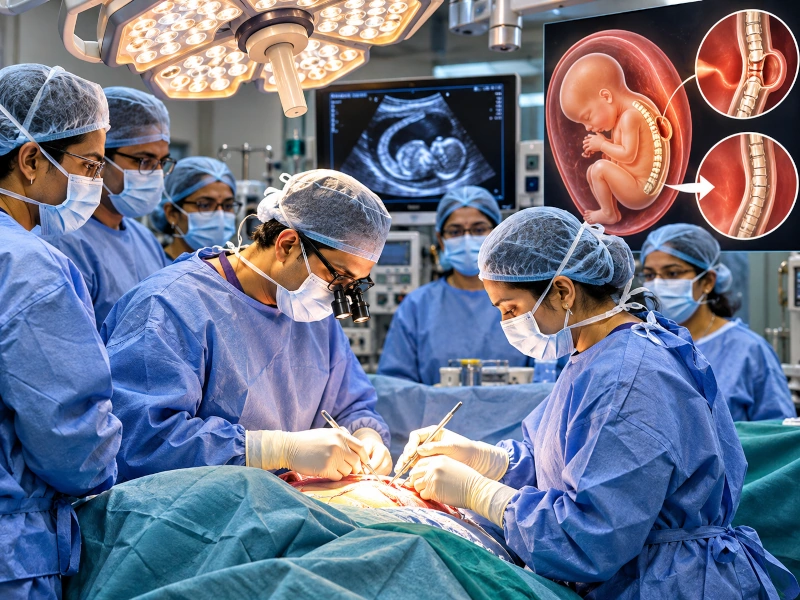
The All India Institute of Medical Sciences (AIIMS), New Delhi, has achieved a significant milestone in advanced fetal medicine by performing India’s first open fetal surgery to repair a severe spinal defect in an unborn baby. The six-hour procedure, conducted on November 12, 2026, at the institute’s Neurosciences Centre, involved repairing a lumbosacral myelomeningocele in a fetus at 25 weeks of gestation.
The surgery was performed by a multidisciplinary team of more than 30 doctors and nursing professionals representing several medical specialties. The operation involved repairing an opening in the lower part of the fetal spine through which spinal structures had protruded, exposing delicate neural tissue and allowing cerebrospinal fluid to leak.
The procedure represents an important development in India’s capabilities in fetal neurosurgery, maternal-fetal medicine and specialised surgical care. Unlike conventional treatment performed after birth, fetal surgery seeks to protect the developing spinal cord from further injury during the remaining period of pregnancy.
Understanding Myelomeningocele and Its Medical Complications
Myelomeningocele is a severe form of spina bifida, a congenital neural tube defect that develops during the early stages of pregnancy. The condition occurs when the neural tube, which eventually forms the brain and spinal cord, does not close properly during fetal development.
In babies affected by myelomeningocele, the spinal cord and its protective coverings protrude through an opening in the vertebral column. The exposed nervous tissue may suffer progressive damage during pregnancy, potentially affecting movement, sensation and other neurological functions.
Children born with this condition can experience paralysis or weakness of the lower limbs, bladder and bowel dysfunction, orthopaedic complications and hydrocephalus, a condition characterised by abnormal accumulation of cerebrospinal fluid within the brain.
Traditionally, surgical repair is undertaken after birth to close the spinal defect and protect the exposed tissues. However, damage to the developing nervous system may already have occurred before delivery.
Prenatal surgical repair seeks to reduce further damage by closing the defect while the fetus is still developing inside the uterus. International clinical evidence indicates that fetal repair can improve certain neurological outcomes and reduce the need for some subsequent interventions in appropriately selected pregnancies.
Five Weeks of Planning Before the Complex Procedure
The AIIMS operation followed more than five weeks of multidisciplinary planning involving detailed fetal imaging, consultations among specialists, counselling of the parents, anaesthetic preparation and surgical simulation.
The neurosurgical component of the procedure was led by Professor Deepak Gupta, while Professor Neena Malhotra and Professor K. Aparna Sharma led the maternal-fetal medicine and obstetric teams.
More than 30 clinicians and nursing professionals participated in the operation, representing obstetrics and gynaecology, maternal-fetal medicine, neurosurgery, obstetric and neuroanaesthesia, plastic surgery, radiodiagnosis and neonatology.
The procedure was conducted at the Neurosciences Centre using advanced surgical microscopy and continuous ultrasonography assistance. These technologies enabled the surgical team to monitor the fetus and guide the repair of the spinal defect.
Open fetal surgery involves accessing the fetus through an incision in the uterus, performing the required surgical correction and subsequently closing the uterus so that the pregnancy can continue under medical supervision.
The complexity of the procedure requires coordinated management of both maternal and fetal health, making detailed preparation and continuous monitoring essential components of the operation.
Potential Benefits of Surgery Before Birth
The principal objective of fetal repair is to protect exposed spinal tissue from additional damage before delivery. By closing the defect during pregnancy, surgeons aim to reduce continuing injury to the developing nervous system.
International research, including the landmark Management of Myelomeningocele Study (MOMS), has demonstrated that prenatal repair can provide benefits in carefully selected cases.
The study found that approximately 40% of children who underwent prenatal repair required cerebrospinal fluid shunt placement by 12 months of age, compared with 82% among children who underwent postnatal repair.
Prenatal surgery was also associated with improvements in certain motor outcomes and reductions in hindbrain herniation associated with Chiari II malformation.
However, fetal surgery is not a cure for myelomeningocele. Children undergoing prenatal repair may still require long-term neurological, orthopaedic, urological and rehabilitation care.
The procedure also carries risks, including premature labour, preterm delivery and complications associated with the uterine incision. Consequently, prenatal repair is recommended only for carefully selected pregnancies following detailed medical assessment and counselling.
These international findings provide the medical basis for fetal spinal repair but do not establish the eventual neurological outcome of the individual procedure performed at AIIMS.
Continued Monitoring of Mother and Baby
Following the operation, AIIMS stated that the mother and fetus would remain under close multidisciplinary monitoring throughout the remainder of pregnancy, delivery and the newborn period.
The monitoring programme is intended to assess maternal recovery, fetal development and potential complications associated with the surgical intervention.
Although the spinal defect has been repaired, the baby’s eventual neurological and functional outcomes will require assessment after birth and during subsequent development.
The institute has emphasised that fetal surgery must form part of a comprehensive maternal-fetal care programme involving careful patient selection, specialised surgical expertise, appropriate counselling and continued medical follow-up.
Surgery Provided Free Under Government Healthcare Scheme
AIIMS confirmed that the procedure was provided free of cost to the family under the Government of India’s Janani Shishu Suraksha Karyakram (JSSK).
The programme supports access to specified maternal and newborn healthcare services in public health institutions by reducing financial barriers to treatment.
The availability of the procedure under the government scheme is significant because advanced fetal surgery requires specialised infrastructure, highly trained medical teams and extensive preparation.
The operation also reflects the development of specialised fetal surgical capabilities within India’s public healthcare system.
Importance of Preventing Neural Tube Defects
While highlighting the successful surgical repair, AIIMS specialists also emphasised the importance of preventing neural tube defects through appropriate maternal healthcare.
Neural tube closure occurs during the earliest stages of fetal development, generally within approximately 28 days after conception. This process often takes place before a woman becomes aware of her pregnancy.
Adequate folic acid intake before conception and during early pregnancy is an established measure for reducing the risk of neural tube defects.
AIIMS highlighted the importance of preconception counselling, evidence-based folate fortification and stronger national surveillance of congenital abnormalities.
The institute also stressed that fetal surgery should not be regarded as a replacement for preventive healthcare. Instead, it represents a specialised treatment option for selected pregnancies in which a serious spinal defect has already developed.
A Milestone in India’s Fetal Medicine Capabilities
The successful completion of the operation represents an important step in the development of fetal surgery capabilities at AIIMS New Delhi.
The institute’s medical team indicated that efforts to develop fetal spinal surgery expertise had been under consideration for approximately 14 years. The November 12 procedure marked the realisation of that institutional objective.
The operation brought together expertise from several specialised departments and demonstrated the importance of coordinated medical care in undertaking complex procedures involving both mother and fetus.
While the completion of India’s first reported open fetal repair of myelomeningocele represents a significant technical achievement, the longer-term clinical outcomes will depend upon continued monitoring and follow-up.
The development adds a specialised surgical capability to India’s public medical infrastructure and marks an important advance in fetal neurosurgery, maternal-fetal medicine and multidisciplinary healthcare.
The procedure also highlights the growing role of advanced diagnostic imaging, specialised surgical techniques and coordinated clinical expertise in managing complex congenital conditions before birth.
You may also like
-
Ayurveda and Heart Health: Daily Habits for Long-Term Prevention
-
Ayurveda and Diabetes Prevention: Lifestyle Lessons from Classical Principles
-
India Examines Regulatory Reforms to Allow Global Pharmaceutical Companies to Conduct First-in-Human Clinical Trials
-
CSIR-CCMB Scientists Identify New Potential Drug Targets Against Tuberculosis Bacterium
-
Ayurveda for Healthy Metabolism: Balancing Agni, Nutrition and Daily Living
