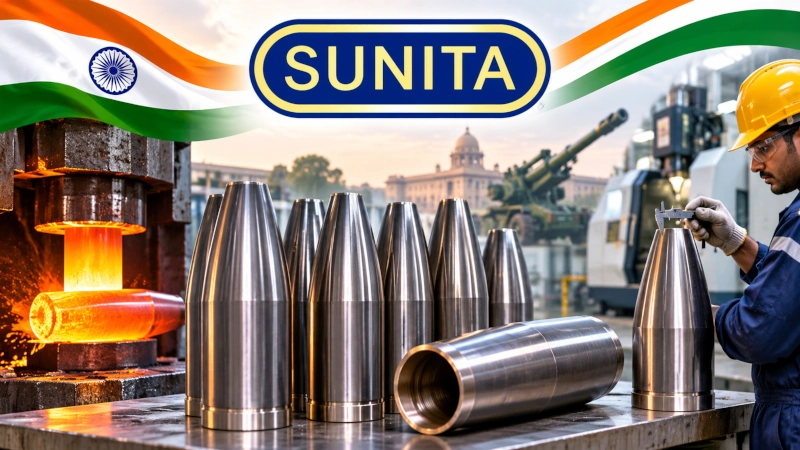
Indian precision engineering and defence manufacturing company Sunita Tools Limited has secured Original Equipment Manufacturer (OEM) qualification and a purchase order for the supply of forged empty artillery shells to a Government of India ordnance factory. The development marks an important milestone in the company’s expansion into specialised defence manufacturing and follows a detailed technical evaluation of its artillery shell production facilities.
In a regulatory disclosure submitted to the Bombay Stock Exchange on November 2, Sunita Tools confirmed that the government customer had completed an extensive inspection of its shell manufacturing infrastructure before approving the company as a qualified supplier. The evaluation covered manufacturing machinery, production processes and the capabilities required to supply forged artillery shell components.
The company also disclosed a domestic supply contract for 6,000 sets of M1 shell forgings from a Central Public Sector Undertaking. The order represents another development in its defence manufacturing activities, although the company has not disclosed the identity of the awarding organisation or the contract’s financial value.
Government Ordnance Factory Approves Manufacturing Capabilities
The qualification granted to Sunita Tools follows a technical assessment conducted by representatives of the purchasing ordnance factory. According to the company, the evaluation involved detailed inspections of its manufacturing facilities, including individual machines and the production processes used for manufacturing forged artillery shell components.
The inspection enabled the customer to assess the company’s ability to manufacture products according to its technical and quality requirements. Following the evaluation, Sunita Tools received approval as a vendor, supplier, manufacturer and OEM for the specified requirements.
Such qualification procedures are important in defence manufacturing because the production of military equipment components requires consistent adherence to specified material properties, dimensional requirements and inspection standards. Manufacturers supplying defence establishments must demonstrate that their production infrastructure and quality-management procedures are capable of delivering components conforming to customer specifications.
For Sunita Tools, the approval represents progress in establishing its position within the domestic defence industrial supply chain. The company has been investing in manufacturing equipment and production capabilities to expand beyond its traditional engineering and mould-base business into higher-value industrial applications.
New Contract Covers 6,000 Sets of M1 Shell Forgings
In a separate regulatory announcement, Sunita Tools confirmed that it had received a domestic supply contract from a Central Public Sector Undertaking for 6,000 sets of M1 shell forgings. The company indicated that execution of the order would take place as soon as possible, although it did not specify a firm delivery schedule.
The awarding organisation’s identity and the financial value of the contract have been withheld for confidentiality reasons. Sunita Tools also clarified that its promoters, promoter group and group companies have no interest in the awarding entity and that the transaction does not constitute a related-party transaction.
The announcement adds to the company’s growing portfolio of defence manufacturing orders and demonstrates commercial demand for its forged artillery components. However, the disclosure does not establish that the full quantity has already been manufactured or delivered.
The precise relationship between the 6,000-set M1 forging contract and the ordnance factory qualification announcement has not been clarified in the available disclosures. Both developments were announced on November 2, but they should not be treated as a single contract without further confirmation from the company.
Precision Engineering Supports Indigenous Artillery Manufacturing
Sunita Tools has more than four decades of experience in the engineering and mould-base industry, with established capabilities in manufacturing ground plates, mould bases and precision CNC-machined components. Its products serve several industries, including automotive manufacturing, pharmaceuticals, electronics, aerospace, defence and consumer goods.
The company’s expansion into artillery shell manufacturing builds upon its existing expertise in engineering processes and precision production. Manufacturing forged shell bodies involves several industrial stages, including raw material preparation, forging, machining and quality inspection, each of which must meet the requirements established by the customer.
Forging is an important manufacturing process for producing components with specified mechanical characteristics and material properties. In artillery shell manufacturing, subsequent machining and inspection help ensure that the forged components conform to the dimensional and quality specifications required for further processing.
The supply of forged empty shells represents one stage within the broader ammunition manufacturing process. These components require additional manufacturing, inspection and assembly operations before becoming complete ammunition rounds. Consequently, the company’s qualification and purchase orders should not be interpreted as confirmation that it is supplying finished explosive-filled artillery ammunition.
Prototype Clearance Remains an Important Requirement
Although Sunita Tools has received OEM qualification and a purchase order, its November 2 press release identifies an additional contractual requirement involving prototype clearance.
The company stated that the existing interim sales agreement would be converted into a formal sales agreement following clearance of the prototype batch. This qualification is important because it distinguishes the customer’s approval of the manufacturing facility from the completion of all product-level acceptance requirements.
Prototype evaluation enables a customer to assess whether manufactured components satisfy the specified requirements before proceeding with subsequent contractual or production stages. Successful clearance can provide a basis for further manufacturing activity, but the company’s announcement does not confirm that the prototype batch has already completed this process.
The latest development therefore represents a combination of manufacturing qualification and order acquisition, with subsequent execution dependent on applicable contractual and technical requirements.
Sunita Tools Expands Defence Manufacturing Operations
The company’s latest announcement follows several earlier developments in its defence manufacturing business. In February 2026, Sunita Tools disclosed an order for the supply of 2,40,000 empty NATO-standard 155 mm M107 artillery shells, reflecting its efforts to establish a larger presence in ammunition component manufacturing.
The company subsequently reported receiving advance payments against its interim sales agreement for the 155 mm M107 programme. It also announced the addition of precision CNC machinery and other measures intended to strengthen its production infrastructure.
These developments illustrate Sunita Tools’ transition from a traditional engineering and mould-base manufacturer towards a more diversified industrial business with growing exposure to defence and aerospace applications.
The expansion also reflects increasing opportunities for qualified Indian private-sector manufacturers to participate in the supply chains of government defence production organisations. Specialised companies possessing suitable machinery, technical expertise and quality-control infrastructure can contribute components required by larger defence manufacturers.
However, the commercial contribution of these programmes will depend on successful prototype clearance, sustained production, customer acceptance and the execution of contractual deliveries.
Private-Sector Participation Strengthens Defence Supply Chains
The qualification of Sunita Tools as an approved ordnance factory supplier highlights the role of private-sector engineering companies in India’s efforts to strengthen indigenous defence manufacturing.
Domestic ammunition production requires an extensive industrial ecosystem comprising manufacturers of specialised materials, forged components, precision-machined products, manufacturing equipment and associated engineering services. The development of qualified suppliers across these areas can support production capacity and improve the availability of domestically manufactured components.
For government defence manufacturing establishments, the availability of additional qualified suppliers can provide opportunities to expand sourcing options and develop relationships with specialised industrial partners. Such arrangements also allow private manufacturers to apply established engineering capabilities to technically demanding defence applications.
Sunita Tools’ qualification and purchase orders demonstrate progress towards greater participation in this industrial ecosystem. The developments are particularly relevant because they involve both manufacturing capability assessment and formal commercial orders rather than expressions of interest alone.
Manufacturing Qualification Opens Further Opportunities
Commenting on the announcement, Sunita Tools Chairman and Whole-Time Director Sanjay Pandey described the OEM qualification and purchase order as an important milestone for the company’s Defence Division. He attributed the development to investments in manufacturing infrastructure, machinery and production capabilities.
The company expects the qualification to strengthen its presence in defence manufacturing and create opportunities for additional business with government organisations and private-sector customers.
The immediate significance of the November 2 announcement lies in the successful qualification of Sunita Tools’ manufacturing facilities and its receipt of artillery shell forging orders. The separate contract for 6,000 sets of M1 shell forgings provides further evidence of commercial opportunities within the company’s expanding defence business.
Sunita Tools’ progress represents another development in India’s private defence manufacturing ecosystem, demonstrating how established precision engineering companies are expanding into specialised military component supply chains through investment, technical qualification and customer-approved production capabilities.
You may also like
-
Balu Forge Secures Quality Approval for Jet Engine Components, Expands Aerospace Manufacturing Capabilities
-
Balu Forge Secures Order from Czech Armoured Vehicle Manufacturer, Expands European Defence Industry Presence
-
Balu Forge Secures New Orders for Indigenous 105 mm Artillery Shells from Indian Defence Manufacturing Unit
-
Balu Forge Secures Quality Approval for 155 mm ERFB Artillery Shells, Prepares for Serial Deliveries
-
CRPF Achieves First Year Without Operational Fatalities in 47 Years as DG Highlights Training and Modernisation
