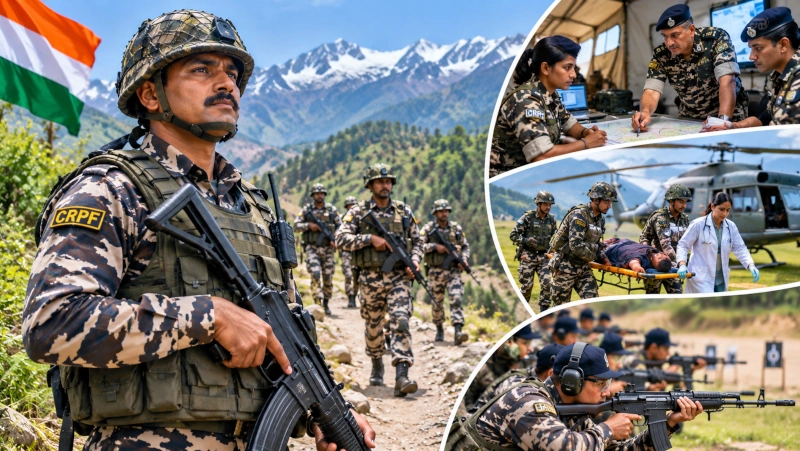
The Central Reserve Police Force (CRPF) has completed 12 consecutive months without recording a single operational fatality, achieving a milestone not witnessed in the force for 47 years. Director General G.P. Singh announced the achievement on November 2, highlighting improvements in operational equipment, personnel training, strategic planning and emergency medical response as important factors contributing to the reduction in fatalities during active security operations.
According to the Director General, the last operational fatality was recorded on October 30, 2025, while the previous comparable period without an operational death ended in January 1979. The milestone is particularly significant because the CRPF has continued to undertake internal security responsibilities across multiple operational theatres, including counter-terrorism, counter-insurgency and operations against Left-Wing Extremism.
In his statement, Singh congratulated CRPF personnel on the collective achievement and emphasised that the force had maintained its operational commitments while improving personnel safety. He attributed the outcome to a combination of modern equipment, improved training standards, operational planning and faster medical evacuation arrangements for personnel injured during security operations.
Modern Equipment and Training Strengthen Operational Safety
The CRPF Director General identified the provision of contemporary equipment and improvements in training as important contributors to the force’s operational safety record. Modern protective equipment, suitable operational hardware and better preparedness can help security personnel respond more effectively to threats encountered during deployments in challenging environments.
Training and strategic planning are particularly important for a force responsible for operating across diverse geographical and security conditions. CRPF personnel are deployed in forested regions affected by insurgency, mountainous terrain, urban environments and areas requiring specialised internal security operations. Each environment presents distinct challenges involving movement, surveillance, communications and the protection of personnel.
The Director General’s emphasis on improved training reflects the importance of preparing personnel for operational risks before deployment. Effective planning, coordination and the appropriate use of equipment can help reduce exposure to avoidable threats while maintaining the ability to respond to security incidents.
Although the CRPF has attributed the milestone partly to modernisation and training improvements, the Director General’s statement did not provide a detailed assessment of individual equipment systems, training programmes or their measurable contributions to the reduction in fatalities.
Rapid Medical Evacuation Becomes an Important Operational Priority
Another factor highlighted by Singh was the CRPF’s increased emphasis on post-incident response, particularly the rapid evacuation of injured personnel to secondary and tertiary medical facilities. The Director General identified faster access to advanced medical treatment as an important element of the force’s efforts to improve survival outcomes following operational incidents.
In security operations, the period immediately following an injury can be critical to survival. Timely medical assistance, effective coordination between operational units and evacuation teams, and access to suitably equipped hospitals can influence the outcome of serious injuries sustained in the field.
Secondary and tertiary medical facilities provide different levels of specialised treatment, including surgical intervention, intensive care and advanced trauma management. Ensuring that injured personnel can reach appropriate facilities quickly is particularly important in remote operational environments where access to comprehensive medical services may be limited.
The CRPF’s focus on medical evacuation demonstrates the importance of integrating healthcare preparedness into operational planning. Personnel safety depends not only on preventing injuries but also on ensuring that effective treatment is available when incidents occur.
Milestone Achieved During Continued Security Operations
The achievement comes while the CRPF continues to perform extensive internal security duties across India. The force remains involved in operations against Left-Wing Extremism, counter-terrorism responsibilities in Jammu and Kashmir, security assignments in the Northeastern states and other deployments undertaken in coordination with central and state authorities.
The Director General emphasised that the absence of operational fatalities had been achieved despite continued engagement across major operational theatres. He also referred to significant operational breakthroughs during the period, although his statement did not provide a detailed account of individual operations or their outcomes.
The CRPF has played an important role in India’s internal security architecture for decades, particularly in areas affected by armed insurgency and terrorist violence. Its specialised formations, including the Commando Battalion for Resolute Action (CoBRA), undertake demanding assignments requiring specialised training, operational intelligence and coordination with other security agencies.
The changing internal security environment has also influenced the deployment requirements of the force. Operations against Left-Wing Extremism have undergone substantial changes following sustained security operations, while other regions continue to require the presence of central security personnel.
The latest milestone therefore reflects the force’s reported ability to maintain its operational commitments without recording fatalities during the specified 12-month period. It does not imply that deployments were free from injuries, security incidents or other operational risks.
CRPF’s Operational Record and Personnel Welfare
The announcement also draws attention to the distinction between operational fatalities and other causes of death among security personnel. Operational fatalities refer to deaths classified by the force as resulting from operational circumstances and do not encompass every death involving serving personnel.
Personnel welfare remains an important issue for the CRPF. On August 14, 2026, the National Human Rights Commission took suo motu cognisance of a media report concerning the deaths by suicide of 19 CRPF personnel between January and May 22, 2026. The Commission sought detailed reports from the Union Home Secretary and the CRPF Director General after observing that the reported incidents raised serious concerns relating to the right to life of personnel serving in the force.
According to the figures cited in the NHRC’s official release, media reports indicated that 59 CRPF personnel died by suicide in 2025. The Commission also referred to reports of 281 such deaths over the preceding five years, with approximately 216 of those personnel reportedly on duty. These figures were cited in the Commission’s notice and should be distinguished from independently established findings of its inquiry.
The NHRC’s intervention highlights the continuing importance of mental health support, working conditions, grievance redressal and personnel welfare within the security forces. Improvements in operational safety and the prevention of deaths from other causes represent separate but complementary responsibilities in protecting those serving in demanding security assignments.
A Significant Milestone in CRPF’s Operational History
The completion of a full year without an operational fatality represents an important achievement for the Central Reserve Police Force, particularly given the demanding nature of its internal security responsibilities. The comparison with January 1979 places the development in a longer historical context and highlights the rarity of such an extended fatality-free period.
The Director General’s statement identifies equipment modernisation, training, operational planning and medical evacuation as important areas contributing to personnel protection. These measures form part of a wider operational approach in which mission effectiveness and the safety of deployed personnel must be addressed together.
Sustaining the achievement will require continued attention to operational preparedness, intelligence coordination, protective equipment, medical support and the changing nature of threats encountered by security personnel. The force’s ability to maintain a strong safety record will also depend on adapting its procedures and capabilities to different operational environments.
The November 2 announcement marks a notable moment in the CRPF’s history. While the force continues to undertake complex internal security missions, its completion of 12 consecutive months without an operational fatality demonstrates the importance of placing personnel protection alongside operational effectiveness in India’s internal security framework.
You may also like
-
Balu Forge Secures New Orders for Indigenous 105 mm Artillery Shells from Indian Defence Manufacturing Unit
-
Balu Forge Secures Quality Approval for 155 mm ERFB Artillery Shells, Prepares for Serial Deliveries
-
India and Vietnam Agree to Deepen Defence Cooperation as NSA Ajit Doval Holds Talks in Hanoi
-
India Optel Flags Off First Indigenous SIGMA 30N Navigation Systems for K9 Vajra Artillery
-
India Signs ₹53,866 Crore Contracts for Eight Indigenous Next Generation Corvettes for Indian Navy
