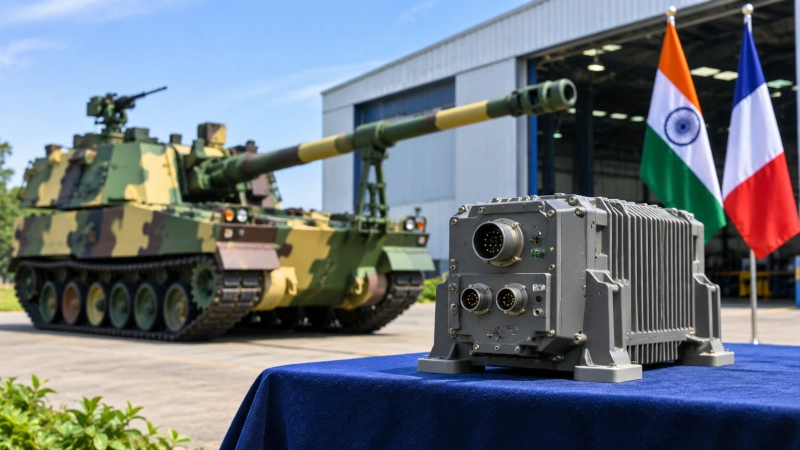
India Optel Limited (IOL), a Defence Public Sector Undertaking under the Ministry of Defence, has flagged off the first batch of indigenously manufactured SIGMA 30N Inertial Navigation Systems (INS) for Larsen & Toubro’s K9 Vajra self-propelled artillery programme. The development marks an important milestone in India’s efforts to establish domestic manufacturing capabilities for advanced artillery navigation technologies through international technology-transfer partnerships.
The first batch was flagged off at Ordnance Factory Chandigarh, a manufacturing unit of India Optel, on 31 October 2026. The systems have been produced under a collaboration agreement between India Optel and France’s Safran Electronics & Defense, which provides for the transfer of production of advanced inertial navigation equipment to India. The initial consignment is intended for Larsen & Toubro, the Indian manufacturer responsible for the K9 Vajra-T artillery platform.
First Indigenous Production Batch Flagged Off in Chandigarh
The flag-off ceremony was attended virtually by Dr Garima Bhagat, Joint Secretary (Land Systems), Department of Defence Production. Senior representatives from India Optel, Larsen & Toubro and Safran Electronics & Defense participated in the event, reflecting the cooperation between India’s public-sector defence manufacturing establishments, private industry and an international technology provider.
Among those present were Sharmishtha Koul Sharma, Chairman and Managing Director of India Optel (Additional Charge), Arun T. Ramchandani, Senior Vice President and Head of Precision Engineering and Systems at Larsen & Toubro, and Frederic Giraud, Managing Director of Safran Electronics & Defense India. The ceremony marked the transition of the SIGMA 30N programme from a production-transfer agreement to the dispatch of its first locally manufactured batch for an Indian artillery programme.
The development is particularly significant because Ordnance Factory Chandigarh will contribute to the manufacture and support of precision navigation equipment used in modern artillery systems. India Optel’s involvement extends beyond the initial production process to include testing, quality assurance and lifecycle support, creating a domestic industrial framework for maintaining the equipment throughout its operational life.
SIGMA 30N Strengthens Artillery Navigation Capabilities
The SIGMA 30N is a digital ring laser gyroscope-based inertial navigation system developed by Safran Electronics & Defense. It is designed to provide accurate positioning, orientation and navigation information for military platforms, particularly artillery systems that require precise alignment before firing.
Unlike navigation equipment that depends entirely on satellite signals, inertial navigation systems calculate changes in position and orientation using onboard sensors. Ring laser gyroscopes measure angular movement, while accelerometers detect changes in motion, enabling the navigation system to maintain an estimate of the platform’s position and attitude without continuously receiving external satellite-navigation signals.
This capability is particularly important for artillery operations in environments where satellite signals may be unavailable, disrupted or deliberately jammed. By providing an independent navigation reference, the SIGMA 30N can support artillery positioning and weapon alignment under challenging operational conditions, although inertial navigation accuracy remains subject to accumulated measurement errors over time.
For self-propelled artillery platforms such as the K9 Vajra-T, accurate position and orientation information is essential for calculating firing solutions and supporting rapid deployment. Inertial navigation technology can contribute to reducing dependence on external positioning references and improving the ability of artillery systems to establish their firing orientation after movement.
India Optel–Safran Agreement Establishes Domestic Manufacturing
The indigenous production of SIGMA 30N systems follows a collaboration agreement signed between India Optel Limited and Safran Electronics & Defense in New Delhi on 22 December 2025. The agreement was signed by the then Chairman and Managing Director of India Optel, Tushar Tripathi, and Alexandre Ziegler, Head of the Defence Global Business Unit at Safran Electronics & Defense, in the presence of Defence Production Secretary Sanjeev Kumar.
The agreement formalised the transfer of production of two advanced defence systems to India. Alongside the SIGMA 30N Digital Ring Laser Gyro Inertial Navigation System, the partnership covers the CM3-MR Direct Firing Sight, an electro-optical targeting system designed for artillery weapons and counter-drone applications.
The collaboration builds upon a memorandum of understanding signed between the two organisations in January 2024. Under the December 2025 agreement, India Optel assumed responsibility for manufacturing, final assembly, testing, quality control and lifecycle support of the systems, combining its domestic industrial facilities with Safran’s expertise in inertial navigation and fire-control technologies.
The successful production of the first SIGMA 30N batch demonstrates tangible progress under the agreement within approximately ten months of its formalisation. It also establishes a foundation for developing specialised manufacturing and maintenance expertise in India, although the extent of indigenous component sourcing and technology absorption has not been publicly disclosed.
Supporting India’s K9 Vajra Artillery Programme
The K9 Vajra-T is a 155 mm/52-calibre tracked self-propelled howitzer manufactured in India by Larsen & Toubro under a technology partnership with South Korea’s Hanwha Aerospace. The artillery system combines mobility, armoured protection and long-range firepower, allowing Indian Army artillery formations to reposition and conduct fire missions across different operational environments.
The platform incorporates sophisticated navigation, fire-control and targeting equipment to support artillery operations. Reliable inertial navigation is an important element of this architecture because accurate knowledge of a weapon platform’s position and orientation contributes to the calculation of firing data and effective deployment after movement.
The supply of locally manufactured SIGMA 30N systems represents an additional opportunity to strengthen India’s domestic supply chain for specialised artillery subsystems. The arrangement brings together a government-owned precision equipment manufacturer, an established Indian defence systems integrator and a foreign technology partner within a common industrial programme.
However, the October 2026 announcement specifically confirms the flag-off of the first batch for Larsen & Toubro. It does not establish that the newly manufactured systems have already been integrated into K9 Vajra platforms, completed platform-level qualification or entered operational service with the Indian Army.
Expanding India’s Defence Electronics Manufacturing Capabilities
The production milestone reflects the increasing importance of precision electronics, navigation equipment and fire-control technologies within India’s defence manufacturing ecosystem. Although major platforms such as artillery guns and armoured vehicles attract considerable attention, their operational performance also depends on specialised subsystems that require advanced manufacturing processes, stringent quality standards and reliable maintenance support.
Domestic production of such equipment can help Indian manufacturers develop specialised technical skills while creating opportunities for greater control over assembly, testing, repair and long-term equipment availability. Establishing these capabilities is particularly relevant for military systems expected to remain in service for extended periods, during which dependable access to replacement components and technical support becomes essential.
The India Optel–Safran partnership also illustrates a model of defence industrial cooperation in which international technology is combined with Indian manufacturing infrastructure. While the SIGMA 30N remains a French-origin system, its production in India represents progress towards domestic manufacturing and support capabilities rather than the indigenous development of an entirely new navigation technology.
With the first batch dispatched from Ordnance Factory Chandigarh, India Optel has achieved an initial production milestone under its collaboration with Safran. The next stages of the programme will depend on the integration, acceptance and subsequent supply requirements of Larsen & Toubro’s K9 Vajra artillery programme, as India continues to expand its capacity to manufacture sophisticated defence electronic systems domestically.
You may also like
-
India and Vietnam Agree to Deepen Defence Cooperation as NSA Ajit Doval Holds Talks in Hanoi
-
India Signs ₹53,866 Crore Contracts for Eight Indigenous Next Generation Corvettes for Indian Navy
-
CISF Introduces Specialised Security Commands to Protect India’s Critical PSU and Industrial Infrastructure
-
Indian and South Korean Navies Conduct Joint Maritime Drills off Busan to Strengthen Operational Cooperation
-
Trishulopulsion Showcases Supersonic Sea-Skimming Naval Target Concept at SWAVLAMBAN 2026
