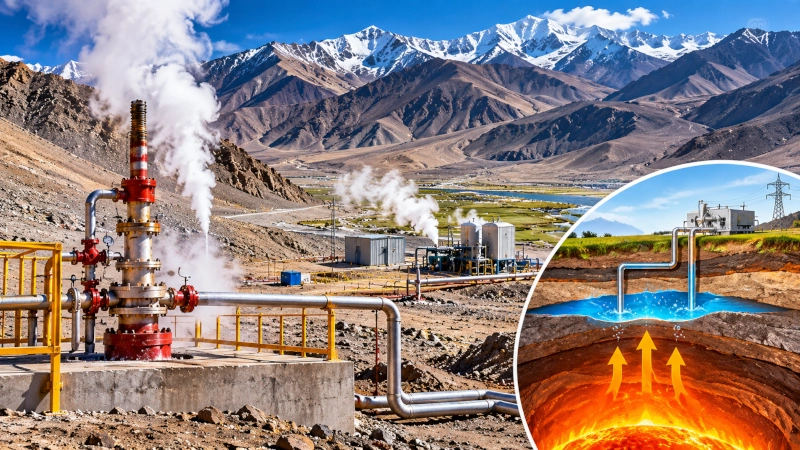
India is taking important steps towards harnessing geothermal energy as an indigenous source of renewable power, with the commissioning of the country’s first two geothermal wells in Ladakh and the introduction of a national policy framework to support exploration, research and commercial development. The initiatives are intended to unlock India’s largely untapped geothermal resources and diversify the country’s clean energy portfolio with a source of energy capable of providing continuous electricity generation.
The Ministry of New and Renewable Energy (MNRE) has identified geothermal energy as an important component of India’s long-term energy transition, particularly because of its potential to provide reliable, weather-independent power. Unlike solar and wind energy, which depend on prevailing environmental conditions, geothermal systems can operate continuously where suitable underground heat reservoirs are available and technically viable. India’s geothermal development strategy combines resource assessment, demonstration projects, indigenous technology development and international cooperation to establish the foundations for future commercial deployment.
India’s First Geothermal Wells Commissioned in Ladakh
A significant milestone in India’s geothermal development programme was achieved in July 2026 when the ONGC Energy Centre commissioned the country’s first two geothermal wells in the Puga Valley of Ladakh. Located at an altitude exceeding 14,000 feet, Puga Valley is recognised as one of India’s most promising geothermal locations because of its hot springs, underground heat reserves and favourable geological characteristics.
The two wells, each approximately 1,000 metres deep, have been developed to support geothermal reservoir evaluation and provide technical information necessary for future electricity generation. Their commissioning represents an important transition from resource identification and preliminary geological studies towards field-level assessment of India’s geothermal potential.
The wells are also expected to support the development of India’s first 1-megawatt demonstration geothermal power project. The proposed facility would provide an opportunity to evaluate the technical performance of geothermal electricity generation under the challenging climatic and geological conditions of the Himalayan region.
Although the commissioning of the wells represents substantial progress, it does not mean that the proposed 1 MW geothermal power plant has already entered commercial operation. The demonstration project remains an important subsequent stage in determining the feasibility of sustained electricity generation from the Puga Valley resource.
India Identifies Geothermal Potential of Nearly 10,600 MW
India possesses considerable geothermal resources across several geologically distinct regions. According to the Geological Survey of India (GSI), the country has 381 identified hot springs distributed across ten geothermal provinces, with an estimated theoretical geothermal potential of approximately 10.6 gigawatts, equivalent to 10,600 megawatts.
The identified geothermal provinces include the Himalayan Geothermal Province, Naga-Lusai region, Andaman and Nicobar Islands, Son-Narmada-Tapi belt, West Coast, Cambay Graben, Aravalli region, Mahanadi basin, Godavari basin and South Indian Cratonic region. These areas contain geological formations and thermal characteristics that may support geothermal development, although their suitability for electricity generation varies considerably.
The Geological Survey of India has identified 42 promising sites for geothermal electricity generation and direct heat applications. These locations provide a starting point for more detailed geological investigations, drilling programmes and technical assessments required to determine whether underground resources can be developed economically.
The estimated 10.6 GW resource represents theoretical potential rather than established electricity generation capacity. Converting this resource into operational power projects will require further exploration, reservoir assessment, drilling, investment and the development of technologies suited to India’s diverse geological conditions.
National Geothermal Energy Policy Provides Development Framework
The Government of India notified the National Policy on Geothermal Energy in September 2025, establishing a framework for developing geothermal resources and supporting their integration into the country’s renewable energy sector. The Ministry of New and Renewable Energy serves as the nodal ministry responsible for implementing the policy.
The policy promotes systematic exploration, resource assessment, drilling, reservoir management and the development of geothermal electricity generation technologies. It also encourages research and development, demonstration projects and collaboration among government institutions, research organisations and private industry.
An important component of the framework is the promotion of direct geothermal heat applications. Underground thermal resources can potentially be utilised for agricultural processing, aquaculture, space heating, cooling and other industrial applications, depending on local temperatures and technical requirements. Such uses could expand the economic value of geothermal resources beyond conventional electricity generation.
The policy also supports Ground Source Heat Pumps for heating and cooling applications, along with the development of a national geothermal data repository and specialised Centres of Excellence. These measures are intended to strengthen technical knowledge, improve resource accessibility and create institutional support for the emerging industry.
Another area of interest involves repurposing abandoned or unproductive oil and gas wells for geothermal applications. Existing wells may offer opportunities to access underground heat while drawing upon drilling expertise, geological data and infrastructure developed by the petroleum industry. However, the feasibility of such projects depends on subsurface temperatures, well integrity, fluid characteristics and economic considerations.
Research and Indigenous Technology Development
India’s geothermal programme is receiving support through research and development initiatives intended to strengthen domestic technical capabilities. Between July and August 2025, the Ministry of New and Renewable Energy sanctioned five research and development projects covering geothermal resource assessment, indigenous technology development and field demonstration.
These projects address opportunities involving electricity generation, heating and cooling applications, geothermal resource evaluation and the adaptation of existing energy infrastructure. The programme is designed to generate field data and technical experience that could support future investments in geothermal technologies.
Advanced approaches such as Enhanced Geothermal Systems and Advanced Geothermal Systems may eventually expand development opportunities beyond locations containing naturally accessible hot water and steam reservoirs. Such technologies seek to make underground heat available under a wider range of geological conditions, although their deployment requires specialised engineering, detailed reservoir characterisation and substantial investment.
The development of indigenous geothermal expertise is particularly relevant because geothermal projects involve complex interactions between geology, drilling technology, fluid management, power generation equipment and reservoir sustainability. Strengthening domestic research capabilities could help India develop solutions adapted to its geological environments while reducing dependence on imported technical expertise.
Geothermal Energy Offers Continuous Renewable Power
Geothermal energy originates from heat stored within the Earth’s interior, including residual heat from the planet’s formation and heat generated through the radioactive decay of naturally occurring elements. In suitable geological environments, this thermal energy can be accessed through underground water, steam or other heat-transfer systems.
Conventional geothermal electricity generation involves extracting hot water or steam from underground reservoirs and using the available thermal energy to drive electricity-generating equipment. Depending on reservoir characteristics, the extracted fluid may be used directly or through a secondary working fluid in a binary-cycle system. Reinjection of geothermal fluids can help maintain reservoir pressure and support long-term resource management.
One of geothermal energy’s principal advantages is its ability to provide continuous generation without relying on sunlight or wind conditions. This characteristic makes it a potentially valuable complement to variable renewable energy sources, particularly as India increases the share of solar and wind power in its electricity system.
Nevertheless, geothermal development presents technical and economic challenges. High exploration costs, uncertainty over underground resources, drilling requirements and location-specific geological conditions can affect project feasibility. Sustainable operation also requires careful reservoir management and environmental safeguards, including appropriate handling of geothermal fluids and monitoring of subsurface conditions.
International Cooperation Supports Geothermal Development
India is also pursuing international cooperation to support geothermal resource development and technology exchange. The government’s geothermal policy initiatives identify collaboration with countries possessing established experience in geothermal energy as an important means of strengthening domestic capabilities.
Geothermal energy has been identified as an area of cooperation under bilateral engagement mechanisms involving Australia and Iceland. An agreement with Saudi Arabia has similarly recognised geothermal energy as a potential area for collaboration.
These partnerships can facilitate the exchange of technical knowledge relating to geothermal exploration, reservoir management, drilling, electricity generation and direct heat applications. International cooperation may also help Indian institutions assess technologies and development approaches suited to the country’s geological conditions.
According to figures cited in the government backgrounder, global geothermal electricity generation capacity reached approximately 15.67 GW by the end of 2025. Countries including Indonesia, the United States, the Philippines, Türkiye and New Zealand account for a substantial share of global geothermal capacity, reflecting the commercial maturity of the technology in regions with favourable geological resources.
Geothermal Energy and India’s Long-Term Energy Transition
India’s geothermal development programme remains at an early stage, but the combination of national policy support, geological resource identification, research projects and field-level demonstration activities is establishing a foundation for future expansion.
The commissioning of the two geothermal wells in Ladakh is particularly significant because it provides an opportunity to examine how India’s underground heat resources can be converted into practical energy applications. The proposed 1 MW demonstration project in Puga Valley could generate important technical information for evaluating the feasibility of additional geothermal installations.
Geothermal energy may also contribute to regional development through applications that extend beyond electricity production. Heating, cooling, agriculture, aquaculture and industrial heat utilisation could provide opportunities for local economic activity where suitable geothermal resources are available.
As India works towards its target of achieving net-zero emissions by 2070, geothermal energy offers a potential means of strengthening domestic energy security while expanding the diversity of renewable energy technologies. Its long-term contribution will depend on successful resource assessment, technological development, commercial viability and the establishment of sustainable operating practices.
The National Policy on Geothermal Energy and the commissioning of India’s first two geothermal wells represent important initial steps towards developing this resource. With an estimated theoretical potential of nearly 10,600 MW, geothermal energy could eventually become a useful component of India’s renewable energy system, complementing solar, wind, hydropower and other clean energy technologies.
References
Primary source: Press Information Bureau, Ministry of New and Renewable Energy, Geothermal Energy: A New Chapter in India’s Clean Energy Journey, 2 November 2026.
https://www.pib.gov.in/PressReleaseDetail.aspx?PRID=2331597®=48&lang=1&utm_source=chatgpt.com
You may also like
-
Over 21 Lakh Indian Households Record Zero Electricity Bills Under PM Surya Ghar Scheme
-
Sikkim’s Soreng Becomes India’s First Organic Fisheries Cluster as Centre Launches New Certification Framework
-
Kalonunia Rice of West Bengal: The Fragrant Black-Husked Heritage Grain of North Bengal with GI Recognition
-
India’s Affle Announces $420 Million Acquisition of Israeli AI Advertising Company Perion
-
CISF Introduces Specialised Security Commands to Protect India’s Critical PSU and Industrial Infrastructure
