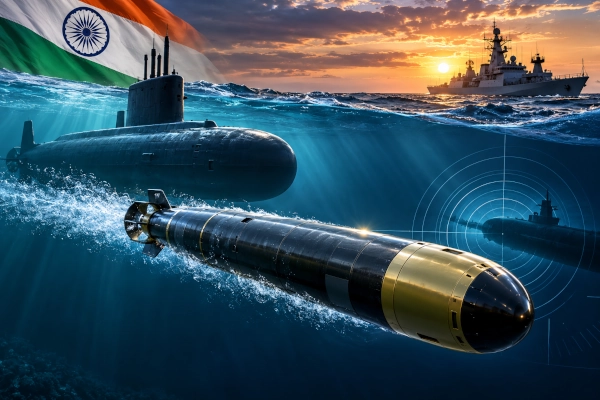
India is moving towards an indigenous submarine-launched heavyweight torpedo capability through the Defence Research and Development Organisation’s Wire-Guided Heavy Weight Torpedo programme, a weapon intended to engage both surface ships and submarines in the open ocean.
The system is increasingly referred to in defence reporting as Takshak, although current official Ministry of Defence and DRDO releases examined for this article publicly identify it as the Wire Guided Heavy Weight Torpedo, or WGHWT, and in earlier documentation as the Electronic Heavy Weight Torpedo, or EHWT. Official material has not yet publicly associated the Takshak name with a detailed technical specification sheet, so the confirmed characteristics in this article are drawn only from government and manufacturer sources.
The programme is strategically important because it would give India an indigenous heavyweight weapon designed specifically for submarine launch, complementing the ship-launched Varunastra and reducing dependence on imported torpedoes for the Indian Navy’s conventional submarine fleet.
DRDO Confirms Indigenous Wire-Guided Heavyweight Torpedo
The clearest recent official description came in January 2026, when DRDO displayed the Wire Guided Heavy Weight Torpedo as part of its “Naval Technologies for Combat Submarines” presentation at Bharat Parv.
DRDO described the weapon as a state-of-the-art submarine-launched torpedo intended to counter contemporary surface ships and submarines in oceanic waters. The organisation specifically highlighted the need for high speed and endurance in an indigenous heavyweight weapon capable of anti-ship and anti-submarine missions.
The torpedo was displayed alongside two other major indigenous submarine technologies: the Integrated Combat Suite and DRDO’s Air Independent Propulsion system. Their presentation together illustrates the broader objective of increasing Indian content not only in submarine construction but also in propulsion, sensors, combat management and weapons.
Kalvari-Class Integration Has Already Been Contracted
The programme moved beyond laboratory development when the Ministry of Defence signed a contract worth approximately ₹877 crore with Naval Group of France in December 2024 for integration of the DRDO-developed heavyweight torpedo with the Indian Navy’s Kalvari-class submarines.
The integration programme is being undertaken jointly by the Indian Navy, DRDO and Naval Group. This is significant because the Kalvari class is based on the French Scorpène design, making combat-system and torpedo-tube integration a specialised engineering task that requires coordination with the original submarine designer.
The Ministry of Defence stated that the project would substantially strengthen the firepower of the Kalvari-class fleet. India now operates six boats of the class: INS Kalvari, INS Khanderi, INS Karanj, INS Vela, INS Vagir and INS Vagsheer.
NSTL Leads India’s Underwater Weapon Development
The Naval Science and Technological Laboratory at Visakhapatnam is DRDO’s principal centre for underwater weapons and associated technologies.
NSTL has already produced several important systems for the Indian Navy, including the Varunastra heavyweight torpedo and Torpedo Advanced Light. Its research extends into homing systems, propulsion, underwater vehicles, counter-countermeasure algorithms and advanced acoustic technologies.
A Parliamentary Standing Committee on Defence visiting NSTL in January 2026 was shown the Advanced Lightweight Torpedo, Varunastra and the EHWT alongside mines, decoys and autonomous underwater systems. This provides further official confirmation that the submarine heavyweight torpedo remains an active DRDO development programme.
Takshak Is Fundamentally Different From Varunastra
The new submarine torpedo should not be confused with Varunastra.
Varunastra is an electrically propelled heavyweight anti-submarine torpedo designed primarily for launch from surface warships. DRDO states that it can operate against quiet submarines in both shallow and deep water and in an environment containing countermeasures. It entered Indian Navy service in 2016.
The WGHWT is being developed specifically around submarine warfare. A submarine-launched torpedo must integrate with the boat’s combat management system, weapon-control system and torpedo tubes while also allowing the submarine to influence the engagement after launch through a guidance link.
This requirement places greater emphasis on two-way tactical interaction between the launching submarine and the weapon.
Wire Guidance Gives the Submarine Control After Launch
Modern heavyweight torpedoes are not simply fired toward the last known position of a target and left to search independently.
Wire or fibre-optic guidance allows the submarine to continue providing information to the weapon after launch. The submarine’s sonar and combat system can maintain a much broader tactical picture than the smaller sonar installed in the torpedo itself.
This allows course updates or revised target information to be passed to the weapon while it travels towards the engagement area.
When the torpedo reaches a suitable point, its onboard sonar and autonomous guidance system can take a greater role in detecting, classifying and pursuing the target.
This architecture is common among the newest heavyweight torpedoes operated by major submarine fleets.
Fibre-Optic Guidance Has Become a Global Standard
Several contemporary torpedoes use fibre-optic communications because the link can carry large quantities of data between the submarine and the weapon.
BAE Systems identifies a high-bandwidth fibre-optic data link as a major feature of the upgraded British Spearfish. Leonardo uses an optical-fibre guidance link on the Black Shark family, while TKMS employs fibre-optic control on its SeaHake and newer DM2A5 heavyweight torpedoes.
Naval Group’s F21 similarly combines wire guidance with autonomous operation.
DRDO has previously listed an Advanced Heavy Weight Torpedo incorporating fibre-optic communication among technologies developed by NSTL. Current public descriptions of the WGHWT do not disclose the full architecture of the production-intent weapon, but fibre-optic communication is clearly within India’s indigenous torpedo technology base.
The Real Challenge Is Finding a Target in a Noisy Ocean
A heavyweight torpedo’s performance cannot be judged by speed and range alone.
Its most difficult task is often finding and identifying the correct target in an underwater environment filled with reverberation, marine noise, merchant traffic and deliberate countermeasures.
Modern submarines can deploy acoustic decoys intended to imitate their signatures or confuse an approaching torpedo. The weapon must distinguish the real target from false contacts while continuing to navigate at high speed.
DRDO’s published underwater technology roadmap includes counter-countermeasure algorithms for torpedoes and mines, homing technology for high-speed torpedoes and underwater acoustic seeker systems intended for speeds above 80 knots. These research areas demonstrate the emphasis NSTL is placing on the sensing and decision-making aspects of future underwater weapons.
F21 Represents the Modern French Approach
France’s F21 is one of the clearest benchmarks for the Indian programme because it has been developed for advanced submarines and has also been integrated with Brazilian Scorpène-class boats.
Naval Group states that the F21 has a diameter of 533 millimetres, weighs approximately 1.3 tonnes and has a range exceeding 50 kilometres. Its maximum speed is stated as more than 50 knots.
The weapon is designed for both shallow and deep water and can attack surface ships or submarines. Its mission system allows autonomous operation while retaining guidance from the launching submarine during the engagement.
F21 entered French service in 2020 and equips French nuclear attack and ballistic-missile submarines. Brazil has also selected the weapon for its Scorpène-derived Riachuelo-class submarines.
For India, the relevance lies not only in performance but in integration philosophy. The Kalvari class shares the Scorpène design lineage, although India is pursuing a DRDO weapon rather than simply adopting the French torpedo.
Spearfish Emphasises High-Speed Submarine Warfare
The United Kingdom’s Spearfish is the Royal Navy’s principal heavyweight torpedo for attacking both submarines and surface ships.
BAE Systems describes the latest configuration as incorporating major improvements in homing, tactical systems and warhead technology. A high-bandwidth fibre-optic connection links the weapon with the submarine’s combat system throughout the engagement.
Its modular hardware and software architecture are designed to simplify upgrades as sonar processing and threat characteristics evolve.
Spearfish is particularly notable because the Royal Navy designed it around demanding submarine warfare requirements, including engagement of fast and deep-diving targets. British official material does not publicly provide a complete current range-and-speed specification, preventing a precise official numerical comparison with the Indian weapon.
US Mk 48 Focuses on Guidance and Autonomous Homing
The American Mk 48 ADCAP is the primary heavyweight torpedo of US Navy submarines and is also used by allied fleets.
Lockheed Martin states that its guidance and control system combines active and passive sonar with digital electronics for detection, classification, localisation and interception.
The submarine can provide real-time guidance after launch, but the Mk 48 can transition to autonomous homing if the guidance connection is lost.
Modern versions incorporate advanced signal processing and continuously updated guidance software. The US Navy and Australia have jointly developed improvements to the weapon through a long-running cooperative programme.
The publicly released US specification does not provide current operational range and maximum speed figures, making unofficial numerical comparisons unsuitable for an official-source article.
Black Shark Combines Electric Propulsion With Low Acoustic Signature
Leonardo’s Black Shark represents another important European design philosophy.
The company describes it as a 21-inch dual-purpose heavyweight torpedo designed for both submarine and surface targets. It can operate in deep ocean and shallow coastal environments and supports both swim-out and push-out launching methods.
Black Shark uses electric propulsion and a fibre-optic guidance system. Leonardo places particular emphasis on reducing radiated noise, allowing the torpedo to approach its target with a comparatively low acoustic signature.
Its guidance link continuously transfers tactical information between the launching platform and the weapon, while its acoustic system is designed to operate in difficult shallow-water conditions where seabed and surface reflections can complicate sonar processing.
Variants of the Black Shark have been integrated with several submarine families, including Scorpène, Type 209, Type 212 and Type 214.
SeaHake Mod4 Shows the Importance of Quiet Electric Propulsion
Germany’s SeaHake Mod4, developed by the Atlas Elektronik business of TKMS, is another electrically powered heavyweight weapon designed for both deep-water and confined littoral operations.
TKMS describes the torpedo as using a modular battery system and an ultra-quiet electric motor. The system combines fibre-optic guidance with advanced digital sonar and wide-band signal processing for engagements involving multiple targets and complex acoustic environments.
The German approach illustrates the advantages of electric propulsion for conventional submarines. A quiet-running torpedo reduces the acoustic warning available to the target while also matching the stealth-focused operating philosophy of diesel-electric submarines.
Germany is now progressing to the newer DM2A5 for its Type 212CD fleet.
DM2A5 Introduces a Software-Defined Approach
The DM2A5 is particularly relevant because it represents the direction in which heavyweight torpedo technology is moving.
TKMS states that the weapon has been developed around a Software Defined Defense architecture, allowing its software to be adapted rapidly as threats evolve. It combines a modular battery-based propulsion system, low acoustic signature, digital sonar and a high-bandwidth fibre-optic connection to the submarine.
The German government and TKMS signed a framework agreement for the weapon in December 2025 for the German-Norwegian Type 212CD submarine programme.
Software-defined architecture changes the development philosophy of underwater weapons because future capability improvements can increasingly come through algorithms, sonar processing and tactical software rather than major changes to the basic torpedo body.
How Takshak Compares With Contemporary Heavyweight Torpedoes
| Torpedo | Country | Launch Platform | Propulsion | Guidance/Data Link | Official Public Range | Official Public Speed |
|---|---|---|---|---|---|---|
| DRDO WGHWT / “Takshak” | India | Submarine | Not publicly detailed in current WGHWT release | Wire-guided; advanced indigenous HWT technology includes fibre-optic communication | Not disclosed | Described by DRDO as requiring high speed and endurance |
| F21 | France | Submarine | Electrically powered heavyweight architecture | Wire-guided with autonomous mission capability | More than 50 km | More than 50 knots |
| Spearfish | United Kingdom | Submarine | Advanced heavyweight propulsion | High-bandwidth fibre-optic link | Not publicly specified by BAE Systems | Not publicly specified in current BAE product material |
| Mk 48 ADCAP | United States | Submarine | Heavyweight torpedo propulsion | Wire guidance, active/passive sonar and autonomous homing | Not publicly specified in current official material | Not publicly specified in current official material |
| Black Shark | Italy | Primarily submarine | Electric propulsion | Optical-fibre guidance and self-homing | Official material describes long range without current numerical value | Described as very high speed |
| SeaHake Mod4 | Germany | Submarine | Modular battery and electric motor | Fibre-optic guidance and digital sonar | Described as extended range | Described as high speed |
| DM2A5 | Germany | Submarine | Modular battery-based electric propulsion | Fibre-optic control and advanced digital sonar | Described as long range | Described as high speed |
The table also illustrates an important limitation when comparing modern torpedoes. Governments and manufacturers deliberately withhold many operational figures, and published maximum speeds or ranges rarely describe the complete combat performance of a weapon.
Range Alone Does Not Determine Combat Reach
A submarine does not necessarily need to launch a torpedo at its theoretical maximum range.
The practical engagement distance depends on whether the submarine can detect, classify and maintain a reliable track on the target. Sonar conditions, water temperature, salinity, seabed topography and ambient noise all influence that process.
A torpedo with an extremely long mechanical range offers limited advantage if its targeting information becomes inaccurate before arrival.
This is why modern heavyweight torpedoes increasingly combine endurance with continuous communication, advanced seekers and autonomous search logic.
Speed Creates a Different Tactical Trade-Off
Higher speed reduces the target’s reaction time, but propulsion at maximum output generally consumes more energy and can create a stronger acoustic signature.
Electric torpedoes can vary their speed during different phases of an engagement. A weapon may approach more slowly to conserve energy and reduce noise before accelerating once it begins the terminal attack.
Manufacturers rarely disclose the detailed speed profiles used during operational engagements.
The Indian Navy’s requirement for both high speed and endurance therefore points towards a weapon expected to balance these competing demands rather than simply maximise one performance figure.
Modern Torpedoes Must Defeat Countermeasures
Contemporary submarines increasingly carry sophisticated torpedo-defence systems.
These can include expendable acoustic decoys, mobile decoys and jammers intended to create false targets or overwhelm the attacking weapon’s sonar.
The torpedo must continuously evaluate acoustic information and determine whether the contact it is following remains credible.
DRDO’s research into counter-countermeasure algorithms is consequently an important part of the indigenous programme. Improvements in processing power and software may ultimately determine combat effectiveness as much as improvements in propulsion.
Integration With the Submarine Is as Important as the Weapon
A modern heavyweight torpedo forms part of a larger combat system.
The submarine detects and tracks the target using its sonar arrays. The combat management system builds the tactical picture and calculates firing solutions, while the weapon-control system prepares and launches the torpedo.
After launch, the submarine can continue supplying tactical data through the guidance link.
DRDO’s decision to display its WGHWT alongside the Integrated Combat Suite in 2026 reflects this systems-level approach. An indigenous weapon becomes considerably more valuable when India also controls the combat software, sensors and interfaces that support it.
Kalvari Integration Could Be a Major Indigenisation Step
The six Kalvari-class submarines represent the core of India’s modern conventional underwater fleet.
Integrating an Indian heavyweight torpedo would reduce dependence on foreign weapons for one of the submarine’s most important combat functions. It would also give DRDO and the Navy greater freedom to modify software, seekers and tactical algorithms over the weapon’s service life.
The ₹877 crore Naval Group integration contract demonstrates that this process is already being treated as a major programme rather than a conceptual proposal.
Official sources, however, have not yet announced completion of submarine firing trials or operational induction of the weapon.
India Is Also Building an Alternative Heavyweight Torpedo Industrial Pathway
India’s underwater weapons environment is becoming more diverse.
In March 2026, Germany’s TKMS and India’s VEM Technologies signed an agreement covering technology transfer and joint development of a Make-in-India heavyweight torpedo. TKMS said the initial objective was to support the existing Indian submarine fleet, with the possibility of wider cooperation in future programmes.
That initiative is separate from DRDO’s indigenous WGHWT.
The existence of both pathways could deepen India’s industrial capability in torpedo propulsion, guidance, manufacturing, integration and lifecycle support, even though their eventual roles within the Navy will depend on procurement decisions.
Takshak’s Exact Specifications Remain Classified or Undisclosed
Official Indian sources have so far been noticeably restrained in publishing detailed technical parameters for the WGHWT.
There is no current official specification giving maximum range, peak speed, warhead weight, operating depth or precise battery chemistry. The public record also does not yet provide a definitive production configuration for its seeker or communications system.
This makes claims that Takshak definitively outranges, outperforms or exceeds weapons such as F21, Spearfish or Mk 48 impossible to establish from official evidence.
The more meaningful development is that India is assembling the complete technological chain required to design such a weapon domestically.
India Is Building More Than a Single Torpedo
The WGHWT programme sits within a much larger Indian underwater warfare ecosystem.
NSTL has experience with Varunastra and lightweight torpedoes, while DRDO is simultaneously pursuing advanced seekers, autonomous underwater vehicles, torpedo-defence systems, high-power batteries, high-speed underwater technologies and networked underwater warfare.
NMRL is adding indigenous Air Independent Propulsion for conventional submarines, while DRDO’s Integrated Combat Suite aims to improve the submarine’s ability to detect threats and manage weapons.
These technologies increasingly reinforce one another. Improvements in batteries developed for underwater vehicles can influence future torpedoes, while advances in sonar processing and artificial intelligence can improve both offensive weapons and defensive systems.
An Indigenous Heavyweight Torpedo Completes a Critical Capability
For a submarine force, the heavyweight torpedo remains one of the most decisive close-to-medium-range weapons available against hostile ships and submarines.
Missiles can attack surface targets from greater distances, but they cannot replace a torpedo in underwater combat against another submarine. The ability to develop, integrate, manufacture and upgrade such weapons domestically is therefore a core element of submarine sovereignty.
India’s WGHWT programme is moving the country towards that objective. Although many performance details remain undisclosed and the Takshak name itself has not yet been formally used in the official technical material reviewed here, DRDO has publicly established the existence, purpose and continued development of the indigenous submarine-launched weapon.
Its eventual significance will not depend on whether a single headline specification surpasses one foreign torpedo or another. The larger achievement lies in creating an Indian-controlled heavyweight torpedo architecture that can evolve alongside the Navy’s submarines, sonar systems, combat suites and future underwater warfare requirements.
References
Press Information Bureau, Ministry of Defence — Republic Day 2026: DRDO to showcase its path-breaking innovations at Kartavya Path & Bharat Parv, January 22, 2026. Press Information Bureau
DRDO Newsletter — Republic Day 2026: DRDO Showcased its Path-Breaking Innovations at Kartavya Path and Bharat Parv, February 2026. DRDO
Press Information Bureau, Ministry of Defence — MoD inks Rs 1,990 crore contract with MDL for construction of AIP Plug; Rs 877 crore contract signed with Naval Group for integration of Electronic Heavy Weight Torpedo, December 30, 2024. Press Information Bureau
Press Information Bureau, Ministry of Defence — Parliamentary Standing Committee on Defence visits Naval Science & Technological Laboratory, Visakhapatnam, January 20, 2026. Press Information Bureau
DRDO — Underwater Defence Technologies, Naval Science & Technological Laboratory. DRDO
DRDO — Varunastra, Naval Science & Technological Laboratory. DRDO
Press Information Bureau — Technologies Developed by DRDO, including Advanced Heavy Weight Torpedo with fibre-optic communication. Press Information Bureau
Naval Group — F21 Torpedo, Naval Group Yearbook 2023–2024. Naval Group
BAE Systems — Spearfish Heavyweight Torpedo. BAE Systems
Lockheed Martin — 5 Fast Facts About the MK 48 Heavyweight Torpedo, July 21, 2025. Lockheed Martin
Leonardo — Black Shark Heavyweight Torpedo. Leonardo Electronics
TKMS — SeaHake Mod4 Heavyweight Torpedo. TKMS Group
TKMS — Largest torpedo order in the company’s history: DM2A5 Heavyweight Torpedoes, December 19, 2025. TKMS IR
TKMS — TKMS and VEM Sign Teaming Agreement for Joint Torpedo Production in India, March 10, 2026. TKMS Group
You may also like
-
Two-Thirds of 98 Tracked Indian Startups Report FY26 Profits as Revenue Reaches ₹3.22 Lakh Crore
-
HAL to Take Full Control of HATSOFF Helicopter Training Venture After Acquiring CAE Stake
-
Solar Defence Facility Images Show Large Loitering Munition Airframe Linked to 150 Kg CSIR-NAL Programme
-
Jindal Defence Taurus T9 Machine Pistols Move Through Indian Army Integration Under 550-Weapon Order
-
India Demonstrates First 5.56 km Free-Space Quantum Key Distribution Link
