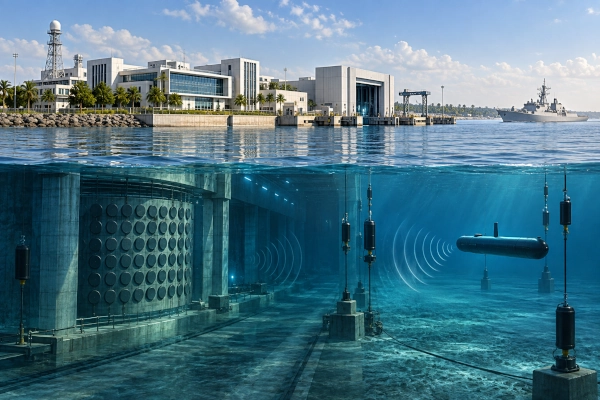
India is expanding its indigenous underwater warfare and naval sensor infrastructure with the establishment of a new SONAR Engineering Assembly, Test & Evaluation Center, or SEATEC, at the Naval Physical and Oceanographic Laboratory in Kochi.
Secretary, Department of Defence Research and Development and DRDO Chairman Rajesh Kumar Singh laid the foundation stone for the new facility at the SAROVAR Campus of NPOL Kochi on September 26, 2026.
The new DRDO SEATEC facility is being developed to support the engineering, assembly, testing and evaluation of advanced SONAR systems and underwater surveillance technologies. Once operational, it will provide NPOL with specialised infrastructure for developing and validating future generations of indigenous naval acoustic systems.
SEATEC to Strengthen Indigenous SONAR Development
The SONAR Engineering Assembly, Test & Evaluation Center will include an underwater simulation channel along with specialised machinery and equipment required for engineering and evaluating advanced underwater acoustic systems.
Such infrastructure is important because SONAR systems cannot be developed solely through laboratory electronics and software testing. Their performance depends heavily on acoustic propagation, transducer behaviour, signal processing, environmental conditions and the interaction between sensors and the surrounding underwater medium.
The new facility is therefore expected to support a wider range of engineering activities, from subsystem development and assembly to system-level testing and evaluation.
For India, the project represents another step towards strengthening domestic capability in technologies associated with anti-submarine warfare, underwater surveillance and maritime domain awareness.
NPOL Remains at the Centre of India’s Naval SONAR Programme
The Naval Physical and Oceanographic Laboratory is one of DRDO’s principal laboratories for underwater acoustic and naval sensor technologies.
Based in Kochi, NPOL works extensively in Sound Navigation and Ranging, or SONAR, together with underwater acoustics, oceanography, signal processing, electronics, transducers, engineering systems and associated materials.
Its technology portfolio includes active and passive SONAR systems, low-frequency underwater acoustic technologies, towed arrays, acoustic transmitters, underwater receivers and handling systems required for naval platforms.
NPOL-developed technologies form an important part of the Indian Navy’s indigenous underwater detection capability.
Why SONAR Is Critical to Modern Naval Warfare
SONAR is among the most important sensor technologies used in underwater warfare because electromagnetic sensors such as conventional radar cannot provide the same detection capability beneath the sea surface.
Instead, naval vessels and submarines depend heavily on acoustic systems to detect, classify and track objects underwater.
Active SONAR transmits acoustic energy into the water and analyses the returning echoes, while passive SONAR listens for acoustic signatures generated by submarines, ships, machinery and other underwater sources.
Modern naval SONAR suites combine these approaches with sophisticated signal processing and large sensor arrays to create a detailed acoustic picture of the underwater environment.
For a navy operating across the Indian Ocean, such systems are particularly important for detecting increasingly quiet submarines and protecting carrier groups, surface warships, strategic assets and maritime approaches.
Underwater Simulation Channel Will Support System Evaluation
One of the major elements planned for SEATEC is an underwater simulation channel.
Such a facility can provide engineers with a controlled environment in which sensors, transducers and SONAR subsystems can be tested before more expensive sea trials are undertaken.
Controlled testing allows researchers to examine acoustic behaviour under repeatable conditions, helping engineers identify design problems, compare system configurations and validate hardware and signal-processing algorithms.
This capability can shorten development cycles and reduce dependence on repeated deployment of ships and offshore test assets during early stages of development.
The addition of specialised engineering machinery should also allow more parts of the SONAR development process to be conducted within an integrated NPOL facility.
India Expanding Indigenous Underwater Surveillance Capabilities
The SEATEC project comes at a time when India is steadily increasing investment in underwater domain awareness.
Submarines have become increasingly important across the Indo-Pacific, with several regional navies expanding both conventional and nuclear-powered submarine fleets.
Detection of submarines consequently requires a layered network consisting of hull-mounted SONAR, variable-depth SONAR, towed arrays, maritime patrol aircraft, helicopters, autonomous underwater vehicles and other underwater sensors.
India has been progressively developing indigenous technologies across several of these categories.
NPOL’s work therefore contributes directly to the Indian Navy’s ability to build a larger domestic ecosystem for acoustic detection rather than relying entirely on imported SONAR technologies.
Indigenous SONAR Already Deployed on Indian Navy Warships
DRDO highlighted in August 2026 that indigenous SONAR technologies developed by NPOL were being deployed aboard newly commissioned Indian naval vessels.
The organisation has described these systems as critical sensors that provide naval platforms with the ability to detect, classify and track underwater threats.
This indigenous deployment is particularly important because modern SONAR systems integrate highly sensitive acoustic hardware with sophisticated software and signal-processing techniques.
Control over these technologies allows India to modify detection algorithms, integrate locally developed weapons and sensors, and adapt naval systems to the acoustic conditions encountered in Indian waters.
It also reduces long-term dependence on foreign suppliers for upgrades and lifecycle support.
SEATEC Complements Existing NPOL Test Infrastructure
SEATEC will add to a growing network of specialised underwater testing infrastructure available to NPOL.
DRDO had earlier established the Submersible Platform for Acoustic Characterisation and Evaluation, or SPACE, at Kochi for evaluation of naval SONAR systems.
SPACE enables sensors and transducers to be lowered to substantial underwater depths for characterisation and evaluation.
SEATEC serves a different but complementary function by creating dedicated engineering, assembly and test infrastructure ashore.
Together, these facilities can support the progression of SONAR technologies from laboratory development and system integration to underwater evaluation and eventual operational deployment.
Anti-Submarine Warfare Becoming Increasingly Important
The establishment of SEATEC also reflects the growing importance of anti-submarine warfare technology in India.
Modern submarines are increasingly difficult to detect because improvements in propulsion systems, hull design, acoustic isolation and machinery have reduced their noise signatures.
Conventional diesel-electric submarines operating on batteries can be particularly quiet, while air-independent propulsion technologies can enable them to remain submerged for extended periods.
Nuclear-powered submarines add another level of complexity because they can remain underwater for long durations and operate across much larger areas.
Detecting such threats requires more sensitive acoustic sensors, better processing algorithms and increasingly sophisticated multi-sensor networks.
Facilities such as SEATEC can therefore contribute directly to the development of technologies needed for future Indian anti-submarine warfare systems.
Supporting India’s Defence Indigenisation Programme
The DRDO SEATEC project in Kochi also fits into India’s wider effort to develop critical defence technologies domestically.
Naval sensor systems are strategically important because their underlying technologies involve specialised materials, acoustic transducers, electronics, processing hardware and complex software.
Developing these capabilities within India allows domestic industry and research laboratories to build intellectual property and manufacturing expertise that can be reused across multiple naval platforms.
Indigenous development can also make future upgrades easier because Indian engineers retain greater control over hardware and software architectures.
This becomes especially important as the Indian Navy introduces new destroyers, frigates, submarines and unmanned underwater platforms over the coming decades.
New Infrastructure Could Support Future Unmanned Systems
The technologies developed through NPOL may eventually support a growing range of unmanned naval platforms as well.
Autonomous underwater vehicles and unmanned surface vessels increasingly depend on acoustic sensors for navigation, mapping, mine detection, submarine surveillance and underwater reconnaissance.
India has already been developing autonomous underwater systems for military applications, making specialised acoustic research and evaluation infrastructure increasingly relevant.
Future versions of Indian SONAR technology could therefore find applications not only aboard conventional ships and submarines but also across distributed networks of autonomous sensors and unmanned platforms.
Building a Domestic Underwater Warfare Technology Base
The establishment of the new SEATEC facility represents a deeper investment in the technological foundations of India’s naval modernisation.
Rather than focusing solely on acquiring warships and submarines, India is increasingly developing the sensors, electronics, software and test infrastructure that determine how effectively those platforms can operate in contested maritime environments.
NPOL already occupies a central position in this effort through decades of work on underwater acoustics and SONAR technologies.
The addition of the SONAR Engineering Assembly, Test & Evaluation Center at NPOL Kochi can strengthen that capability further by creating a dedicated environment for engineering, integration and evaluation of future underwater surveillance systems.
As submarine activity grows across the Indo-Pacific and underwater warfare becomes increasingly technology-intensive, domestic control over SONAR and acoustic technologies will remain an important component of India’s maritime security and strategic autonomy.
References
Defence Research and Development Organisation — SONAR Technology Foresight, Naval Physical and Oceanographic Laboratory.
https://drdo.gov.in/drdo/en/offerings/technology-foresight/sonar
Government of India Central Public Procurement Portal — DRDO tender for SEATEC, Kochi; Tender Reference 83739/CIV/SEATEC/KOCHI/CON.
https://eprocure.gov.in/eprocure/app
Defence Research and Development Organisation — Indigenous SONAR technology deployed on newly commissioned ships, August 2026.
https://drdo.gov.in/drdo/en/documents/publication
Defence Research and Development Organisation — NPOL Kochi, Naval SONAR and underwater acoustic technology programmes.
https://drdo.gov.in
DRDO official communication — Foundation stone laying of SONAR Engineering Assembly, Test & Evaluation Center at NPOL SAROVAR Campus, Kochi, September 26, 2026.
You may also like
-
IndoWings Unveils STRIKE Loitering Munition Concept for MBRL Launchers
-
Kalyani-Paramount Unveil 10-Tonne Mbada 4×4 Light Armoured Vehicle at AAD 2026
-
Embraer and Mahindra Deepen C-390 Partnership for Indian Air Force’s Medium Transport Aircraft Programme
-
India Will Protect Its Security and Strategic Autonomy While Remaining Committed to Peace: Rajnath Singh
-
ArthX Expands FANG-7 Interceptor Drone Production as FANG-10 Development Moves Ahead
