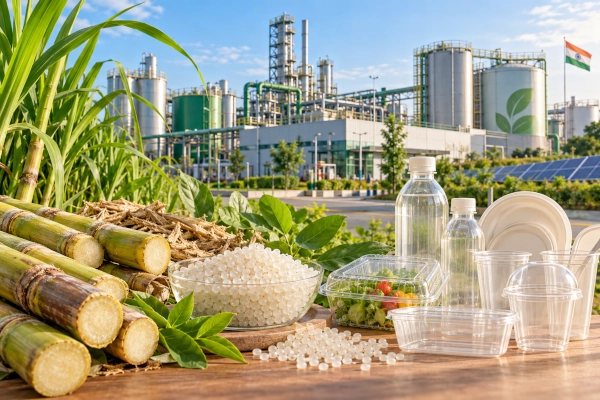
India has formally moved bio-based biodegradable polylactic acid, or PLA plastic, from research towards commercial use, marking a significant development in the country’s bioeconomy and sustainable manufacturing sector.
Union Minister of State for Science and Technology Dr Jitendra Singh formally launched the commercial use of bio-based biodegradable plastic based on PLA on 24 September 2026 in New Delhi. The initiative is being taken forward by Balrampur Chini Mills Limited under the Government of India’s BioE3 — Biotechnology for Economy, Environment and Employment — framework.
The project links biotechnology with industrial manufacturing by converting renewable sugar-based feedstock into high-value bioplastics. It also represents an effort to build indigenous capability in advanced sustainable materials rather than relying entirely on imported technologies or conventional petroleum-derived plastics.
₹75 Crore BIRAC Support for PLA Research and Scale-Up
A key component of the programme is a ₹75 crore grant from the Biotechnology Industry Research Assistance Council, or BIRAC, under the Department of Biotechnology.
The funding will support establishment of a 100 tonnes-per-annum pilot-scale research and development facility for PLA and advanced PLA co-polymers. The facility will be created at Balrampur Chini Mills’ integrated manufacturing complex at Kumbhi in Uttar Pradesh.
The pilot facility is intended to generate process knowledge, techno-economic data and specialised PLA grades while supporting product development, customer validation and future commercial-scale manufacturing.
This is important because producing commercially competitive biodegradable polymers requires more than laboratory-level chemistry. It requires stable production processes, consistent material quality, scalable manufacturing systems and reliable supply chains.
From Sugar to Sustainable Bioplastics
PLA is a bio-based polymer that can be produced using renewable agricultural feedstocks rather than conventional fossil-derived raw materials.
In this project, renewable sugar-based feedstock will form the basis of the manufacturing pathway. Biological resources can be processed into lactic acid and subsequently converted into PLA and related biopolymers.
This creates a new industrial opportunity for India’s sugar and agricultural sectors by moving beyond traditional products such as sugar and ethanol towards higher-value bio-based materials.
The government has described the initiative as part of a larger effort to convert biological resources into commercially useful products while creating new manufacturing and employment opportunities.
BioE3 Pushes Biotechnology From Laboratory to Factory
The PLA programme falls under the BioE3 framework, which seeks to expand biotechnology-driven manufacturing across the economy.
Dr Jitendra Singh said the initiative represents the transition of Indian biotechnology from laboratory research towards commercial production, sustainable manufacturing and employment generation.
The government’s emphasis is increasingly focused on developing a complete pathway from research to pilot-scale validation and then to industrial production.
This approach is designed to prevent promising Indian technologies from remaining confined to laboratories without reaching commercial markets.
India’s Bioeconomy Approaches $195 Billion
The PLA initiative comes as India’s bioeconomy continues to expand rapidly.
According to the Ministry of Science and Technology, India’s bioeconomy has grown from approximately $10 billion in 2014 to nearly $195 billion in 2026.
The government has increasingly identified biotechnology as an industrial growth sector capable of contributing to healthcare, agriculture, manufacturing, energy, advanced materials and environmental sustainability.
Earlier official assessments placed India’s bioeconomy at more than $190 billion and set a target of reaching $300 billion by 2030.
The commercialisation of PLA therefore represents part of a wider attempt to translate the growing biotechnology research base into manufacturing capacity.
New Value Chain Beyond Ethanol
The project could also create a new industrial pathway for India’s sugar sector.
Sugarcane has traditionally supported sugar production, ethanol manufacturing and power generation from bagasse. Bio-based polymers could add another high-value product to that chain.
Department of Biotechnology Secretary Dr Rajesh Sudhir Gokhale said the programme could create a value chain beyond ethanol by converting biological resources such as sugar and biomass into lactic acid and high-value biopolymers.
Such diversification could gradually transform sugar-producing regions into broader bio-manufacturing centres.
Pilot Facility to Develop Advanced PLA Grades
The proposed 100 TPA facility will not simply manufacture standard PLA.
It is intended to develop specialised PLA grades and advanced PLA co-polymers for higher-value applications. The facility will also generate the technical information needed to evaluate production economics and support scale-up.
The programme will involve product validation, process development and collaboration between industry, researchers and academic institutions.
Building such capabilities domestically could help Indian manufacturers develop materials suited to specific applications rather than relying only on imported polymer formulations.
Biodegradable Plastics and India’s Waste Challenge
Plastic waste has become a major environmental challenge because many conventional petroleum-derived polymers remain in the environment for long periods.
Bio-based and biodegradable materials such as PLA can offer alternatives for selected applications where appropriate waste-management and composting systems are available.
Their environmental impact, however, depends on the complete lifecycle of the material, including feedstock production, manufacturing energy, collection and end-of-life treatment.
The importance of the Indian programme therefore lies not simply in replacing one plastic with another, but in building domestic expertise in next-generation sustainable materials that can eventually be integrated into a wider circular economy.
Waste-to-Wealth Approach Gains Importance
Dr Jitendra Singh also linked the programme with India’s broader waste-to-wealth strategy.
India generates different forms of agricultural residues and biological waste across regions, creating opportunities for locally adapted biotechnology processes.
The government believes that regional biomass resources can eventually be converted into fuels, chemicals, polymers and other value-added products.
Such an approach could create additional income streams while supporting regional manufacturing and reducing dependence on fossil-derived raw materials.
Indigenous Manufacturing at the Centre of the Programme
Another important objective is technology indigenisation.
The pilot plant will generate process knowledge and manufacturing experience within India, providing the foundation for larger commercial facilities if the technology performs successfully at scale.
This aligns with the government’s broader effort to strengthen domestic production in technologies considered important for future industrial competitiveness.
The Ministry of Science and Technology has repeatedly emphasised that Indian research institutions and companies should move beyond technology adoption and develop globally competitive indigenous products.
From Bio-Based Research to Commercial Manufacturing
The PLA project illustrates a broader change taking place in India’s biotechnology sector.
Public funding is increasingly being directed towards programmes that bridge the gap between laboratory research and industrial-scale manufacturing.
Government initiatives such as BioE3 and BIO-NIVESH are intended to connect biotechnology research with industry, private investment and commercial markets. BIO-NIVESH, launched earlier in September 2026, was specifically designed to strengthen interaction between biotechnology innovators and investors so promising technologies can move from research to scale.
The PLA initiative provides a practical example of that model in action.
India Builds a New Bio-Based Manufacturing Industry
The commercialisation of bio-based biodegradable PLA plastic in India could eventually have significance well beyond the individual project.
Successful scale-up could establish domestic capability in biodegradable polymers, advanced bioplastics and specialised bio-based materials while creating new markets for agricultural feedstocks.
It could also strengthen collaboration between biotechnology laboratories, industrial manufacturers, farmers, investors and material-science researchers.
India’s emerging bioeconomy is consequently moving from a predominantly research-driven sector towards one increasingly connected with large-scale manufacturing.
The PLA project at Kumbhi represents one of the clearest examples of that transition — converting renewable agricultural resources into advanced industrial materials while building domestic capability in a technology expected to play an increasingly important role in sustainable manufacturing.
References
Press Information Bureau, Ministry of Science & Technology — “Union Minister Dr. Jitendra Singh Formalises Commercial Launch of Bio-based Biodegradable Plastic under BioE3,” 24 September 2026.
Press Information Bureau, Ministry of Science & Technology — Official update on the growth of India’s bioeconomy and BioE3 framework, June 2026.
Press Information Bureau, Ministry of Science & Technology — Launch of BIO-NIVESH to support investment and commercial scale-up of biotechnology innovations, 3 September 2026.
Press Information Bureau, Ministry of Science & Technology — CSIR@85 address on technological sovereignty, indigenous technology development and industry-led commercialisation, 25 September 2026.
You may also like
-
Indian Pharmaceutical Market Grows 12.96% in August as Chronic Therapies Drive Expansion
-
India and GCC Review Joint Action Plan as Free Trade Agreement Negotiations Move Forward
-
EdgeForce Solutions Emerges L1 Bidder for Indian Army Manned–Unmanned Teaming System
-
Indian Navy Seeks Indigenous GPS PS1 and PS2 Assemblies for MRSAM Air-Defence System
-
Indian Army Para SF Reportedly Begins Trials of Indigenous SSS Defence G72 Submachine Gun
