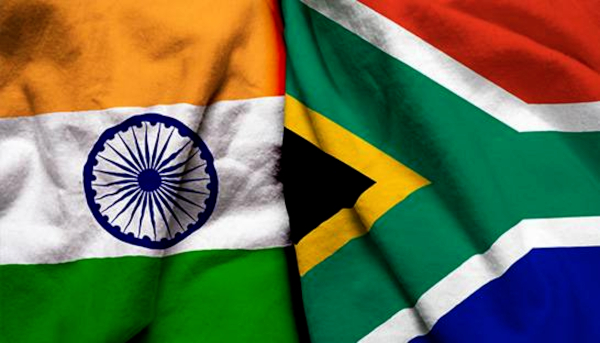
South African President Cyril Ramaphosa has called for a new phase in economic relations with India, identifying renewable energy, critical minerals, infrastructure, agriculture, digital technology and advanced manufacturing as major areas where the two countries can build deeper commercial partnerships.
Addressing the India–South Africa Business Leadership Roundtable in New Delhi on September 12, 2026, on the sidelines of the 18th BRICS Summit, Ramaphosa said changing global supply chains, accelerating energy transitions and the rapid spread of digital technologies were creating new opportunities for cooperation between emerging economies.
The South African President said India was expanding rapidly while South Africa was undertaking major reforms across its energy, telecommunications, logistics and water sectors. He invited Indian businesses to participate more extensively in South Africa’s investment and industrial development plans.
Indian Companies Already Have Major South African Presence
Ramaphosa highlighted the substantial presence Indian companies have already established in South Africa. According to figures provided by the South African Presidency, more than 150 Indian companies have collectively invested over $10 billion in South Africa and created employment for more than 18,000 South Africans.
South African companies have likewise invested in India, with Ramaphosa highlighting firms including Naspers, FirstRand Bank, Sanlam and Momentum.
The President said the next stage should concentrate on turning the strong political relationship between the two countries into more investment, exports, innovation, industrial development and sustainable growth. He urged businesses to move beyond discussions and build commercially viable projects and long-term partnerships.
Green Energy and Critical Minerals Offer Major Opportunity
Energy transition and green industrialisation emerged as one of the most important areas identified by Ramaphosa.
Both India and South Africa are undertaking major transformations of their energy systems, creating opportunities in renewable-energy technologies, green hydrogen, critical minerals, battery value chains and sustainable manufacturing.
South Africa possesses substantial mineral resources, while India has increasingly strong capabilities in manufacturing, engineering and technology. Ramaphosa argued that these complementary strengths could support cooperation across critical-mineral value chains rather than limiting South Africa’s role to supplying raw materials.
He particularly highlighted the potential for joint activity involving new-energy vehicles, batteries and downstream mineral-based products. South Africa is seeking greater domestic beneficiation of minerals before export, while India requires growing quantities of critical materials for electric vehicles, renewable energy, electronics and advanced manufacturing.
South Africa Opens $100-Billion Infrastructure Opportunity
Infrastructure represents another potentially large opportunity for Indian companies.
Ramaphosa said South Africa has identified 195 Strategic Integrated Projects worth more than $100 billion across priority sectors. These include transport systems, rail corridors, renewable-energy facilities, electricity transmission infrastructure, water-treatment plants and hospitals.
South Africa is also investing in project preparation to move these plans towards implementation and has prepared a new national construction pipeline covering funded projects expected to go out for tender over the coming 18 months.
Ramaphosa specifically invited Indian companies to explore partnerships and participate in these projects. He identified transport, logistics, ports, digital connectivity, smart cities and industrial corridors as areas capable of improving South Africa’s competitiveness while strengthening its links with wider African markets.
For Indian engineering, construction, energy and infrastructure companies, the programme could therefore offer opportunities extending well beyond conventional bilateral trade.
Agriculture and Food Security Form Another Pillar
Agriculture was identified as another sector with considerable scope for cooperation.
Ramaphosa said India and South Africa could expand partnerships in agro-processing, agricultural technology, food innovation and sustainable farming practices. Such cooperation could improve productivity, strengthen supply chains and contribute to food security in both countries.
India has developed significant capabilities in agricultural machinery, irrigation, food processing, digital agricultural platforms and affordable technologies for small farmers. South Africa, meanwhile, possesses a large commercial agricultural sector and can act as an important gateway into markets across Southern Africa.
Digital Economy Opens New Front
The South African President also placed considerable emphasis on cooperation in the digital economy, pointing to possibilities in fintech, artificial intelligence, cybersecurity, digital trade, innovation ecosystems and digital skills.
As an example of expanding Indian involvement, Ramaphosa highlighted Indian-headquartered global business services company Atain, which recently opened a new facility in Cape Town.
According to the Presidency, the expansion is expected to increase Atain’s South African workforce from around 1,500 to more than 2,000 employees, many of them young South Africans.
Ramaphosa also called for closer partnerships between Indian and South African universities, research institutions, skills-development organisations and private companies to create workforces capable of supporting emerging industries.
Trade Negotiations Could Strengthen Economic Links
The renewed business push comes only a month after India and the Southern African Customs Union, or SACU, formally signed the Terms of Reference for negotiations towards a Preferential Trade Agreement on August 12, 2026.
SACU comprises South Africa, Botswana, Eswatini, Lesotho and Namibia. The proposed PTA could therefore expand India’s preferential market access not only to South Africa but across the wider Southern African customs bloc.
India’s Commerce Ministry says negotiations are expected to cover trade and market access for goods, rules of origin, customs procedures, trade facilitation, trade remedies, sanitary measures, technical barriers and dispute settlement.
The development is particularly important because South Africa is by far the largest economy within SACU and one of India’s most important commercial partners on the African continent.
From Political Friendship to Commercial Partnership
India and South Africa already cooperate closely through BRICS, IBSA and the G20 and have long shared similar positions on reform of international institutions and stronger representation for developing countries.
The emphasis in New Delhi, however, is increasingly shifting towards converting that political relationship into tangible economic outcomes.
Ramaphosa summed up the direction of the relationship by saying South Africa was ready for “a new era in economic relations” in which business engagement results in actual trade, investment and contracts.
With more than 150 Indian companies already established in South Africa, a potential India–SACU preferential trade agreement moving towards negotiations and opportunities emerging across minerals, green energy, infrastructure and digital technologies, the economic relationship now has the potential to become a substantially larger component of the India–South Africa strategic partnership.
References
- The Presidency, Republic of South Africa — Remarks by President Cyril Ramaphosa during the India–South Africa Business Leadership Roundtable, New Delhi, 12 September 2026.
- Press Information Bureau, Government of India — India and Southern African Customs Union Sign Terms of Reference for Preferential Trade Agreement Negotiations, 12 August 2026.
- Ministry of External Affairs, Government of India — India–South Africa Bilateral Relations, 2026.
- Department of Trade, Industry and Competition, Republic of South Africa — Official material relating to India–South Africa trade, investment and business cooperation.
You may also like
-
India and Brazil Push for Deeper Strategic Partnership as Trade Target Rises to $30 Billion
-
Modi–Xi Talks at BRICS Put Border Peace, Trade Imbalance and Market Access at Centre of India–China Ties
-
PM Modi Meets PM Abiy Ahmed at BRICS Summit as India and Ethiopia Deepen Strategic Partnership
-
PM Modi Meets PM Anwar Ibrahim at BRICS Summit as India and Malaysia Deepen Strategic Partnership
-
PM Modi Meets Vietnam PM Le Minh Hung at BRICS Summit as India–Vietnam Strategic Ties Deepen
