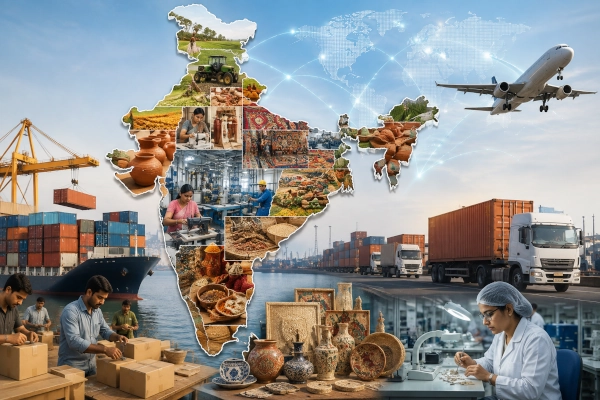
India is widening its export strategy beyond traditional industrial centres and port cities, with the government’s Districts as Export Hubs initiative now covering more than 770 districts across the country. The programme seeks to identify products and services with international potential in individual districts and connect local manufacturers, farmers, artisans and MSMEs with overseas markets.
The Department of Commerce is implementing the initiative through the Directorate General of Foreign Trade, treating each district as a unit of export planning rather than merely as a centre of production. According to a government factsheet released on September 2, 2026, the programme had expanded to more than 770 districts by January 2026, significantly broadening India’s district-level export architecture.
The initiative builds on the One District One Product concept, but its scope is considerably wider. Instead of concentrating solely on identifying and promoting a distinctive local product, Districts as Export Hubs seeks to develop an entire export ecosystem around each district. This includes identifying products and services, addressing logistics constraints, improving quality and certification, building exporter capacity and developing links with international markets.
Importantly, the programme is not a separate funding scheme. It follows a convergence model under which existing Central and State government schemes, institutions and industry partners are brought together to address district-specific export requirements.
The government believes such decentralisation is increasingly important as India seeks to sustain the strong expansion of its overseas trade. India’s combined exports of goods and services reached $825.25 billion in FY2024-25 and an estimated record $863.11 billion in FY2025-26. The Districts as Export Hubs framework is intended to broaden participation in this growth by bringing smaller towns, rural production centres and specialised regional clusters into global supply chains.
A nationwide institutional structure has been created to support the programme. State Export Promotion Committees operate at the State and Union Territory level, while District Export Promotion Committees coordinate implementation locally. These committees bring together government departments, industry representatives, exporters and other stakeholders to identify opportunities and address obstacles affecting exports.
One of their principal responsibilities is preparing District Export Action Plans. These plans identify products and services with overseas potential, assess infrastructure and logistics, locate bottlenecks and recommend measures to improve competitiveness and market access. As of March 2026, draft action plans had been prepared for 590 districts, with 249 formally adopted by their respective District Export Promotion Committees.
The programme has identified a highly diverse range of potential exports. In Gujarat’s Sabarkantha district, for example, ceramics, tiles and potatoes have been identified, while neighbouring Aravalli includes minerals, agro-processing products, glass and tiles. Maharashtra’s Jalgaon district includes its well-known bananas and Bharit brinjal, while Agar Malwa in Madhya Pradesh has been identified for oranges.
Traditional and agricultural products are also prominent. Bastar in Chhattisgarh includes Bastar iron craft, rice, jowar and maize, while Jamtara in Jharkhand has been identified for bamboo craft and cashew. The wider programme covers GI-tagged goods, agricultural clusters, toy clusters, engineering products and other locally competitive goods and services.
Identifying a product, however, is only the first stage. The programme also seeks to help producers meet international requirements relating to quality standards, testing, certification, packaging and branding. These capabilities can be particularly important for smaller manufacturers and agricultural producers that may have commercially competitive products but lack experience navigating overseas regulations and export procedures.
Digital commerce is another important part of the strategy. Under the initiative, partnerships with platforms and logistics companies including Amazon, Shiprocket and DHL are being used to give MSMEs additional routes to overseas customers and lower-cost shipping options. Dak Ghar Niryat Kendras are also intended to make postal exports more accessible by assisting small businesses with documentation, packaging and smaller international consignments.
Capacity-building programmes conducted by DGFT Regional Authorities and district administrations cover export procedures, logistics planning, packaging norms and regulatory compliance. Government organisations and institutions including the Export Credit Guarantee Corporation of India, Export Promotion Council for Handicrafts, Federation of Indian Export Organisations, Ministry of MSME, India Post and EXIM Bank are participating in different parts of this ecosystem.
DGFT has also partnered with EXIM Bank to strengthen export capabilities in selected districts under its Grassroots Initiatives for Development programme. Six districts — Anantapur, Raipur, Solan, Tiruppur, Kanpur and Kolhapur — have been selected for focused support aimed at identifying sector-specific constraints and developing interventions suited to their local industries.
The government has moved towards a more outcome-oriented implementation model from June 1, 2026. In the first phase of this approach, districts across 27 States and Union Territories are being covered with assistance from 24 DGFT Regional Authorities and 11 partner agencies. Greater emphasis is being placed on measurable outcomes, including creating new exporters and increasing the value of exports by bringing together existing government schemes, GI products and MSME clusters.
The Districts as Export Hubs initiative therefore represents a broader change in India’s export strategy. Instead of depending primarily on established manufacturing belts and major metropolitan centres, the government is attempting to identify globally marketable capabilities at the district level and build the infrastructure, skills and institutional support required to convert them into exports.
As India works towards its longer-term ambition of crossing $1 trillion in exports, the success of this approach will depend on whether district-level planning can translate local production advantages into sustained international sales. If implemented effectively, the programme could expand the country’s exporter base while creating new opportunities for MSMEs, farmers, artisans and specialised manufacturing clusters far beyond India’s traditional export centres.
Official References:
- Press Information Bureau (PIB), Government of India
Districts as Export Hubs: Taking India’s Exports to Every District
Published: 2 September 2026
Ministry/Department: Department of Commerce, Government of India
https://www.pib.gov.in/PressNoteDetails.aspx?ModuleId=3&NoteId=159804&id=159804&lang=2®=48
Key official figures:
- Districts covered under Districts as Export Hubs initiative: More than 770
- Draft District Export Action Plans prepared: 590 districts
- District Export Action Plans formally adopted by DEPCs: 249
- India’s total exports of goods and services in FY2024-25: US$825.25 billion
- Estimated exports in FY2025-26: US$863.11 billion
- Outcome-oriented implementation model introduced from: 1 June 2026
- States and Union Territories covered in the first phase: 27
- DGFT Regional Authorities involved: 24
- Partner agencies involved: 11
- Press Information Bureau (PIB), Government of India
Department of Commerce – Districts as Export Hubs Initiative
Published: 24 March 2026
https://www.pib.gov.in/PressReleasePage.aspx?PRID=2244401&lang=1®=1
The Government of India confirmed that State Export Promotion Committees and District Export Promotion Committees have been established across all 36 States and Union Territories. As of March 2026, draft District Export Action Plans had been prepared for 590 districts, of which 249 had been formally adopted by the respective District Export Promotion Committees.
- Directorate General of Foreign Trade (DGFT)
Ministry of Commerce and Industry, Government of India
Districts as Export Hubs Initiative
https://www.dgft.gov.in/
Official Note:
The Districts as Export Hubs initiative is implemented by the Department of Commerce through the Directorate General of Foreign Trade. It is not a separate financial assistance scheme. The initiative follows a convergence approach by using existing Central and State government schemes and institutional support to identify export-potential products and services, address infrastructure and logistics gaps, improve certification and market access, and connect district-level producers, MSMEs, farmers and artisans with international markets.
You may also like
-
NoPo Nanotechnologies: Bengaluru Deep-Tech Company Building India’s Single-Walled Carbon Nanotube
-
Japan Credit Rating Agency Upgrades India’s Sovereign Rating to ‘A-’ With Stable Outlook
-
Reliance Consumer Enters India’s Ice-Cream Market With Bombay Creamery
-
BEML Adds ₹180.6-Crore Vande Bharat Sleeper Order to Growing Manufacturing Book
-
India Launches Indigenous iNDiC Underwater Systems for Military and Professional Diving
