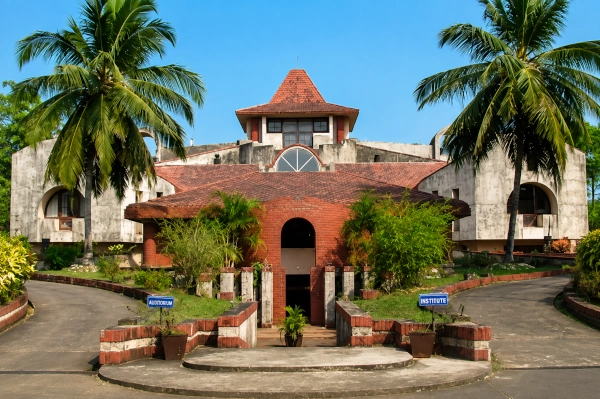
Goa University researchers have developed VEDA — Visible-light Extinction with Depth Analysis, a specialised digital tool for understanding how visible light behaves beneath coastal and estuarine waters. Developed by the university’s Remote Sensing Laboratory with funding from the Naval Research Board under the Defence Research and Development Organisation, the system can estimate underwater light attenuation and vertical visibility under varying marine conditions.
VEDA uses a combination of field observations and numerical modelling to calculate parameters that determine how far visible light can penetrate through water. The tool can generate estimates according to factors such as water depth, season, tidal phase and the angle of the Sun, making it useful for studying the highly variable optical conditions found along Goa’s coastal and estuarine environments.
The underlying research was built from observations collected at 22 sampling locations between September 2019 and January 2023. Measurements were conducted during the Indian Summer Monsoon, post-monsoon and pre-monsoon periods, enabling researchers to capture substantial seasonal variation in coastal-water clarity. The field campaign used a HyperOCR hyperspectral ocean-colour radiometer assembly equipped with sensors measuring downwelling irradiance, upwelling radiance, fluorescence, backscattering, temperature, conductivity and pressure.
Using these measurements, VEDA estimates the diffuse attenuation coefficient of downwelling light at 490 nanometres and other optical attenuation parameters. It then calculates vertical visibility, providing an indication of how deeply useful visible light can penetrate under different environmental conditions. This is particularly relevant in turbid coastal waters, where suspended sediments, plankton, dissolved substances and seasonal runoff can rapidly alter visibility.
The technology has potential relevance to naval research because the effectiveness of underwater cameras, electro-optical sensors and other light-dependent systems can vary significantly according to water clarity. Reliable information about underwater optical conditions can help researchers understand where such sensors are likely to perform effectively and how their operational range may change with season, tide and local water properties.
The Naval Research Board supports basic and applied research in universities and research institutions on technologies relevant to future naval requirements. DRDO states that the programme is intended to expand India’s naval science and technology knowledge base by supporting academic research in areas including ocean environment, hydrodynamics, sonar and signal behaviour, marine systems and related disciplines.
Goa University is particularly well positioned for this work because marine and coastal research forms one of its recognised research strengths. Its Remote Sensing Laboratory undertakes work in optical remote sensing of aquatic ecosystems, radiative-transfer modelling and hyperspectral observations, while collaborating with organisations including CSIR-NIO, INCOIS, NCPOR and ISRO institutions. The university also maintains research links with DRDO’s Naval Physical and Oceanographic Laboratory.
VEDA should therefore be viewed primarily as an ocean-optics research and decision-support tool, rather than as an underwater weapon or operational naval sensor itself. Its value lies in improving understanding of the environment through which optical systems must operate, potentially supporting the design, testing and deployment of future underwater imaging and surveillance technologies.
Official References
- Goa University, Remote Sensing Laboratory. VEDA — Visible-light Extinction with Depth Analysis. The official project page confirms that VEDA was developed by the Remote Sensing Laboratory, Goa University, with funding from the Naval Research Board under sanction letter DNRD/0100/NRB/4179/D. The application estimates underwater light attenuation, attenuation coefficients and vertical visibility in Goa’s coastal and estuarine waters using in-situ measurements and numerical modelling.
https://exam.unigoa.ac.in/veda/app/info
- Defence Research and Development Organisation (DRDO), Ministry of Defence, Government of India. Naval Research Board – Extramural Research Grant Programme. The Naval Research Board supports academic and scientific research relevant to naval technologies and maritime research requirements.
https://academyresearch.drdo.gov.in/DRDO/NRB_ERG
Project Details Confirmed by Goa University:
The VEDA database uses measurements from 22 sampling locations collected between September 2019 and January 2023 across monsoon, post-monsoon and pre-monsoon seasons. The system provides estimates of underwater attenuation coefficients and vertical visibility according to water depth, season, tidal phase and solar zenith angle.
You may also like
-
Air Vice Marshal Shakti Sharma Becomes First Non-Medical Woman Two-Star Officer in Indian Armed Forces
-
India’s 16 Defence PSUs Record ₹1.29 Lakh Crore Output as Government Pushes Global Expansion
-
India Builds Multi-Architecture Quantum Computing Ecosystem at IISc
-
Indian Scientists Decode Mustard’s Self-Rejection Genes to Develop Higher-Yield Oilseed Hybrids
-
Genrobotics Partners Territorial Army for Defence Robotics and Field Trials
