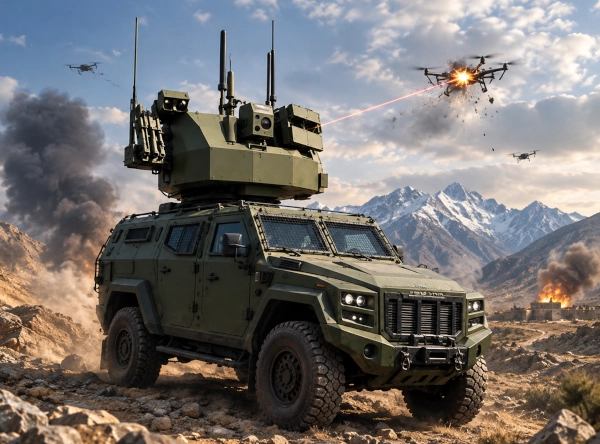
The Indian Army is reportedly moving to integrate its PRABAL Counter-Unmanned Aircraft System (C-UAS) with the indigenous Mahindra Armado Armoured Light Specialist Vehicle (ALSV), potentially creating a highly mobile counter-drone platform capable of operating alongside frontline formations.
Reports emerging on 28 August 2026 indicate that work has begun on mounting the PRABAL system on the protected Armado platform. If confirmed, the configuration would represent another important step in the Army’s rapidly expanding effort to develop mobile defences against drones and loitering munitions.
The development follows a broader transformation of the Army’s counter-UAS architecture. During the 78th Army Day Parade in Jaipur in January 2026, the Army publicly displayed PRABAL C-UAS in both vehicle-based and man-portable configurations, establishing the system as part of its emerging indigenous counter-drone inventory.
Mobility for Frontline Counter-Drone Defence
Integrating PRABAL with the Armado could significantly increase the tactical flexibility of the system. Fixed counter-drone installations are useful for protecting bases and critical infrastructure, but frontline formations increasingly require systems capable of moving with troops, artillery, command posts and logistics elements.
A protected vehicle-mounted C-UAS could accompany such formations and rapidly reposition as battlefield conditions change. This would be particularly valuable in mountainous and high-altitude areas, as well as the open terrain along India’s western borders, where units may operate across large distances.
The Army has increasingly emphasised mobile counter-drone capabilities as unmanned aerial systems become central to modern warfare. Small reconnaissance drones can locate troops and equipment, while weaponised drones and loitering munitions can strike vehicles, artillery positions, command centres and logistics nodes with increasing precision.
The ability to detect and neutralise such threats close to frontline formations has therefore become an important element of battlefield survivability.
PRABAL 2.0 Procurement Already Underway
The reported Armado integration comes amid fresh procurement of the PRABAL 2.0 C-UAS.
An Indian Army procurement issued on 23 May 2026 sought 10 PRABAL 2.0 counter-UAS systems for deployment in Leh. The procurement process concluded with the contract being awarded in July 2026.
The Leh requirement is particularly significant because high-altitude regions along India’s northern frontier have emerged as important environments for drones, surveillance UAVs and other unmanned platforms. Lightweight and mobile counter-drone systems can therefore provide tactical units with an additional defensive layer against low-flying unmanned threats.
The Army has simultaneously been evaluating and inducting a much wider range of counter-UAS technologies, including electronic warfare systems, drone jammers, spoofers, radars and integrated drone detection and interdiction systems.
Armado Provides an Indigenous Protected Platform
The Mahindra Armado, developed by Mahindra Defence Systems, provides a suitable platform for such a mobile role because of its combination of protection, payload capacity, mobility and modular design.
The Ministry of Defence signed a ₹1,056-crore contract in March 2021 for 1,300 Light Specialist Vehicles for the Indian Army. The vehicles were designed and developed in India and intended to support fighting units carrying equipment such as medium machine guns, automatic grenade launchers and anti-tank guided missiles.
The Armado’s modular architecture also allows the basic vehicle to be adapted for different battlefield roles.
Rather than exposing a counter-drone crew and sensitive electronic equipment on an unprotected light vehicle, an Armado-based configuration could provide protected mobility while allowing the system to accompany operational formations across difficult terrain.
The vehicle has already been designed to function in demanding conditions ranging from deserts to high-altitude environments, giving it potential utility for counter-UAS deployments along multiple fronts.
Counter-Drone Systems Becoming Battlefield Necessity
The growing emphasis on PRABAL reflects lessons being drawn from recent conflicts, where inexpensive drones have demonstrated their ability to threaten equipment costing many times more.
The Indian Army has consequently accelerated the induction of both UAS and Counter-UAS capabilities, with senior leadership identifying unmanned warfare as an important component of the force’s ongoing transformation.
Counter-drone protection is also evolving from isolated jamming equipment towards layered architectures capable of combining several technologies. These can include radio-frequency detection, radar, electro-optical sensors, electronic jamming and, where necessary, kinetic interception systems.
Mobile platforms will be particularly important within such an architecture because advancing formations cannot depend solely on permanent air-defence installations.
Part of a Wider Indigenous Counter-UAS Push
PRABAL sits within a rapidly expanding indigenous ecosystem of Indian counter-drone solutions being developed by military establishments, defence public-sector organisations and private companies.
The Army has already displayed drone jamming and spoofing systems alongside its new unmanned platforms, while the Ministry of Defence has repeatedly highlighted the need for accelerated indigenous development of drones and counter-UAS technologies.
Pairing an Indian counter-drone system with the indigenously developed Mahindra Armado would therefore fit closely with the wider objective of building a more self-reliant battlefield technology ecosystem.
For now, the specific integration of PRABAL with the Armado remains based on emerging reports rather than a formal Army or Ministry of Defence announcement. Nevertheless, the existence of vehicle-mounted PRABAL systems is officially established, and ongoing procurement of PRABAL 2.0 demonstrates that the Army is actively expanding the capability.
If the Armado configuration is formally confirmed, it would represent a significant step towards giving Indian frontline formations a protected, rapidly deployable and indigenous mobile counter-drone shield against one of the fastest-growing threats on the modern battlefield.
You may also like
-
India Moves Ahead With Javelin Anti-Tank Missile Acquisition as US Envoy Confirms Procurement Plan
-
PM Modi Begins Central Asia Visit With Uzbekistan State Visit and SCO Summit in Kyrgyzstan
-
PM Modi to Meet Vladimir Putin at SCO Summit in Bishkek as India-Russia Engagement Intensifies
-
India’s Indigenous Sonar Ecosystem Powers New Generation of Indian Navy Warships
-
Murshidabad Becomes First West Bengal District to Complete Land Handover for India-Bangladesh Border Fencing
