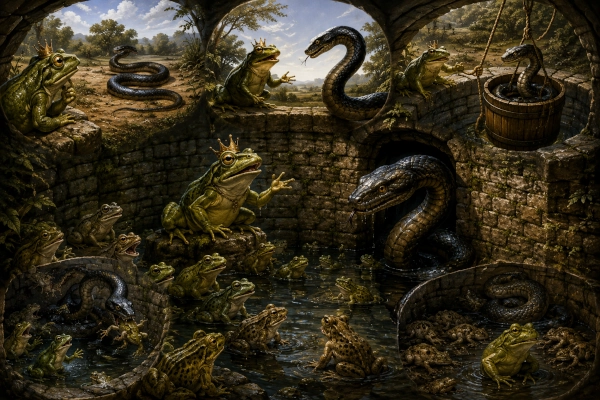
Deep inside an old stone well lived a great colony of frogs. Cool water filled its lower depths, moss covered the walls, and generations of frogs had made their homes among the cracks and ledges above the water. Their king was Gangadatta, who had ruled the colony for many years.
But Gangadatta’s greatest trouble did not come from outside the well. It came from within his own family.
Several of his relatives had grown disrespectful and troublesome. They challenged his authority, mocked his decisions and constantly disturbed the order of the colony. Every quarrel seemed to deepen Gangadatta’s anger. What had begun as irritation slowly became resentment, and resentment eventually hardened into a desire for revenge.
One day Gangadatta could bear it no longer. Using the bucket and waterwheel attached to the well, he climbed upward until he reached the world outside.
He did not leave because he wanted peace.
He left because he wanted to find a weapon.
As Gangadatta moved through the grass, he noticed a large black serpent disappearing into a hole in the earth. The serpent’s name was Priyadarshana.
Every instinct of a frog should have told Gangadatta to flee. A serpent was not merely dangerous to frogs. It was their natural predator.
Yet Gangadatta looked at the snake and saw something entirely different.
He saw an opportunity.
“If I can bring this serpent into the well,” he thought, “he can destroy those who have tormented me.”
Gangadatta approached the entrance of the serpent’s hole while carefully remaining beyond striking distance.
“Priyadarshana!” he called.
Inside the darkness, the serpent became suspicious. The voice was certainly not that of another snake. Priyadarshana had survived long enough to understand that unexpected friendship often concealed danger.
“Who calls me?” he asked.
“I am Gangadatta, king of the frogs,” came the reply.
The serpent could scarcely believe what he had heard.
A frog had come voluntarily to the home of a snake.
Gangadatta then made an even more extraordinary proposal.
“I have come to become your friend.”
Priyadarshana understood the absurdity immediately. Friendship between a snake and a frog was like friendship between fire and dry grass. One existed naturally at the expense of the other.
Gangadatta admitted this openly.
“You are indeed the enemy of my kind,” he said. “But there are frogs in my well who have become my enemies. Come with me, and I will show them to you.”
Priyadarshana listened carefully.
He was growing old. Hunting had become difficult, and even catching a rat required increasing effort. Gangadatta was now offering something no ageing predator could easily refuse: a protected place filled with prey.
The serpent agreed.
Gangadatta, delighted with his cleverness, explained how the snake could descend into the well. Near the waterline was a cavity in the stonework where Priyadarshana could conceal himself.
There was only one condition.
“You must eat only the frogs I point out,” Gangadatta warned him. “My loyal followers must remain untouched.”
Priyadarshana agreed.
Gangadatta had convinced himself that he had mastered the danger. He believed he could bring a predator into his kingdom, direct its hunger towards his enemies and then dismiss it when its task was finished.
The two returned to the well.
Gangadatta helped the serpent descend using the bucket and waterwheel. Priyadarshana slipped quietly into the hidden cavity near the water.
Then the killings began.
Gangadatta identified the frogs he hated. One after another, they disappeared into the serpent’s jaws.
At first the king was pleased.
The voices that had insulted him became silent. His rivals vanished. Those who had challenged his authority were gone.
Gangadatta believed his plan had succeeded perfectly.
Then the last of his enemies was eaten.
Priyadarshana emerged from his hiding place.
“I am hungry,” said the serpent. “Give me another frog.”
Gangadatta was startled.
“There are no enemies left. You have done what I asked. Now return to your old home.”
But the serpent had no intention of leaving.
Priyadarshana reminded Gangadatta that it was the frog king himself who had brought him into the well. His old burrow might already have been occupied, and the well provided shelter, safety and abundant food.
“You brought me here,” the serpent told him. “Now you must feed me.”
Gangadatta suddenly understood the terrible flaw in his plan.
He had imagined that he controlled the serpent because he controlled the list of victims.
But Gangadatta could control neither the serpent’s hunger nor its strength.
Priyadarshana demanded another frog.
Gangadatta reluctantly surrendered one of his own followers.
The next day the serpent demanded another.
Soon those who had remained loyal to Gangadatta began disappearing just as his enemies had.
Worse still, Priyadarshana did not always wait for permission. When Gangadatta was absent, the serpent sometimes seized additional frogs for himself.
The king who had invited the predator into his kingdom now watched helplessly as the predator consumed the kingdom itself.
The well grew quieter every day.
The joyous chorus of frogs that had once echoed from the stone walls faded. Families vanished. Friends disappeared. Ledges that had once been crowded with life became empty.
Gangadatta’s revenge had destroyed not merely his enemies but his entire community.
Eventually only Gangadatta remained.
Priyadarshana looked at him hungrily.
“There are no frogs left,” the serpent said. “You brought me here and promised me food. What will you give me now?”
Gangadatta knew that his own life would be next unless he found a way to escape.
Then he devised one final plan.
“My friend,” he said, hiding his terror, “why should you eat me when I can bring you hundreds of other frogs? Let me leave this well. I will visit neighbouring ponds and wells, gain the confidence of the frogs living there and persuade them to return with me.”
Priyadarshana considered the offer.
One frog would provide only a single meal.
Gangadatta might bring many.
The serpent allowed him to leave.
Gangadatta climbed into the bucket and slowly rose towards the mouth of the well. When he finally reached the surface, he jumped onto the ground and fled.
He never returned.
Days passed.
Priyadarshana waited.
When Gangadatta still did not appear, the serpent sent an iguana who knew the frog king to find him. The messenger eventually located Gangadatta living safely elsewhere and delivered Priyadarshana’s promise that he could return without fear.
Gangadatta had learned too much to believe him.
He refused.
The frog king had finally understood what his anger had prevented him from seeing at the beginning: a predator invited to destroy one’s enemies does not cease being a predator when the enemies are gone.
Gangadatta had wanted revenge against a few troublesome relatives. To achieve it, he introduced into his home something far more dangerous than the dispute he was trying to solve.
His enemies died.
Then his friends died.
Then his kingdom disappeared.
And in the end, Gangadatta himself survived only by abandoning the home he had once ruled.
The Deeper Meaning of the Story
The story is ultimately about the dangerous illusion that a powerful enemy can be temporarily controlled for personal advantage. Gangadatta believed that because he had invited Priyadarshana into the well, he could determine whom the serpent would harm. But the snake never stopped being a snake merely because their interests briefly coincided.
The tale also warns against allowing personal resentment to become a political strategy. Gangadatta was king of an entire community, yet he used an external threat to settle an internal quarrel. His desire to punish rivals became more important than his responsibility to protect the kingdom.
There is also a powerful lesson about unintended consequences. Gangadatta’s plan worked perfectly at first. That temporary success made the decision appear wise. Only after his enemies were gone did the true cost become visible.
The most dangerous decisions are sometimes not those that fail immediately, but those that succeed long enough to hide the disaster they are creating.
Moral
Never invite a greater danger into your home merely to defeat a smaller enemy.
A temporary ally whose interests depend upon your weakness may become far more dangerous than the opponent you employed him to destroy. Anger can make revenge appear clever, but wisdom asks what will happen after the revenge succeeds.
You may also like
-
The Serpent and the Meaning of Violence: When Grief Turned Ruru Against Every Snake
-
The Hawk and the Smaller Birds: Bhishma’s Lesson on Surviving Greater Powers
-
The Birds and the Destruction of Their Forest Home: A Mahabharata Lesson on Foresight, Leadership and the Duty to Protect
-
Chanakya’s Warning for Modern India: Why Internal Disorder Is the Cheapest Weapon Against a Rising Power
-
The Jackal Who Remembered a Former Life: The King Who Learned That Conduct Matters More Than Birth
