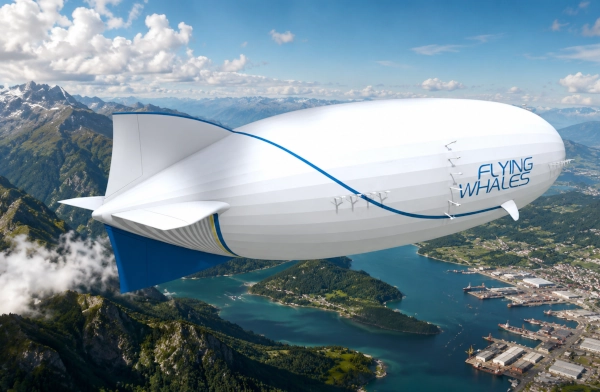
India could soon enter a new segment of strategic aerospace manufacturing following an agreement between Bharat Forge Limited and French-Canadian airship developer FLYING WHALES. The two companies have signed a Memorandum of Understanding to jointly develop, manufacture and field heavy-lift airships in India for defence, logistics and other sovereign applications.
The agreement was signed at the Farnborough International Airshow 2026 by Bharat Forge Aerospace Chief Executive Officer Guru Biswal and FLYING WHALES President Sébastien Bougon. It proposes the establishment of manufacturing, integration and production capabilities for FLYING WHALES–Bharat Forge airships within India.
At the centre of the partnership is the LCA60T, a large rigid airship designed to carry cargo weighing up to 60 tonnes. Unlike a conventional cargo aircraft, the platform obtains much of its lift from helium held within its enormous structure. Powered propulsion systems control its direction, speed and positioning, allowing it to hover while loading or unloading cargo.
What Is the LCA60T?
The LCA60T is designed as a point-to-point cargo transport platform for places where roads, railways, runways and ports are limited or completely absent. According to FLYING WHALES, the airship is planned to be approximately 200 metres long and 50 metres in diameter. Its internal cargo hold is designed to measure about 96 metres in length, eight metres in height and seven metres in width.
Cargo that cannot fit inside the hold could be transported externally beneath the aircraft using slings. This would allow the airship to move unusually shaped or oversized equipment without dismantling it into smaller sections.
The aircraft is designed to carry 60 tonnes while using approximately 180,000 cubic metres of non-pressurised helium for lift. Its published specifications include a maximum speed of around 100 kilometres per hour, power of up to 4,000 kilowatts and a flight ceiling of about 3,000 metres while carrying its maximum payload.
Its greatest advantage is its hovering cargo-transfer capability. The airship would be able to collect or deliver heavy equipment without requiring a conventional runway. This could reduce dependence on airports, paved roads, large cranes and other permanent transport infrastructure.
A New Form of Strategic Mobility
India’s geography creates exceptional logistical challenges. Military personnel and supplies must be moved across Himalayan regions, deserts, forests, islands and border areas where building permanent transport infrastructure can be difficult, expensive or environmentally disruptive.
A heavy-lift airship could potentially carry vehicles, artillery components, engineering equipment, generators, communications systems, fuel containers, prefabricated shelters and other oversized loads directly to forward areas. It would occupy a space between helicopters, fixed-wing cargo aircraft and surface transport.
Helicopters offer vertical lift and rapid access but have comparatively limited payload capacity and high operating costs. Large transport aircraft can carry heavy loads over long distances but require suitable airfields. Roads can move large volumes economically, although construction in mountains, forests and isolated regions can take years.
The LCA60T concept seeks to combine heavy payload capacity with the ability to operate without a runway. Its slower speed would make it unsuitable as a replacement for conventional military transport aircraft, but it could complement them by handling heavy or oversized cargo on routes where surface access is poor.
Defence and National-Security Applications
Bharat Forge and FLYING WHALES intend to examine several defence applications for the platform. These include supplying forward operating bases, transporting critical military stores, moving oversized equipment and supporting rapid deployment in difficult border regions.
The airship could also be adapted for intelligence, surveillance and reconnaissance missions. Its ability to remain airborne for long periods and carry large payloads may permit the installation of radar, electro-optical sensors, communications equipment or other mission systems.
Another potential role is communications relay. An airship positioned over a remote operational area could extend radio or data connectivity between units separated by mountains, forests or long distances. Such applications would require dedicated military configurations and extensive operational testing.
The announcement also identifies humanitarian assistance and disaster relief as an important mission. Heavy-lift airships could carry field hospitals, rescue equipment, food, water, power systems and emergency shelters into regions where floods, landslides, earthquakes or cyclones have damaged roads and airfields.
Opportunities Beyond Defence
The technology could eventually serve civilian infrastructure and industrial projects. Large electrical transformers, wind-turbine components, construction machinery, drilling equipment and prefabricated structures are often difficult to move through narrow roads or environmentally sensitive regions.
FLYING WHALES presents the LCA60T as a transport solution for isolated territories and industries requiring the movement of very large loads. Its official application areas include energy, construction, industrial logistics, humanitarian assistance and the transport of timber from remote regions.
For India, such a platform could support infrastructure construction in the Northeast, Himalayan states and island territories. It could also help move equipment to mining, renewable-energy and telecommunications projects where conventional road construction would be costly or ecologically damaging.
These applications remain prospective. Each mission would require suitable operating procedures, ground teams, weather assessment, airspace management and regulatory approval.
Building an Indian Airship Industry
The partnership is significant because it proposes more than the purchase of completed foreign aircraft. Bharat Forge and FLYING WHALES intend to create manufacturing, assembly and integration capabilities in India.
Bharat Forge already manufactures critical and safety-related components for automotive, aerospace, defence, rail, marine, energy and industrial markets. Its operations include design, metal forming, machining, testing and validation, providing a foundation for participation in a complex airship programme.
The company has been expanding its aerospace and defence operations from individual components towards larger assemblies and complete products. Its manufacturing system includes aerospace-certified forging, machining, heat-treatment and non-destructive-testing capabilities for steel, titanium, nickel and other specialised alloys.
An Indian LCA60T programme could require composite structures, propulsion equipment, avionics, flight-control systems, textiles, helium-management systems, electrical equipment and specialised ground-support machinery. Developing these elements domestically could create opportunities for established aerospace companies, engineering firms, research institutions and smaller suppliers.
The proposed localisation programme is expected to create high-technology employment and establish a specialised supply chain. The companies have also indicated that airships manufactured in India could eventually be offered to international customers, creating a possible aerospace export opportunity.
Environmental Dimension
Airships require less continuous aerodynamic lift than conventional fixed-wing aircraft because helium provides most of their buoyancy. FLYING WHALES says this reduces the energy required for flight and could produce lower carbon emissions for certain heavy-cargo missions.
The company also plans a future transition towards fully electric propulsion using hydrogen fuel cells. The absence of a requirement for heavy ground infrastructure could further reduce the environmental disruption associated with building roads or runways in isolated areas.
The environmental performance of an operational fleet would ultimately depend on propulsion configuration, energy sources, flight frequency, payload utilisation, helium management and comparison with alternative transport methods.
Important Challenges Ahead
The agreement represents the beginning of industrial cooperation rather than the immediate establishment of an operational airship fleet. The companies have not yet announced a production site, investment amount, localisation percentage, delivery schedule or confirmed Indian defence order.
The LCA60T must also complete development, certification and operational validation. A platform of this size will have to demonstrate safe handling in strong winds, monsoon conditions, high temperatures and demanding operational environments.
India would additionally require trained crews, maintenance facilities, hangars or suitable mooring arrangements, helium-management infrastructure and specialised regulations for large airship operations. Military variants would need secure communications, sensor integration, survivability assessments and compatibility with defence logistics procedures.
These challenges make the programme ambitious. They also underline why domestic participation from the development stage is important. Indian engineers and manufacturers would gain experience in a specialised aerospace field rather than remaining dependent on imported finished platforms.
A Potential New Pillar of Make in India
The Bharat Forge–FLYING WHALES partnership could open an entirely new category within India’s aerospace ecosystem. Heavy-lift airships offer a distinctive combination of payload capacity, hovering operation and low dependence on runways or roads.
Their value for India lies in reaching places where conventional logistics becomes slow, expensive or physically constrained. Defence resupply, disaster relief, remote infrastructure and oversized industrial transport could all benefit if the technology successfully completes development and proves commercially viable.
The programme remains at the MoU stage, and its real significance will depend on subsequent investment, technology localisation, certification, prototype production and firm orders. Yet the decision to explore Indian manufacturing represents an important first step towards creating a sovereign heavy-lift airship capability under Make in India and Aatmanirbhar Bharat.
Official References
REFERENCES
1. Bharat Forge Limited. “Bharat Forge and FLYING WHALES Sign Strategic MoU to Develop and Manufacture Heavy-Lift Airships for Sovereign Applications in India.” Official press release and stock-exchange disclosure, 22 July 2026.
https://www.bharatforge.com/media/press-releases
2. National Stock Exchange of India. Bharat Forge Limited corporate announcement: “Intimation Regarding Press Release,” 22 July 2026. NSE Symbol: BHARATFORG.
https://www.nseindia.com/companies-listing/corporate-filings-announcements
3. FLYING WHALES. “The LCA60T—Large Capacity Airship 60 Tons.” Official platform specifications and applications.
https://www.flying-whales.com/en/the-lca60t/
4. Bharat Forge Limited. “Business Overview.” Official information on the company’s aerospace, defence, engineering and manufacturing capabilities.
https://www.bharatforge.com/businesses/overview
5. Bharat Forge Limited. Integrated Annual Report—Manufactured Capital and Aerospace Manufacturing Capabilities.
https://www.bharatforge.com/AR2025/manufactured-capital.html
6. Bharat Forge Limited. Integrated Annual Report—Strategy and Expansion of Aerospace and Defence Manufacturing.
https://www.bharatforge.com/AR2025/strategy.html
You may also like
-
India Earmarks ₹1.39 Lakh Crore for Domestic Defence Procurement in 2026–27
-
India’s First Port-Based e-Methanol Plant at Kandla to Supply Green Fuel to Global Shipping
-
India’s Recent Oil and Gas Discoveries: New Finds, Offshore Frontiers and How Much Crude India Produces at Home
-
India’s Hidden Gold Mountain: How Households Came to Own an Estimated 31,000 Tonnes of Gold
-
India–Afghanistan Air Cargo Corridor Returns to Focus as Both Sides Push for Stronger Trade Connectivity
