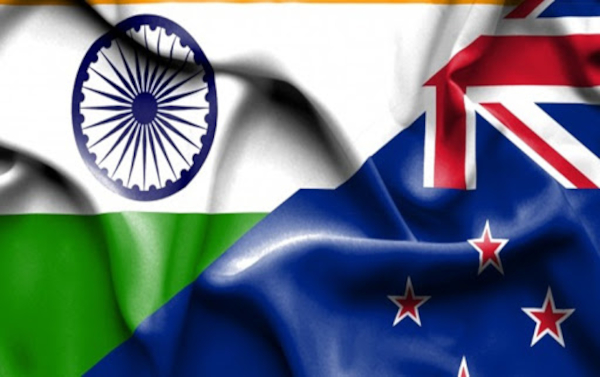
Prime Minister Narendra Modi’s official visit to New Zealand on 10 and 11 July 2026 marked a decisive expansion of India–New Zealand relations, with both countries elevating their bilateral engagement to a Strategic Partnership and adopting a Roadmap to 2030 covering defence, maritime security, trade, agriculture, tourism, education, science, culture and people-to-people relations.
The visit to Auckland, undertaken at the invitation of New Zealand Prime Minister Christopher Luxon, was the first visit by an Indian Prime Minister to New Zealand in 40 years. Prime Minister Modi received a ceremonial welcome at Government House, held comprehensive bilateral discussions with Prime Minister Luxon, interacted with business leaders and members of the Indian community, and viewed a presentation on New Zealand’s sporting innovation.
The summit built upon Prime Minister Luxon’s visit to India in March 2025, when the two countries launched negotiations for a Free Trade Agreement and expanded cooperation across defence, education, customs, horticulture, forestry and sport. The Auckland meeting converted that momentum into a structured long-term partnership supported by new agreements, institutional mechanisms and economic targets.
India and New Zealand Establish Strategic Partnership
The central outcome of the visit was the elevation of bilateral relations to an India–New Zealand Strategic Partnership. The two leaders endorsed the India–New Zealand Strategic Partnership: Roadmap to 2030, which will guide cooperation between ministries, government agencies and other stakeholders over the next four years.
The roadmap seeks to provide continuity and measurable progress across political engagement, trade, defence, maritime security, agriculture, tourism, culture, sport, education, technology and Indo-Pacific cooperation. India and New Zealand will establish a regular Foreign Ministers’ Dialogue, continue annual senior officials’ meetings and promote reciprocal ministerial and parliamentary exchanges.
The Strategic Partnership reflects the growing convergence between the two democratic maritime nations. India offers New Zealand access to one of the world’s largest and fastest-expanding markets, while New Zealand brings expertise in agriculture, food processing, dairy technology, education, sports science, maritime administration and climate-resilient development.
Free Trade Agreement Concluded
One of the most significant economic outcomes was the conclusion and signing of a comprehensive India–New Zealand Free Trade Agreement. Both leaders called for its early entry into force and effective implementation.
The agreement is expected to reduce trade barriers, improve market access, encourage investment and create new opportunities for businesses in both countries. India and New Zealand set an aspirational target of doubling bilateral trade in goods and services to NZ$7 billion, approximately ₹35,000 crore, by 2030.
The two governments encouraged businesses to develop partnerships in agriculture, food processing, digital technology, clean energy, innovation, skills, education, tourism and manufacturing. New Zealand also expressed its readiness to support India’s Viksit Bharat 2047 vision through investment, knowledge-sharing and sectoral cooperation.
The FTA provides the economic foundation for a broader relationship that increasingly combines trade with technology, sustainability, supply-chain resilience and human-capital development.
Major Expansion of Maritime and Defence Cooperation
Defence and maritime security emerged as major pillars of the summit. India’s Ministry of Defence and the New Zealand Defence Force concluded a Memorandum of Arrangement on Maritime Cooperation, creating a framework for dialogue, coordination, information exchange and joint activities in the Indo-Pacific.
A separate implementation arrangement on hydrography and nautical cartography will support the joint production of navigational charts, hydrographic data sharing, professional training and capacity-building.
The Indian Navy and the New Zealand Defence Force also concluded a Mutual Logistics Support Arrangement. The arrangement will facilitate reciprocal logistical assistance during approved exercises, deployments, port visits and maritime operations. This can improve the ability of the two countries’ naval forces to sustain longer deployments and cooperate more effectively across the Indo-Pacific.
The leaders welcomed the possibility of bilateral naval exercises under the new maritime cooperation framework. They also agreed to establish an annual Maritime Security Dialogue to strengthen coordination and information-sharing.
New Zealand nominated maritime security as its priority pillar under the India-led Indo-Pacific Oceans Initiative. Cooperation under this framework will include efforts to combat illegal, unreported and unregulated fishing, an issue that directly affects marine resources, coastal communities and Pacific Island economies.
India and New Zealand also recognised their successful cooperation under Combined Task Force 150 during 2025, when New Zealand held command and India served as deputy commander. The multinational maritime force works against narcotics trafficking, terrorism and illicit activity in the Middle East and the western Indian Ocean.
Joint Working Group on Counter-Terrorism
The two countries established a Joint Working Group on Counter-Terrorism, providing a dedicated platform for intelligence exchange, policy coordination, information-sharing and joint efforts against violent extremism and terrorist networks.
Prime Ministers Modi and Luxon condemned terrorism in all its forms, including cross-border terrorism, and called for a consistent zero-tolerance approach. They stressed the need to disrupt terrorist financing, eliminate safe havens, dismantle physical and online terror infrastructure and ensure swift accountability for perpetrators and their supporters.
Both sides condemned the April 2025 terrorist attack in Pahalgam and the November 2025 terror incident near Delhi’s Red Fort. They also called for sustained international action against organisations and individuals designated under United Nations sanctions mechanisms.
India and New Zealand will also deepen law-enforcement cooperation against narcotics trafficking, financial crimes, cyber-enabled offences, people smuggling, human trafficking and organised criminal networks.
Agriculture, Dairy and Kiwifruit Cooperation
Agriculture forms a natural area of cooperation between India and New Zealand. A new Memorandum of Cooperation on animal husbandry and dairying will enable technical collaboration, knowledge-sharing and the exchange of best practices.
New Zealand’s expertise in dairy productivity, animal health, food safety, post-harvest management, sustainability and agricultural value chains can support India’s efforts to improve farmer incomes, modernise processing and strengthen export competitiveness.
Under the Agricultural Productivity Partnership connected with the FTA, the two countries launched a Kiwifruit Action Plan. Two Centres of Excellence for kiwifruit will be established in Nagaland and Uttarakhand, combining agricultural research, farmer training, productivity enhancement and skills development.
India and New Zealand also plan cooperation on improving the productivity of apples and honey. These initiatives can help Indian farmers gain access to better cultivation practices, planting material, disease management techniques, cold-chain systems and international marketing expertise.
Tourism and Direct Air Connectivity
A Memorandum of Arrangement on tourism was signed to increase visitor flows, strengthen economic links and promote greater understanding of the two countries’ cultures.
The two Prime Ministers encouraged airlines to establish direct non-stop flights between India and New Zealand. Direct air connectivity would support tourism, education, trade, business travel and family links while reducing travel times for the large Indian community living in New Zealand.
The tourism arrangement can also encourage cooperation among travel operators, hospitality businesses, cultural institutions and destination-management organisations.
Sport and People-to-People Relations
India and New Zealand adopted a Joint Action Plan on Sport, covering high-performance training, sports medicine, sports science, coaching, athlete development, participation programmes and exchanges between national sporting organisations.
Sport holds a special place in India–New Zealand relations, particularly through cricket, hockey and other competitive disciplines. The action plan extends this connection into professional training, scientific research, athlete welfare and sports business.
The two countries also welcomed events marking 100 Years of Unity Through Sport in 2026. These celebrations recognise the historic sporting links that have brought Indian and New Zealand communities closer over generations.
The Indian community in New Zealand was described as an important living bridge between the two nations. Its contributions to business, education, public service, culture, professional life and sport have strengthened the foundations of the bilateral relationship.
Culture and Maritime Heritage
An Arrangement on Cultural Cooperation will promote exchanges in the arts, heritage conservation, museum partnerships and cultural programmes.
A separate agreement between India’s National Maritime Heritage Complex at Lothal in Gujarat and the New Zealand Maritime Museum will support the development of the Lothal project through institutional collaboration and mutually agreed initiatives.
The partnership carries strong symbolic value. Lothal represents India’s ancient maritime and commercial heritage, while New Zealand’s history and national identity are deeply connected to the Pacific Ocean. Cooperation between the two institutions can highlight the long maritime traditions of both civilisations.
The leaders also welcomed continued engagement in traditional medicine and broader cultural exchanges aimed at deepening mutual understanding.
Education, Antarctic Research and Food Technology
Education, science and research gained further momentum during the visit. India’s National Centre for Polar and Ocean Research in Goa signed an agreement with the University of Canterbury in New Zealand to promote cooperation in Antarctic research.
The partnership will support joint research, academic exchanges, training and capacity-building in polar and ocean sciences. Both countries have strong interests in Antarctic governance, climate research, marine ecosystems and the study of environmental changes affecting the Southern Ocean.
India’s National Institute of Food Technology Entrepreneurship and Management at Kundli also signed an agreement with Massey University. The partnership will support research, academic collaboration, student mobility and educational exchanges in food science, processing and entrepreneurship.
The leaders encouraged universities, research institutions, government agencies and industries to explore further partnerships in agriculture, climate science, digital transformation, emerging technologies and innovation.
Disaster Management and Climate Resilience
India’s National Disaster Management Authority and New Zealand’s National Emergency Management Agency signed a cooperation agreement covering earthquake resilience, tsunami preparedness, coastal hazards, emergency response and institutional capacity-building.
India and New Zealand both face significant natural-hazard risks. New Zealand has extensive experience in earthquake preparedness, while India has developed considerable capabilities in cyclone forecasting, disaster response, resilient infrastructure and large-scale emergency management.
The partnership will enable policy dialogue, technical exchanges, professional training and the sharing of operational practices that can improve community and infrastructure resilience.
Prime Minister Modi also welcomed New Zealand’s decision to join the Global Biofuels Alliance, expanding international cooperation on sustainable fuels and the transition towards cleaner energy systems.
Cooperation in the Indo-Pacific and United Nations
The two leaders reaffirmed their support for a free, open, peaceful and prosperous Indo-Pacific in which sovereignty, territorial integrity, freedom of navigation and international law are respected.
India and New Zealand agreed to strengthen cooperation through ASEAN-led regional institutions, including the East Asia Summit, the ASEAN Regional Forum and the ASEAN Defence Ministers’ Meeting Plus.
New Zealand reaffirmed its support for India’s permanent membership of an expanded and reformed United Nations Security Council. It also acknowledged the value of India joining the Nuclear Suppliers Group, particularly in the context of India’s clean-energy ambitions and non-proliferation record.
The leaders discussed global supply-chain security, energy-market stability, freedom of maritime commerce and the economic vulnerability of Pacific Island countries to disruptions in fuel and shipping routes.
A New Chapter in India–New Zealand Relations
Prime Minister Modi’s 2026 visit has transformed India–New Zealand engagement from a steadily developing relationship into a structured Strategic Partnership.
The combination of an FTA, a ₹35,000-crore trade target, maritime logistics cooperation, hydrographic collaboration, counter-terrorism coordination, agricultural partnerships, scientific research and stronger cultural links gives the relationship a broad institutional foundation.
The Roadmap to 2030 provides both governments with a mechanism to monitor progress and convert agreements into practical projects. Ministers and senior officials have been directed to remain closely engaged and regularly review implementation.
The historic visit signals that India and New Zealand now view each other as long-term partners in Indo-Pacific security, economic growth, maritime cooperation, sustainable agriculture, education, innovation and cultural exchange.
References
- Press Information Bureau, Government of India. “Prime Minister’s Visit to New Zealand: List of Outcomes.” 11 July 2026.
https://www.pib.gov.in/PressReleasePage.aspx?PRID=2283528®=48&lang=1 - Press Information Bureau, Government of India. “Joint Statement on the Official Visit of Prime Minister Narendra Modi to New Zealand.” 11 July 2026.
https://www.pib.gov.in/PressReleasePage.aspx?PRID=2283527®=48&lang=1
You may also like
-
PM Modi Meets Nigerian Vice President Kashim Shettima, Reviews Strategic Partnership at BRICS Summit
-
PM Modi Meets African Union Chairperson Évariste Ndayishimiye, Calls for Early India-Africa Forum Summit
-
India and Kazakhstan Agree to Deepen Cooperation in Defence, Energy, Critical Minerals and Emerging Technologies
-
India and Uganda Seek Deeper Technology, Investment and Capacity-Building Partnership at BRICS Summit
-
India and Philippines Agree to Deepen Defence, Trade, Space and Fintech Cooperation at BRICS Summit
