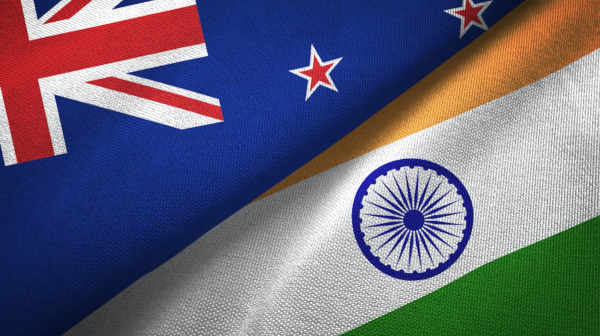
Prime Minister Narendra Modi arrived in Auckland on 10 July 2026 for a two-day official visit to New Zealand, marking the first visit by an Indian Prime Minister to the country in nearly four decades. New Zealand Prime Minister Christopher Luxon personally received him at the airport, where the two leaders exchanged a warm greeting before the visiting Prime Minister was accorded a ceremonial welcome.
The Auckland visit forms the final leg of Prime Minister Modi’s three-nation journey covering Indonesia, Australia and New Zealand. It carries considerable diplomatic significance because it elevates a relationship that has gathered momentum across trade, defence, education, mobility, sports and cultural engagement during the past two years. The Ministry of External Affairs described the visit as an opportunity to review the entire spectrum of bilateral relations and identify new areas of practical cooperation.
A Special Welcome in Auckland
Prime Minister Luxon’s presence at the airport reflected the importance New Zealand attached to the visit. Members of the Indian community also gathered to welcome Prime Minister Modi with traditional music, cultural performances and Indian flags. The Prime Minister praised the diaspora for carrying India’s civilisational heritage across generations while contributing actively to New Zealand’s society and economy.
Auckland’s iconic Sky Tower was illuminated in the colours of the Indian tricolour to mark the occasion. The gesture added a symbolic dimension to a visit already described by both sides as a historic milestone in bilateral relations.
The welcome also highlighted the central role of the Indian community in connecting the two countries. Families of Indian origin have established themselves across commerce, healthcare, education, information technology, agriculture, hospitality and public life in New Zealand. Their cultural organisations, temples, festivals, language schools and community associations have helped maintain close links with Bharat while enriching New Zealand’s multicultural character.
Building on Recent Diplomatic Momentum
Prime Minister Modi’s visit follows the official visit of Prime Minister Christopher Luxon to India in March 2025. During that visit, the two leaders agreed to expand cooperation in trade, investment, defence, education, science, technology, agriculture, sports and people-to-people engagement. Prime Minister Luxon also invited Prime Minister Modi to undertake a reciprocal visit to New Zealand.
Senior-level engagement continued through visits by New Zealand Deputy Prime Minister and Foreign Minister Winston Peters, Foreign Office Consultations and meetings between the two prime ministers on the sidelines of international gatherings. These interactions created the political foundation for faster progress in economic and strategic cooperation.
The Auckland summit therefore represents the culmination of a sustained diplomatic process. The leaders are expected to assess the implementation of earlier decisions while expanding cooperation into emerging technologies, resilient supply chains, maritime security, clean energy, food processing and innovation.
Free Trade Agreement Transforms Economic Relations
The India–New Zealand Free Trade Agreement has emerged as the economic anchor of the renewed partnership. Signed in April 2026 after negotiations were completed within a relatively short period, the agreement provides duty-free access for all Indian exports entering New Zealand. It also includes a New Zealand investment commitment of approximately 20 billion US dollars in India over 15 years.
The agreement creates significant opportunities for Indian textiles, apparel, leather products, engineering goods, pharmaceuticals, gems and jewellery, processed food and manufactured products. It also supports micro, small and medium enterprises and women-led businesses seeking access to international markets.
The services component opens opportunities in information technology, professional services, healthcare, traditional medicine, education and skilled mobility. New Zealand has offered commitments across 118 services sectors, including facilitative provisions for Ayurveda, yoga and traditional medicine. The arrangement also supports post-study work opportunities for Indian students and includes a quota for skilled Indian professionals in sectors important to both economies.
Bilateral trade crossed 2.07 billion US dollars in 2024, reflecting growing commercial exchanges even before the full benefits of the new trade framework began to emerge. The agreement creates a platform for trade to expand towards the five-billion-dollar level while encouraging deeper investment partnerships in manufacturing, infrastructure, innovation, agriculture and services.
Defence and Indo-Pacific Cooperation
Defence cooperation has become an increasingly important part of the relationship. India and New Zealand share an interest in a peaceful, stable and inclusive Indo-Pacific supported by respect for international law, secure sea lanes and stronger regional institutions.
During Prime Minister Luxon’s 2025 visit to India, the two countries agreed to expand defence exchanges, training, maritime cooperation and contacts between their armed forces. The Auckland talks provide an opportunity to translate these commitments into regular exercises, professional exchanges, maritime-domain awareness and cooperation in humanitarian assistance and disaster relief.
New Zealand’s position in the South Pacific and India’s growing role across the Indian Ocean give the partnership a wider geographical relevance. Both countries can work together on maritime safety, climate resilience, disaster response, cyber security and the protection of critical infrastructure.
The visit also complements India’s Act East Policy and MAHASAGAR vision, which seek inclusive development, maritime security and stronger partnerships throughout the Indo-Pacific.
Education, Skills and Mobility
Education has long been one of the strongest human connections between India and New Zealand. Indian students contribute to New Zealand’s universities, institutes and vocational-training ecosystem, while New Zealand institutions are increasingly exploring academic partnerships and collaborative programmes in India.
The new economic framework can encourage joint degrees, research partnerships, faculty exchanges and cooperation in agricultural science, biotechnology, renewable energy, sports science and digital technology. Clearer mobility pathways and post-study employment provisions can also make educational engagement more closely aligned with the skill requirements of both countries.
India’s large talent base and New Zealand’s specialised educational institutions create natural opportunities in professional training, healthcare, hospitality, engineering and advanced agriculture. Institutional partnerships can allow students to complete portions of their studies in both countries while supporting research and innovation.
A Century of Sporting Connections
Sport occupies a distinctive place in India–New Zealand relations. Cricket remains the most visible link, with players and supporters in both countries sharing a deep appreciation for the game. Hockey provides an older historical connection stretching back to the first New Zealand hockey team’s tour of India in 1926.
The countries are commemorating a century of sporting links in 2026. A Memorandum of Cooperation in Sports signed during Prime Minister Luxon’s 2025 visit expanded possibilities for exchanges involving athletes, coaches, sports scientists and high-performance institutions.
Prime Minister Modi’s programme in Auckland includes interaction with prominent sporting personalities. This engagement reflects the potential for cooperation in cricket, hockey, sports medicine, athlete development, coaching and sports technology.
Culture and the Living Bridge
The Indian community remains the living bridge supporting the relationship. Celebrations of Diwali, Holi, yoga and Indian cultural traditions have become familiar features of New Zealand’s social landscape. Indian cuisine, cinema, music and classical traditions also enjoy a growing audience.
Prime Minister Modi’s interaction with the diaspora gives recognition to its role in strengthening cultural understanding and economic engagement. The community contributes both to New Zealand’s development and to India’s wider engagement with the Pacific region.
The relationship also benefits from shared democratic values, respect for cultural diversity and a strong enthusiasm for education and sport. These social foundations give bilateral agreements a deeper and more durable character.
A New Phase in India–New Zealand Relations
The historic Auckland visit signals that India and New Zealand are ready to transform goodwill into a comprehensive modern partnership. The Free Trade Agreement provides a powerful economic foundation, while defence, education, technology, agriculture, mobility and sports offer multiple avenues for expansion.
Prime Minister Modi’s arrival after a gap of nearly four decades gives the relationship renewed political visibility. His meetings with Prime Minister Luxon, business leaders, sporting personalities and members of the Indian community can help connect government-level agreements with institutions, enterprises and people.
India and New Zealand stand at opposite ends of the Indo-Pacific, yet their democratic traditions, maritime outlook, economic complementarities and human connections bring them increasingly closer. The Auckland visit represents a bridge between the historic ties of the past and an ambitious partnership shaped for the decades ahead.
References
- News On AIR. “PM Modi Receives Rousing Welcome Upon His Arrival in Auckland: First Indian PM to Visit New Zealand in Four Decades.” 10 July 2026.
https://newsonair.gov.in/auckland-abuzz-ahead-of-pm-narendra-modis-new-zealand-visit/ - DD News. “PM Modi Arrives in New Zealand on First Visit by an Indian PM in 40 Years.” 10 July 2026.
https://ddnews.gov.in/en/pm-modi-arrives-in-new-zealand-on-first-visit-by-an-indian-pm-in-40-years/ - Press Information Bureau, Government of India. “Prime Minister’s Visit to Indonesia, Australia and New Zealand.” 3 July 2026.
https://www.pib.gov.in/PressReleasePage.aspx?PRID=2280912 - DD News. “PM Modi to Visit Indonesia, Australia and New Zealand from July 6–11; to Hold Bilateral Talks, Address Diaspora.” 3 July 2026.
https://ddnews.gov.in/en/pm-modi-to-visit-indonesia-australia-and-new-zealand-from-july-6-11-to-hold-bilateral-talks-address-diaspora/ - DD News. “Indian High Commissioner Calls PM Modi’s New Zealand Visit Historic, First by an Indian PM in 40 Years.” 9 July 2026.
https://ddnews.gov.in/en/indian-high-commissioner-calls-pm-modis-new-zealand-visit-historic-first-by-an-indian-pm-in-40-years/ - Ministry of External Affairs, Government of India. “India–New Zealand Joint Statement.” 17 March 2025.
https://www.mea.gov.in/bilateral-documents.htm?dtl/39197/India__New_Zealand_Joint_Statement_March_17_2025 - Press Information Bureau, Government of India. “India–New Zealand Free Trade Agreement Signed.” 27 April 2026.
https://static.pib.gov.in/WriteReadData/specificdocs/documents/2026/apr/doc2026427857501.pdf - DD News. “India–New Zealand Trade Reaches USD 2.07 Billion in 2024 as FTA Talks Gather Pace.” 10 July 2026.
https://ddnews.gov.in/en/india-new-zealand-trade-reaches-usd-2-07-billion-in-2024-as-fta-talks-gather-pace/ - News On AIR. “India, New Zealand Celebrate 100 Years of Sporting Ties as Hockey Strengthens Friendship.” 10 July 2026.
https://newsonair.gov.in/india-new-zealand-celebrate-100-years-of-sporting-ties-as-hockey-strengthens-friendship/ - DD News. “PM Modi Begins Three-Nation Tour to Indonesia, Australia and New Zealand with Focus on Indo-Pacific, Trade and Diaspora.” 6 July 2026.
https://ddnews.gov.in/en/pm-modi-begins-three-nation-tour-to-indonesia-australia-and-new-zealand-with-focus-on-indo-pacific-trade-and-diaspora/
All online sources were referred by author on 10 July 2026.
You may also like
-
India and Kazakhstan Agree to Deepen Cooperation in Defence, Energy, Critical Minerals and Emerging Technologies
-
India and Uganda Seek Deeper Technology, Investment and Capacity-Building Partnership at BRICS Summit
-
India and Philippines Agree to Deepen Defence, Trade, Space and Fintech Cooperation at BRICS Summit
-
India and Uruguay Agree Trade and Connectivity Roadmap as Montevideo Ratifies International Solar Alliance
-
Ramaphosa Calls for New Era in India–South Africa Economic Ties, Targets Green Energy, Minerals and Infrastructure
