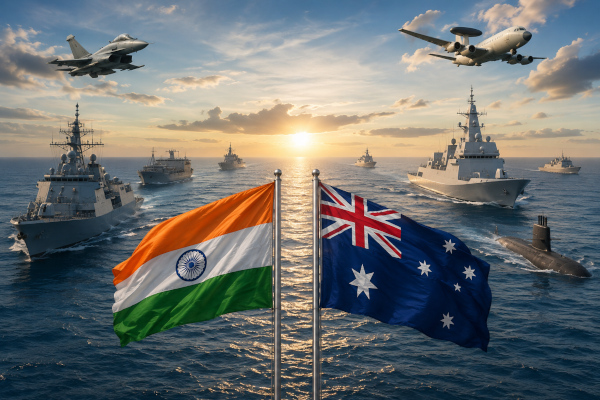
India and Australia have taken a major step toward building a deeper defence and security partnership with the release of the India-Australia Joint Declaration on Defence and Security Cooperation during Prime Minister Shri Narendra Modi’s visit to Australia. The declaration reflects the growing strategic convergence between the two countries and places their partnership firmly within the larger vision of an open, peaceful, stable and prosperous Indo-Pacific.
The declaration builds on the Comprehensive Strategic Partnership established in 2020 and the earlier India-Australia Joint Declaration on Security Cooperation of 2009. Over the years, India and Australia have moved from routine diplomatic engagement to a more structured strategic relationship involving the Foreign Ministers’ Framework Dialogue, the 2+2 Foreign and Defence Ministerial Dialogue and the Defence Ministers’ Dialogue. This new declaration gives that relationship a stronger operational and security-driven direction.
At the centre of the declaration is the shared understanding that the Indo-Pacific is facing a period of geostrategic uncertainty. India and Australia have called for disputes to be resolved peacefully, without coercion or the use of force, and in accordance with international law. This language is significant because it links the bilateral partnership to the wider regional order, especially the need to protect sovereignty, territorial integrity, freedom of navigation, freedom of overflight and the United Nations Convention on the Law of the Sea.
The declaration clearly identifies the maritime domain as a central area of cooperation. For India, the Indian Ocean is vital for trade, energy flows, naval reach and regional security. For Australia, the Indo-Pacific is central to national security, sea lines of communication and regional influence. The proposed India-Australia Maritime Security Collaboration Roadmap will increase the depth, sophistication and regularity of maritime cooperation between the two countries. This can strengthen maritime domain awareness, operational coordination, joint exercises and crisis response in the Indian Ocean and the wider Indo-Pacific.
A major defence outcome is the commitment to increase the complexity of joint exercises, including with partners. India and Australia already work together in formats such as the Quad, and the declaration opens the door for more advanced and integrated military engagements. More complex exercises can improve interoperability between the armed forces, sharpen operational coordination, and prepare both countries for joint responses to maritime security threats, humanitarian crises and regional contingencies.
The declaration also places strong emphasis on interoperability and information sharing. This is one of the most important aspects of modern military cooperation. Interoperability allows armed forces to operate together during exercises, deployments, evacuation missions, disaster relief operations and maritime security tasks. Information sharing improves situational awareness and helps both sides respond faster to emerging risks in the Indo-Pacific.
Another important element is the expansion of aircraft deployments from each other’s territories. This has clear strategic value. It can improve reach, familiarity with operating environments and coordination between air forces. It also signals a higher level of trust between the two countries. In practical terms, such deployments can support exercises, surveillance missions, logistics cooperation and rapid response operations.
The declaration also gives defence industry cooperation a stronger push. India and Australia have committed to encouraging defence industrial integration, industry engagement and supply chain resilience. This is highly relevant as India expands its defence manufacturing base under Atmanirbhar Bharat and Australia looks for trusted defence technology and industrial partners. Cooperation in advanced defence science and technology can open opportunities in areas such as maritime systems, surveillance platforms, autonomous technologies, cyber defence, communications, undersea awareness and logistics support.
Cyber security and critical technologies form another key pillar of the declaration. Through the Australia-India Partnership on Cyber, Critical Technologies and Supply Chains, both countries aim to strengthen cooperation in cyber resilience, information sharing and strategic technologies. In the modern security environment, cyber threats, digital infrastructure vulnerabilities and supply chain disruptions can affect national security as seriously as conventional military challenges. The India-Australia partnership therefore extends beyond ships, aircraft and exercises into the digital and technological foundations of security.
Counter-terrorism cooperation has also been given a clear operational focus. India and Australia have committed to increasing information sharing on terrorist threats, including entities and individuals. The declaration identifies new and emerging technologies, terror financing, critical infrastructure, crowded spaces, the maritime domain and online radicalisation as important areas for collaboration. This is important for India because terrorism remains a core national security concern, while Australia also views violent extremism and transnational threats as major security challenges.
The declaration also strengthens cooperation in humanitarian assistance and disaster relief. India and Australia have committed to information sharing, expert exchanges and joint HADR exercises, including through the Quad Indo-Pacific Logistics Network. This gives the partnership a practical regional role. The Indo-Pacific is highly vulnerable to cyclones, earthquakes, tsunamis, floods and climate-related disasters. Coordinated India-Australia action can improve disaster response, evacuation operations and emergency logistics across the region.
The declaration’s reference to cooperation with the United States and Japan is also strategically important. It reinforces the Quad framework and confirms that India-Australia defence cooperation is part of a wider network of like-minded Indo-Pacific partnerships. At the same time, the declaration also mentions ASEAN, the Indian Ocean Rim Association and the Pacific Islands Forum, showing that both countries want regional institutions to remain central to Indo-Pacific stability.
This declaration strengthens India’s role as a net security provider in the Indian Ocean and a key Indo-Pacific power. It also supports India’s wider strategic goals: stronger maritime security, deeper defence partnerships, resilient supply chains, defence industrial growth and improved crisis-response capability. For Australia, the declaration consolidates India as a major strategic partner in the Indo-Pacific and gives Canberra a stronger link to the Indian Ocean security architecture.
The India-Australia Joint Declaration on Defence and Security Cooperation is therefore more than a diplomatic document. It is a roadmap for a more advanced military, maritime, cyber, industrial and regional security partnership. It brings together hard security, maritime stability, defence technology, counter-terrorism, HADR and supply chain resilience under one strategic framework. In the coming years, the real value of this declaration will be measured through joint exercises, defence industrial projects, maritime coordination, cyber cooperation and regional crisis response.
India and Australia are preparing for a more complex Indo-Pacific by building a stronger, more practical and more trusted defence partnership. This declaration marks a new phase in that journey.
You may also like
-
India and UK Expand Defence Partnership With Joint Exercises, R&D and Ten-Year Industrial Roadmap
-
India and Mauritius Sign Oil and Gas Cooperation Pact, Deepen Long-Term Energy Partnership
-
EndureAir Unveils VAHAK-6 Multi-UAV Mothership as India Pushes Deeper Into Drone Teaming
-
Big Bang Boom Solutions — Building Indigenous Counter-Drone Defences for India’s New Battlefield
-
DIASPRO Develops Indigenous SATEEK Digital Ballistic Computer to Modernise T-90 Tank Fire-Control Systems
