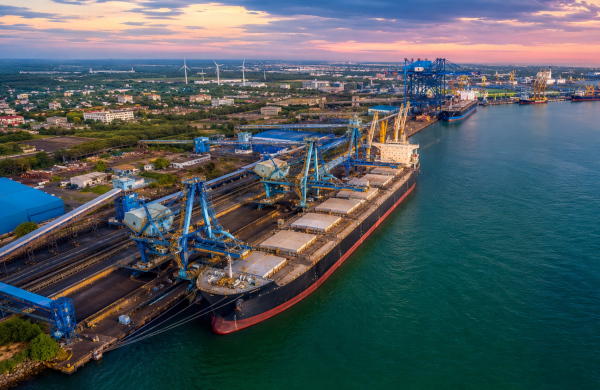
Kamarajar Port Limited has achieved a major maritime milestone by becoming India’s second Major Port, after Visakhapatnam Port, to offer an operational draft of 18 metres. The achievement follows the completion of the Capital Dredging Phase VI project, enabling the port to handle fully laden Capesize vessels carrying cargo parcels of up to 1,70,000 deadweight tonnage.
The project marks a significant upgrade for India’s east coast trade infrastructure. With deeper channels and berth-side capacity, Kamarajar Port can now receive larger bulk carriers, allowing shipping lines to move more cargo per vessel. This is expected to lower freight costs through economies of scale, improve operational efficiency, raise cargo-handling capacity and strengthen India’s competitiveness in EXIM trade.
Capital Dredging Phase VI was carried out at an investment of about ₹440 crore. The work involved deepening the outer approach channel from 20 metres to 23 metres, the inner entrance channel from 19 metres to 22 metres, and strengthening the harbour basin, berths and associated navigational areas to support 18-metre draft operations. The Ministry of Ports, Shipping and Waterways has described the development as part of the larger effort to make Kamarajar Port “Cape Compliant.”
The upgrade is especially important for bulk cargo movement. Capesize vessels are among the largest dry bulk carriers used globally for commodities such as coal, iron ore and other heavy cargo. By joining the league of deep-draft ports capable of handling such vessels, Kamarajar Port gains a stronger position in international bulk cargo logistics and becomes more attractive for large-volume importers and exporters.
Located on the Coromandel Coast about 24 km north of Chennai, Kamarajar Port is India’s first corporatised Major Port and operates under the landlord port model. The port began with a capacity of 12 MMTPA and has grown into a diversified maritime gateway with a present handling capacity of 58.44 MMTPA. Its long-term expansion plan projects capacity growth to 254.52 MTPA by 2047 through new terminals, public-private partnership projects and captive cargo facilities.
Kamarajar Port was originally developed to handle thermal coal for power generation, particularly for nearby thermal power stations. Over time, it has evolved into a multi-cargo hub handling bulk cargo, liquid cargo, automobiles, containers, LNG and project cargo. The port’s infrastructure includes specialised cargo terminals, mechanised handling systems, road and rail connectivity, and modern navigation and monitoring systems.
The port’s latest operating data reflects its growing role in India’s maritime economy. In FY 2025–26, Kamarajar Port handled 49.08 million tonnes of cargo, up from 48.41 million tonnes in FY 2024–25 and 45.28 million tonnes in FY 2023–24. Its container terminal handled 7,00,639 TEUs in FY 2025–26, while the port handled 1,008 cargo vessels during the same year.
The port has also invested in modern operational systems to improve cargo movement and ease of doing business. Its Vessel Traffic Management System uses radar, AIS, CCTV surveillance and meteorological aids for safe navigation up to 24 nautical miles offshore. The port has also upgraded to RFID and ANPR-based gate control, helping reduce container trailer movement time from the truck parking yard to the container terminal from 10 minutes to 2 minutes.
Kamarajar Port’s deep-draft upgrade comes at a time when India is pushing for larger ports, faster cargo evacuation and lower logistics costs under Maritime India Vision 2030 and Maritime Amrit Kaal Vision 2047. For Tamil Nadu’s industrial belt, Chennai’s automobile and manufacturing ecosystem, energy imports and east coast trade corridors, the 18-metre draft capability gives Kamarajar Port a stronger strategic role.
With the completion of Capital Dredging Phase VI, Kamarajar Port has moved from being a regional cargo gateway to a nationally significant deep-water maritime asset. The ability to handle larger Capesize vessels gives India another high-capacity Major Port on the east coast and strengthens the country’s ambition to build world-class, future-ready port infrastructure.
You may also like
-
India’s E-Commerce Platforms Record ₹24,000 Crore Festive Sales in Two Days as Meesho Reports 75% Surge in Orders
-
India’s Economic Warfare Challenge: Strategic Autonomy, Energy Security and the Rise of a Global Power
-
India-US Trade Deal Stalemate: Why Washington’s Tariff Pressure Has Failed to Secure an Agreement
-
US Double Standards in Foreign Policy: 16 Recent Cases Involving India, Russia, China and Global Trade
-
India’s Arctic Energy Ambitions: Russian Oil, LNG and a New Sea Route to Indian Ports
