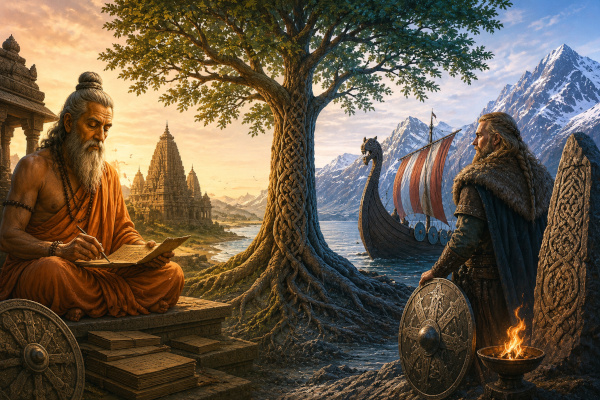
India and Norway may appear distant on the map, yet their cultural memory carries a deep linguistic connection that reaches back to the ancient Indo-European world. Long before modern diplomacy, before trade missions and embassies, the ancestors of Sanskrit and Old Norse belonged to a broad family of languages that once shared common roots. This makes the India–Norway cultural relationship more than a modern partnership; it is also a story of ancient words, shared sounds, sacred ideas and civilisational memory.
Sanskrit and Old Norse both belong to the wider Indo-European language family, with Sanskrit representing the ancient Indian linguistic tradition and Old Norse belonging to the North Germanic branch that later shaped Scandinavian languages. Old Norse later developed into the Scandinavian language world that shaped Norwegian, Icelandic, Danish, Swedish and Faroese. This means Sanskrit and Old Norse are not isolated languages. They are distant relatives, preserved in two great civilisational traditions: the Vedic world of India and the Norse world of Scandinavia. Old Norse is classified as a North Germanic language within the Indo-European group, while Sanskrit is one of the great classical languages of the Indo-European family.
The most striking evidence appears in family words. These are among the oldest and most stable words in any language because they belong to daily life, kinship and social identity. The Sanskrit word for mother is linked to mātṛ or mātā, while Old Norse uses móðir and modern Norwegian uses mor. The Sanskrit word for father is linked to pitṛ or pitā, while Old Norse uses faðir and modern Norwegian uses far. The Sanskrit word for brother is bhrātṛ, while Old Norse uses bróðir and modern Norwegian uses bror. Etymological sources trace “mother” through Proto-Indo-European mater, with Sanskrit matar- and Old Norse móðir among its descendants; “brother” is similarly traced through Proto-Indo-European bhrater- with Sanskrit bhrátar- and Old Norse bróðir as related forms.
These similarities are powerful because they show a shared ancestral layer beneath two distant cultures. A Norwegian child saying mor and an Indian tradition preserving mātṛ are separated by geography and centuries, yet they echo an older linguistic inheritance. The same pattern appears in bror and bhrātṛ, where the sound has changed but the ancestral relationship remains visible.
One reason these words look slightly different is the historical sound shift seen in Germanic languages. In Sanskrit, the older Indo-European sound is often preserved more clearly, while in Germanic languages certain sounds changed over time. This is why Sanskrit pitṛ and Old Norse faðir both mean father, even though one begins with “p” and the other with “f”. The similarity is not accidental; it belongs to the scientific study of historical linguistics.
The connection becomes even more fascinating when we look at sacred words. In Norse mythology, the Æsir are one of the great groups of gods, associated with divine power and cosmic order. Odin, Thor, Baldr and other major Norse deities belong to this divine family. In the Vedic world, the word Asura appears in early Sanskrit literature with meanings connected to lordship, power and divine authority. Later Hindu traditions developed more complex meanings for the word, but in the early Vedic layer, Asura could be an exalted title applied to powerful divine beings. Scholars commonly connect Sanskrit asura with Avestan ahura, and several etymological discussions also relate this wider Indo-Iranian sacred term to Old Norse Æsir.
This does not mean that Norse gods were copied from Indian gods, or that Vedic deities were copied from Norse mythology. The deeper and more respectful understanding is that both traditions preserved echoes of an ancient Indo-European sacred vocabulary. India developed the Vedic world of devas, yajna, rishis, mantras and dharma. Scandinavia developed the Norse world of Æsir, sagas, runes, sacred groves and heroic poetry. The two traditions grew in different lands, yet some of their deepest words appear to have emerged from an ancient shared linguistic background.
The Sanskrit–Norse connection also shows how culture travels through memory. Words such as mother, father and brother belong to the home. Words such as god, lord and divine power belong to worship. When both categories show deep linguistic parallels, they point towards a civilisation-level inheritance. India preserved this inheritance through the Vedas, Sanskrit grammar, oral recitation and philosophical literature. Norway preserved its branch through Old Norse poetry, sagas, mythology and later Scandinavian language traditions.
The Vedic tradition gave the world one of the most refined linguistic cultures in history. Sanskrit was not merely a spoken language; it became a sacred, philosophical and scientific medium. The precision of Sanskrit grammar, especially through the tradition of Pāṇini, allowed India to preserve ancient sounds and meanings with extraordinary discipline. This is why Sanskrit remains so valuable for understanding the Indo-European past.
Old Norse, in its own way, preserved another heroic and poetic branch of the same ancient family. The Norse sagas and Eddic poems carried memories of gods, kings, warriors, cosmic trees, creation stories and moral duties. The world of Odin and Thor was very different from the world of the Vedas, yet both traditions treated speech, poetry and sacred memory with great seriousness.
For India–Norway cultural relations, this linguistic bridge creates a beautiful civilisational theme. Modern India and Norway are connected through diplomacy, maritime cooperation, education, technology, green energy and trade. But behind the modern relationship stands a deeper cultural possibility: the recognition that Sanskrit and Old Norse belong to a shared ancient language family.
The first clearly documented institutional link between India and the Norwegian world came much later, during the Danish-Norwegian presence at Tranquebar in Tamil Nadu in the 1600s. Norway’s official account of India–Norway relations notes that a Danish-Norwegian trading station was established at Tranquebar, now Tharangambadi, in Tamil Nadu as early as the 1600s. The National Museum of Denmark records that the Danish trading station was established there in 1620, when Tranquebar was already a well-functioning Indian town with commercial activity, fishing communities and a fertile hinterland.
This gives India–Norway relations two layers. The first is the ancient linguistic and cultural layer, where Sanskrit and Old Norse stand as distant relatives within the Indo-European family. The second is the historical institutional layer, beginning with the Danish-Norwegian connection to Tamil Nadu in the early modern period. Together, they show that India and Norway are linked not only by modern diplomacy but also by long historical currents.
The Sanskrit–Norse connection should therefore be celebrated as a bridge of knowledge. It reminds us that civilisations can be distant yet related, different yet connected, unique yet part of a wider human story. India’s Sanskrit heritage and Norway’s Old Norse heritage both preserve echoes of an ancient world where language carried family, faith, memory and identity.
In this sense, India and Norway share more than a diplomatic relationship. They share a linguistic ancestry that reaches into the deep past. From mātṛ to mor, from pitṛ to faðir, from bhrātṛ to bróðir, and from Asura to Æsir, the words themselves become cultural messengers. They speak of a time when the roots of language spread across continents and later blossomed into distinct civilisations.
India’s Sanskrit culture and Norway’s Norse heritage stand today as two proud branches of an ancient linguistic tree. One grew in the sacred geography of the Vedas; the other in the fjords, forests and saga-world of Scandinavia. Their shared roots offer a powerful reminder that ancient cultures were never isolated islands. They were part of a vast human journey of language, imagination and sacred memory.
You may also like
-
Shaka in the Mahabharata: Central Asia’s Steppe Peoples, Nakula’s Campaign and the Alliance with Duryodhana
-
Yavana in the Mahabharata: Greek Connections, Pandava Campaigns and the Warriors of Kurukshetra
-
India and Sri Lanka Launch SAMHiTA Manuscript Digitisation Project to Preserve Ancient Buddhist Heritage
-
ASI Uses Ground-Penetrating Radar to Investigate Ancient Buddhist Stupa at Ujjain After Nearly 90 Years
-
Pahlava: The Parthian World Beyond India’s Northwestern Frontiers in the Mahabharata
