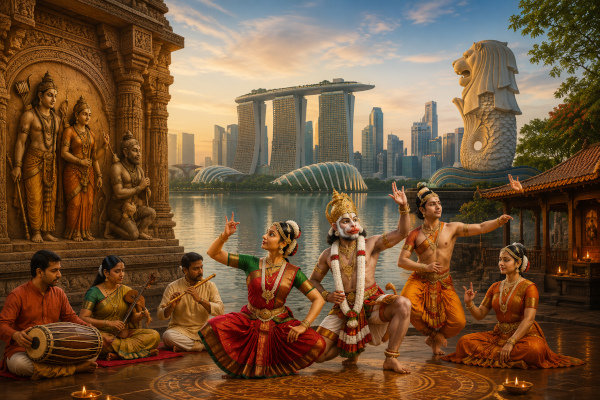
Singapore may be a modern island nation known for finance, technology and global trade, but beneath its urban skyline lives a deep cultural memory shaped by Asia’s ancient civilisational routes. Among the most beautiful expressions of this memory is the continued presence of the Ramayana through dance, theatre, festivals, storytelling, temple culture and multicultural performance.
The Ramayana reached Singapore through several streams. One stream came through the Indian community, especially Tamil, Telugu, Malayali, North Indian and other Hindu cultural traditions carried by migrants, traders, priests, teachers, artists and families. Another stream came through the wider Southeast Asian world, where the Ramayana had already taken root in countries such as Indonesia, Thailand, Cambodia, Laos, Myanmar and Malaysia. Singapore, standing at the crossroads of the Indian Ocean and Southeast Asia, became a natural meeting ground for these traditions.
This makes Singapore special in the Ramayana map. It is both Indian and Southeast Asian in its cultural inheritance. The epic is preserved through Indian classical forms such as Bharatanatyam, Odissi and storytelling, while also being understood as part of the wider Southeast Asian cultural family. In Singapore, the Ramayana is not only remembered as scripture or literature; it becomes performance, education, community identity and shared heritage.
The Indian Heritage Centre in Singapore has played an important role in keeping this civilisational memory alive. Its programmes on the influence of the Ramayana in Southeast Asia show how one ancient epic travelled across regions and was reimagined through different languages, costumes, music, dance systems and local cultural values. Such platforms help younger generations understand that the Ramayana is not confined to one geography. It is a living story that has moved across seas, kingdoms and communities.
Singapore’s cultural groups have also presented Ramayana-inspired productions for modern audiences. Maya Dance Theatre’s Ramayana performances have used dance-drama to bridge cultures through multi-racial Singaporean artistes. Apsaras Arts, one of Singapore’s important Indian dance institutions, has brought Ramayana themes to the stage through productions inspired by Sita, Hanuman and other epic characters. These performances show how the Ramayana continues to speak to contemporary society through beauty, movement and moral imagination.
The story’s appeal in Singapore lies in its universal values. Rama represents duty, discipline and ethical leadership. Sita represents strength, dignity and inner resolve. Hanuman represents devotion, courage and service. Lakshmana represents loyalty. Bharata represents sacrifice and restraint. These ideals are easily understood across communities because they belong to the moral vocabulary of family, society and public life.
Singapore’s multicultural environment gives the Ramayana a unique expression. The epic can be performed by Indian artistes, interpreted by Southeast Asian dancers, watched by audiences from many backgrounds and studied as part of Asia’s shared cultural heritage. This makes the Ramayana a bridge between communities rather than a boundary between them.
The idea of Akhand Bharat, when understood in a positive cultural sense, fits naturally into this story. Akhand Bharat here does not mean political expansion or territorial claim. It means the unbroken civilisational flow of Bharat’s ideas, stories, values, trade routes, spiritual traditions and artistic forms across Asia. The Ramayana is one of the finest examples of this civilisational unity. It travelled without conquest, adapted without losing its essence, and became local without ceasing to be connected to Bharat.
Singapore’s place in this civilisational world is important because it stands where Indian Ocean culture meets Southeast Asian culture. For centuries, ships carried merchants, monks, texts, rituals, languages, sculptures, food traditions and stories between India and Southeast Asia. The Ramayana moved through these maritime routes and became part of the cultural imagination of the region. Singapore, located along these routes, reflects that long memory.
In this sense, Singapore shows the gentlest and strongest form of India’s ancient influence: cultural attraction. The Ramayana did not require force to travel. Its power came from storytelling, ethics, devotion, performance and beauty. Communities adopted it because it offered meaning. Artists performed it because it offered drama. Kings respected it because it offered a model of righteous leadership. Families preserved it because it taught values across generations.
The Singaporean Ramayana tradition also connects with the wider Southeast Asian Ramayana family. Thailand has the Ramakien, Cambodia has the Reamker, Laos has Phra Lak Phra Lam, Indonesia has Ramayana ballet and wayang traditions, and Malaysia has Hikayat Seri Rama. Singapore brings these traditions into conversation through festivals, academic platforms, diaspora performance and regional cultural exchange.
This is why Ramayana in Singapore should be seen as part of a larger Asian cultural network. It is not merely a story carried by Indians abroad. It is a civilisational thread connecting India with Southeast Asia. It reminds us that Bharat’s cultural presence spread through wisdom, trade, faith, family, scholarship and art.
For the Indian community in Singapore, Ramayana performances help preserve roots. For young Singaporeans of Indian origin, these productions become a way to understand ancestry, language, dharma and identity. For non-Indian audiences, they open a window into one of Asia’s greatest epics. For Southeast Asian cultural practitioners, they create a shared platform to explore how different societies shaped the same story in their own way.
The Ramayana’s continued presence in Singapore is also a reminder that tradition can thrive in modern settings. A global city can still honour ancient wisdom. A digital economy can still make space for classical dance. A multicultural society can still celebrate a story that began thousands of years ago and continues to inspire new artistic forms.
Singapore’s Ramayana journey is therefore a story of continuity, adaptation and harmony. It shows how Indian civilisation travelled across the seas and became part of a larger Asian cultural family. It shows how Akhand Bharat, understood as a cultural and spiritual continuum, lives through memory, performance, values and shared heritage.
In Singapore, the Ramayana is not a relic of the past. It is performed, taught, reinterpreted and celebrated. It stands as a luminous bridge between Bharat and Southeast Asia, between ancient dharma and modern society, between Indian roots and global cultural dialogue. Through Singapore, the Ramayana continues its journey across borders, carrying the timeless message that truth, duty, courage and righteousness belong to all humanity.
You may also like
-
ASI’s Kashipur Archaeological Site Reveals Ancient Govisana, Gupta-Era Temples and Mahabharata Traditions
-
Parasika in the Mahabharata: Tracing the Persian Lands Through Modern Iran
-
Kapisa: The Ancient Kingdom North of Kabul at the Gateway of the Hindu Kush
-
Lampaka: The Mountain Kingdom of Laghman on the Kabul River Frontier
-
Navaratri and Ayurveda: The Nine Divine Medicinal Plants Associated with Navadurga
