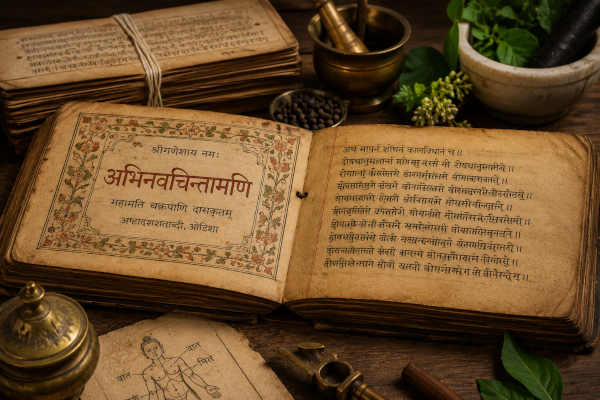
Abhinava Chintamani, also written as Abhinavacintāmaṇi, is one of the important but less widely known Sanskrit works in the later Ayurvedic tradition. Composed in Odisha by Mahamati Cakrapani Das during the latter part of the 18th century, the text represents a mature phase of Ayurveda in which classical medical knowledge, regional clinical experience, pharmacy, dietetics, prognosis and spiritual healing approaches are brought together in a compact and practical form.
The title itself is meaningful. “Abhinava” means new, fresh or renewed, while “Chintamani” refers to the mythical wish-fulfilling jewel. In the Ayurvedic context, the title suggests a new jewel of medical reflection, a work intended to guide physicians with useful, tested and carefully organised knowledge. It is a book of health, disease management and medical wisdom, created within the Sanskrit intellectual world but preserved through Odisha’s rich palm-leaf manuscript tradition.
Abhinava Chintamani belongs mainly to the field of Kayachikitsa, the branch of Ayurveda concerned with internal medicine. Kayachikitsa deals with the diagnosis and treatment of systemic disorders, digestion, metabolism, fever, respiratory conditions, urinary disorders, skin diseases, women’s health, children’s health, rejuvenation and general physical well-being. In this sense, the book is not merely a list of medicines. It is a clinical guide that reflects how Ayurvedic physicians understood the body, disease, strength, diet, treatment sequence and recovery.
One of the most remarkable aspects of Abhinava Chintamani is its regional background. Odisha has a deep and ancient connection with Ayurveda, Sanskrit learning, temple culture, palm-leaf manuscripts and traditional healing. Medical knowledge in Odisha was preserved not only in formal scholarly circles but also among physicians, families, temple-linked intellectual traditions and manuscript collections. Abhinava Chintamani emerged from this living environment. It shows that Odisha was not only a land of art, architecture and devotion, but also a strong centre of medical learning.
The text was composed in Sanskrit but written in Oriya script, a common practice in many regions of India where Sanskrit knowledge was transmitted through local scripts. This detail is important because it shows the pan-Indian character of Sanskrit learning and the regional strength of manuscript culture. A Sanskrit medical work did not need to appear only in Devanagari script. It could be preserved in Oriya, Grantha, Bengali, Telugu, Malayalam, Sharada or other scripts depending on the scholarly community that copied and used it.
Abhinava Chintamani came to wider academic attention through the study of palm-leaf manuscripts and older printed editions. One known manuscript contains the complete text in 66 Kirans, or chapters. An incomplete edition was also published in Oriya script in the early 20th century. Later scholarly work helped bring attention to the value of the text and encouraged its publication in more accessible scripts and languages.
The structure of Abhinava Chintamani shows the mind of a systematic physician. The work begins with foundational subjects such as measurement, medical definitions, purification of rasa substances, time-related principles and diagnostic considerations. After these introductory sections, the main body of the work discusses diseases and their management. The concluding chapters deal with rasayana, vajikarana and seasonal or procedural discipline.
This arrangement is practical. A physician first needs clarity about measures, substances, principles and diagnostic thinking. Then comes the treatment of diseases. Finally, the text turns towards restoration, rejuvenation, vitality and disciplined living. The arrangement reflects the complete Ayurvedic view of health: correct knowledge, correct diagnosis, correct treatment, correct diet, recovery support and long-term maintenance of strength.
The book’s disease chapters cover a wide range of conditions. These include jvara, or fever; atisara, or diarrhoeal disorders; grahani, or digestive assimilation disorders; arsha, or piles; ajirna, or indigestion; krimi, or worm-related disorders; pandu, or anaemia-like conditions; kamala and halimaka, linked with jaundice-like disorders; raktapitta, or bleeding disorders; rajayakshma, traditionally associated with wasting disease; kasa, or cough; hikka, or hiccup disorders; svasa, or breathing difficulties; vata disorders; amavata; abdominal disorders; urinary disorders; skin conditions; wounds; fistula-type conditions; women’s diseases; pregnancy-related disorders; postnatal disorders; children’s diseases; diseases of the mouth, ear, nose, eye and head; and many more.
A distinctive feature of the text is that it often gives separate attention to treatment after giving only a brief account of disease features. This shows its practical nature. Many older Ayurvedic works provide detailed theoretical descriptions of disease origin and diagnosis, while Abhinava Chintamani appears strongly focused on chikitsa, or treatment. It acts like a physician’s working manual, designed for application by trained practitioners.
The treatment pattern in the book is also noteworthy. Simple preparations such as kvatha, or decoctions, and churna, or powders, are often discussed along with rasaushadhi, ghrita and taila preparations. This means the text includes plant-based formulations, mineral or processed formulations, medicated ghee and medicated oils. Such a combination reflects the developed pharmacy of later Ayurveda, where classical herbal medicine was integrated with rasa preparations and specialised compound formulations.
The text also gives importance to pathya and apathya, the beneficial and avoidable diet and lifestyle factors in disease. This is one of the most valuable aspects of Ayurveda. Treatment is not seen as medicine alone. Food, digestion, rest, seasonal behaviour, strength of the patient and suitability of regimen are central to recovery. Abhinava Chintamani continues this tradition by linking medical treatment with dietary discipline.
The book also discusses prognosis, known as sadhyasadhyata, before dietary instructions in many contexts. This reflects clinical maturity. A physician must know whether a disease is easily curable, difficult to treat, manageable over time or unsuitable for aggressive treatment. Prognosis helps the physician choose the right intensity of care, advise the family responsibly and avoid careless intervention.
Another important feature is the text’s inclusion of rasayana and vajikarana. Rasayana in Ayurveda refers to rejuvenative measures that support strength, tissue nourishment, vitality, immunity, memory, longevity and recovery. Vajikarana deals with reproductive strength, vitality and healthy continuity of life. Their inclusion shows that the text is concerned not only with disease removal but also with restoration of health and vitality.
Abhinava Chintamani also contains references to daivavyapashraya chikitsa, the spiritual or divine-oriented dimension of healing in Ayurveda. This includes practices such as mantra, ritual, auspicious timing and faith-linked measures. In the modern world, this should be understood within its historical context. Ancient and early modern medical systems often treated health as a combination of body, mind, environment, fate, morality and cosmic order. The presence of such ideas in the text shows the holistic worldview within which Ayurveda functioned.
The text’s discussion of jvara, or fever, is especially important. Fever occupies a central place in Ayurvedic medicine and is often described as one of the most significant diseases because it affects strength, digestion, mind and vitality. Abhinava Chintamani records clinical categories such as amlapitta jvara and discusses specific treatment approaches for different stages and types of fever. It also mentions circumstances where medication may be restricted, which shows caution in clinical thinking.
The work’s attention to digestive disorders is equally important. Ayurveda places agni, the digestive and metabolic fire, at the centre of health. Conditions such as ajirna, aruchi, grahani, atisara, amlapitta and gulma are treated as major disturbances of internal balance. Abhinava Chintamani’s many formulations for digestive weakness, indigestion and related conditions show the importance given to digestion as the foundation of health.
Respiratory health is another major area in the book. Kasa, svasa, hikka and svarabheda are discussed with separate attention. These chapters show how traditional physicians classified cough, breathing difficulty, hiccup-related disorders and voice disturbances. The use of herbal, rasa, ghrita and taila preparations in these sections reflects the layered treatment approach of later Ayurveda.
Women’s health and child health also receive attention. The text groups conditions such as pradara, yonivyapat, garbhini roga and sutika roga under women’s health. It also includes balaroga, or diseases of children. This shows that Abhinava Chintamani had a broad clinical scope and was not limited to adult internal medicine. It recognised different stages of life and the special needs of women, pregnant women, mothers after delivery and children.
The book is also valuable for the history of Ayurvedic pharmacy. It records many formulations, some inherited from earlier traditions and others presented with new emphasis. The names of several preparations show the richness of Ayurvedic medicinal literature: rasas, churnas, ghritas, tailas, modakas, vatis, lehas and guggulu preparations appear across chapters. For scholars of traditional medicine, such works help trace how formulations travelled, changed, expanded and entered regional practice.
At the same time, the book must be approached with responsibility. Abhinava Chintamani is a historical and medical heritage text, not a self-medication manual for modern readers. Many formulations in later Ayurvedic works require proper identification of ingredients, purification procedures, dosage discipline, patient assessment and expert supervision. Rasaushadhi and mineral preparations especially demand trained handling. The value of the text lies in its scholarship, clinical tradition and historical importance, while actual treatment must remain under qualified medical guidance.
Abhinava Chintamani also stands as evidence of the continuity of Ayurvedic scholarship after the classical period. Ayurveda did not stop with Charaka, Sushruta, Vagbhata, Madhava Nidana or Bhavaprakasha. Later scholars continued to compile, organise, interpret and expand medical knowledge. They adapted inherited wisdom to their own regions, patients, materials and clinical experience. Cakrapani Das belongs to this living line of scholar-physicians.
The text can be described as a bridge between classical Ayurveda and regional medical practice. It borrows from earlier authoritative sources, reshapes material in a fresh style, adds original formulations and arranges disease treatment in a practical format. This makes it important for historians, Sanskrit scholars, Ayurveda physicians, pharmacology researchers and students of Indian knowledge systems.
For Odisha, Abhinava Chintamani is a matter of intellectual pride. It shows the state’s contribution to India’s health sciences and manuscript heritage. Odisha’s palm-leaf culture preserved not only religious and literary works but also technical knowledge, including medicine, astrology, mathematics, ritual science and practical arts. The recovery and study of such works can enrich the national understanding of Ayurveda.
In the present age, Abhinava Chintamani has multiple layers of relevance. For Ayurveda students, it is a source of clinical categories and formulations. For historians, it reveals late 18th-century medical thought in eastern India. For Sanskrit scholars, it shows the continued use of Sanskrit for specialised knowledge. For manuscriptologists, it highlights the importance of regional scripts and palm-leaf preservation. For cultural readers, it offers a window into India’s older understanding of health as a disciplined way of living.
The book’s core message is that health is built through knowledge, digestion, discipline, suitable medicines, correct diet, seasonal awareness and restoration of strength. It treats the human body as a living system shaped by food, environment, time, constitution, disease force and mental-spiritual balance. This integrated approach is the reason Ayurvedic texts like Abhinava Chintamani continue to attract attention.
Abhinava Chintamani deserves wider recognition as one of Odisha’s important contributions to Sanskrit medical literature. It is a carefully structured Ayurvedic treatise that preserves practical healing knowledge, regional scholarship and the living intelligence of India’s traditional physicians. As more manuscripts are studied, edited, translated and interpreted, works like this can help modern readers appreciate the depth and diversity of India’s health heritage.
In the great library of Ayurveda, Abhinava Chintamani is a later but luminous gem. It carries the voice of a scholar-physician who respected earlier authorities while adding his own clinical insight. It shows that Indian medical knowledge remained creative, organised and regionally vibrant even in the early modern period. Above all, it reminds us that health, in the Ayurvedic imagination, is not merely freedom from disease, but a balanced life supported by wisdom, food, conduct, medicine and inner harmony.
You may also like
-
The Ayurvedic Approach to Work-Life Balance: Restoring Harmony Between Work, Health and Personal Life
-
Ayurveda and Mental Fatigue in the Digital Age: Ancient Wisdom for a Calm and Focused Mind
-
Bharat Biotech’s Nucelion and VeGen Bio Partner to Manufacture Advanced Dual-Target CAR-T Cancer Therapy in India
-
Ayurveda and Anger: How Emotional Excess Affects Physical and Mental Health
-
Ayurveda and Stress: Daily Practices for Mental Balance and Emotional Well-Being
