The Nileshwaram Rajas occupy a special place in the history of northern Kerala. Their story belongs to the Kasaragod region, where Kerala’s Malabar world met the Tulu-speaking cultural belt, the Arabian Sea trade routes, the hill produce of the eastern highlands, the ritual power of temples, and the martial politics of medieval swaroopams. Nileshwaram, also known as Neeleswaram or Nileswar, became one of the important royal seats of North Malabar and grew into a cultural centre remembered for palaces, temples, sacred groves, Theyyam, Poorakkali, traditional learning, and regional administration.
The royal house of Nileshwaram is usually linked with the wider Kolathiri tradition of North Malabar. Historical accounts also connect the family with the Zamorin line of Kozhikode, making the Nileshwaram Rajas a bridge between two powerful royal traditions of Kerala. This connection is central to the prestige of the dynasty. It placed Nileshwaram inside a larger political world where kinship, marriage alliances, temple authority, military service, and land rights shaped the rise of royal houses.
In medieval Kerala, power was often organised through swaroopams, or royal houses with their own territories, ritual centres, military retainers, and administrative spaces. Nileshwaram was associated with Allada Swaroopam, a northern principality situated near the old Kolathunadu sphere. The Nileshwaram Rajas held influence over areas linked with present-day Hosdurg taluk and the surrounding Kasaragod region. Their authority was rooted in land, temple trusteeship, warrior networks, and the ability to manage a culturally mixed frontier.
The geography of Nileshwaram made it important. The town stood close to the coastal belt, riverine routes, backwaters, agricultural settlements, and eastern highland access points. This allowed it to function as a market zone for spices, hill produce, cash crops, and local craft goods. The old place names around Nileshwaram still preserve memories of these functions. Names associated with kovilakams, chiras, military quarters, goldsmiths, weavers, potters, fishing communities, court spaces, markets, and sacred sites show how the royal centre once organised everyday life.
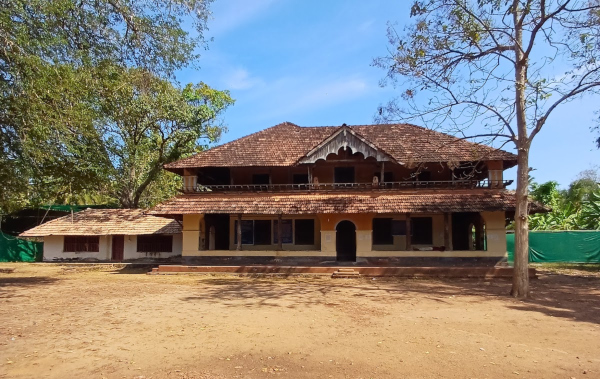
The palace world of the Nileshwaram Rajas was the visible centre of this authority. Nileshwaram Palace and the associated kovilakams represented the social and political dignity of the ruling family. These palaces followed the traditional Kerala architectural language of timber, laterite, tiled roofs, courtyards, carved woodwork, and calm interior spaces suited to ritual life and administrative activity. The palace was a residence, a courtly centre, a symbolic capital, and a cultural anchor.
The Nileshwaram royal house also carried strong temple associations. The Thaliyil Shiva Temple, local kavus, Bhagavathi shrines, serpent groves, and ritual spaces formed an important part of the region’s sacred geography. In Kerala’s older royal culture, kingship was tied to temple protection and ritual order. The ruler’s legitimacy came through dharma, patronage, festival organisation, and the safeguarding of sacred institutions. Nileshwaram’s cultural identity grew through this close bond between palace and temple.
Theyyam gives Nileshwaram its deepest cultural voice. Kasaragod and North Malabar are famous for Theyyam, where memory, devotion, caste history, hero worship, ancestral honour, and local political traditions come together in performance. The Nileshwaram Rajas ruled in a landscape where Theyyam was a living archive. The stories performed in kavus and temple grounds preserved the memories of warriors, guardians, deities, clan histories, social conflicts, and reconciliations. Through Theyyam, the past remained alive in ritual form.
The Nileshwaram Rajas also belonged to a frontier zone shaped by conflict. Northern Kerala faced pressures from the Vijayanagara world, the Ikkeri or Bednore Nayakas, Mysore, European trading powers, and finally the British. The Kasaragod region saw fort-building, shifting alliances, tribute arrangements, and military contestation. Hosdurg Fort near Kanhangad stands as a reminder of this turbulent period. The fort is associated with the Nayaka phase, when the northern Kerala coast became a strategic zone for military control and trade protection.
The Bednore Nayakas played a major role in the political history of the region. Their expansion into northern Kerala affected older Kolathiri-linked principalities, including Nileshwaram. The Nileshwaram Rajas had to navigate this changing environment with diplomacy, tribute, resistance, and survival. Their story therefore carries the character of a border kingdom: proud, adaptive, ritualised, and constantly aware of larger powers moving around it.
With the arrival of Mysore and later British power, the older political system of Malabar changed deeply. Traditional royal houses across Kerala gradually lost sovereign authority and became pensioned aristocratic families, ritual trustees, landholding elites, or cultural patrons. The Nileshwaram Rajas too moved from direct political rule into a heritage role. Their old authority survived through temples, palaces, local memory, festivals, education, and the cultural life of Nileshwaram.
One of the important later memories linked with the royal house is Rajah’s High School, established in the early twentieth century. Such institutions show how royal families adapted to the modern age by supporting education and public life. The shift from sword and sceptre to school and civic culture is an important part of Kerala’s transition from princely and feudal structures to modern society.
Nileshwaram today is remembered as the cultural capital of Kasaragod. This title is linked directly to the legacy of the Rajas. The town is known for palaces, temple festivals, serpent groves, Theyyam, beaches, backwaters, and a calm heritage atmosphere. The old palace has also been associated with folklore preservation, giving the royal seat a new life as a cultural memory space. What was once a centre of rule has become a centre of heritage.
The greatness of the Nileshwaram Rajas lies in the way their legacy survives through landscape. Their story is seen in the kovilakams, heard in Theyyam songs, felt in temple festivals, traced in place names, remembered in local traditions, and carried in the identity of Kasaragod. They were rulers of a region where Kerala and Tulu culture met, where sea routes and hill routes joined, and where royal power depended as much on ritual legitimacy as on military strength.
Nileshwaram’s royal tradition deserves wider attention because it represents a distinct northern Kerala model of kingship. It was connected to Kolathunadu, touched by the Zamorin tradition, shaped by Allada Swaroopam, tested by Nayaka power, transformed by colonial rule, and preserved through culture. In the larger history of Kerala, the Nileshwaram Rajas remind us that many royal houses shaped the state beyond the famous centres of Travancore, Kochi, Kozhikode, and Kolathunadu.
The Nileshwaram Rajas were more than local chiefs. They were custodians of a frontier civilisation. Their palace stood between coast and hill, temple and market, ritual and administration, memory and power. Their legacy continues to give Nileshwaram its cultural dignity and gives Kasaragod one of its most valuable historical identities.
You may also like
-
Avanti in the Mahabharata: The Ancient Kingdom of Ujjain and the Malwa Region
-
Karusha in the Mahabharata: The Ancient Kingdom of Baghelkhand and the Vindhyan Heartland
-
Indian Woodblock Craft Helps Preserve Indigenous Australian Designs for Future Generations
-
Surasena and Chedi in the Mahabharata: The Ancient Kingdoms of Mathura-Braj and Bundelkhand
-
Matsya in the Mahabharata: The Kingdom of Virata Across Alwar, Jaipur and Bharatpur
