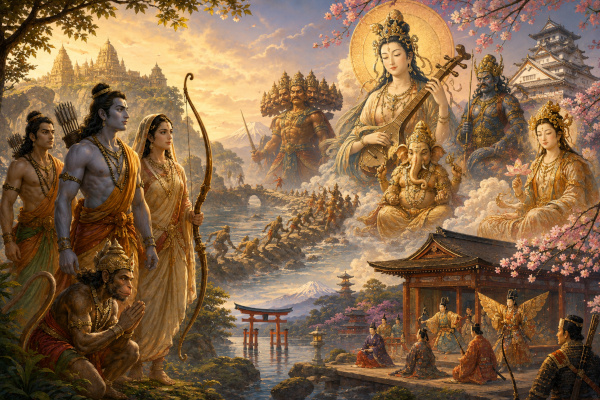
The Ramayana’s presence in Japan is one of the most unusual chapters in the global journey of the Indian epic. In Southeast Asia, the Ramayana became a royal theatre tradition, a temple sculpture tradition and a national cultural memory. Thailand has the Ramakien, Cambodia has the Reamker, Indonesia has the Kakawin Ramayana and Wayang traditions, and Laos has Phra Lak Phra Lam. Japan’s relationship with the Ramayana is different. It is quieter, more indirect and deeply connected to Buddhism, manuscript culture, Indian-origin deities, folk stories, performance traditions and modern anime.
The first bridge between India and Japan was Buddhism. When Buddhism reached Japan through China and Korea, it carried more than philosophy. It carried Sanskrit sounds, Indian cosmology, deities, sacred stories, moral parables, ritual forms, iconography and ideas about kingship, virtue and spiritual discipline. This is the cultural route through which Rama-related material entered Japan. The Ramayana did not arrive there as a complete public epic in the way it did in Thailand or Cambodia. It arrived through Buddhist storytelling and was reshaped for a Japanese religious world.
This explains why the Japanese Ramayana is not a simple copy of Valmiki’s Ramayana. In the Buddhist world, Rama appears through traditions such as the Dasaratha Jataka, where Rama becomes Rama-Pandita, a figure of patience, discipline and moral wisdom. This Buddhist Rama is less focused on royal conquest and more focused on restraint. The story becomes a lesson in conduct, duty, obedience and emotional control. The epic hero becomes a moral exemplar.
Japanese Buddhist literature preserved this kind of adapted Rama memory. The Hōbutsushū, or “Jewel Collection,” a 12th-century Buddhist tale collection, is one of the strongest references in this tradition. It contains a parable that closely resembles the Ramayana. This is important because it shows that the Rama story had entered Japan’s Buddhist literary imagination by the medieval period. The grand Indian epic was compressed into a moral story suitable for religious teaching.
Sanbō Ekotoba, also known as Sanbōe or “Illustrations of the Three Jewels,” belongs to the earlier 10th-century Buddhist literary world. It was created as a guide to Buddhist teachings and stories. It is often mentioned in discussions of Japan’s Rama-related transmission because it shows the kind of Buddhist didactic environment through which Indian narratives entered Japan. The stronger direct Rama connection is with Hōbutsushū, while Sanbōe is better understood as part of the larger Buddhist story-culture that made such transmission possible.
Another fascinating Japanese Ramayana-related tradition is Bontenkoku. In this story-world, Tamawaka is often compared to Rama, Himegimi to Sita, and King Baramon to Ravana. Tamawaka is portrayed as a hero who rescues his wife from captivity. This gives Japan one of its closest local echoes of the Rama-Sita rescue pattern. The names and setting are Japanese, but the emotional structure resembles the Ramayana: separation, captivity, courage, rescue and restoration.
This Bontenkoku tradition is valuable because it shows that the Ramayana did not remain only as a Buddhist moral reference. It also entered the wider field of Japanese popular and folk narrative. The story was localised. The characters changed names. The epic frame became smaller. Yet the core emotional architecture remained recognisable. A righteous hero moves through danger to recover his abducted wife from a powerful captor. That is a deeply Ramayana-like pattern.
The Japanese pantheon also helps us understand the same cultural route. Several Indian deities entered Japan through Buddhism and became part of the Shinto-Buddhist religious world. These deities are not Ramayana characters, but they prove how Indian sacred figures were absorbed, renamed and worshipped in Japan. This created the spiritual environment in which Rama-related stories could also be received.
Benzaiten is the best-known example. She is the Japanese form of Saraswati, the Indian goddess of knowledge, music, speech and learning. In Japan, Benzaiten became associated with music, eloquence, water, beauty and fortune. She is often shown with the biwa, the Japanese lute, just as Saraswati is associated with the veena in India. Her transformation shows how Indian sacred forms could be translated into Japanese culture without losing their core symbolism.
Taishakuten is another major example. He is the Japanese Buddhist form of Indra. In Japan, Taishakuten became a protective heavenly figure, often associated with Buddhist guardianship. Ancient Japanese Buddhist art from the Nara period shows Bonten and Taishakuten, corresponding to Brahma and Indra, as protective figures near Buddhas and bodhisattvas. This shows that Vedic and Indian epic-world deities had entered Japanese temple culture very early.
Kangiten is the Japanese Buddhist form of Ganesha. In Japan, Kangiten is especially linked with Shingon and Tendai Buddhism. He is associated with bliss, prosperity, success and the removal of obstacles. His iconography is different from the common Indian image of Ganesha, but the underlying Indian origin is clear. Like Benzaiten and Taishakuten, Kangiten shows how Japanese Buddhism absorbed Indian divine figures and gave them new local forms.
Kichijōten, also known as Kisshōten, is especially important for understanding Sita-like symbolism. Kichijōten is the Japanese Buddhist form of Śrī-Lakshmi, the goddess of fortune, fertility, abundance and beauty. Since Sita is traditionally associated with Lakshmi in Hindu thought, Kichijōten becomes the closest Indian-origin Japanese goddess to the sacred world surrounding Sita. She is not Sita herself, but she carries the Lakshmi symbolism of auspiciousness, grace and prosperity.
If we search for a native Japanese deity who resembles Sita symbolically, Konohanasakuya-hime becomes a powerful comparison. She is a Japanese Shinto goddess associated with blossoms, Mount Fuji, beauty and delicate earthly life. Her myth includes a striking fire episode. After her fidelity is questioned, she enters a doorless hut, sets it on fire and gives birth safely inside the flames. This is not a direct borrowing from the Ramayana, but the symbolic resemblance to Sita’s fire ordeal is remarkable. Both figures are linked with feminine honour, public suspicion, fire and vindication.
For a Rama-like comparison, Hachiman is the most useful Japanese deity. Hachiman is one of Japan’s most popular Shinto deities and is regarded as the patron of warriors. He is associated with martial legitimacy, protection, sacred authority and the warrior class. He is not Rama and should not be presented as a Japanese version of Rama. The comparison is symbolic. Rama represents the ideal warrior-king of dharma. Hachiman represents sacred protection and martial order in Japan. Both occupy the space where war, legitimacy and divine authority meet.
This gives us a careful answer to the question of Rama-like and Sita-like deities in Japan. There is no exact Japanese Rama and no exact Japanese Sita in mainstream Japanese worship. The closest literary pair is Tamawaka and Himegimi in Bontenkoku. The closest Rama-like deity by symbolism is Hachiman. The closest Sita-like Indian-origin deity is Kichijōten because of her Lakshmi connection. The closest Sita-like native symbolic comparison is Konohanasakuya-hime because of the fire-purity motif.
Japanese classical performance traditions also belong to this wider cultural story. Bugaku and Gagaku are Japanese court music-and-dance traditions shaped by imported Asian influences. Bugaku drew from dance forms that reached Japan from China, Korea, India and Southeast Asia. This supports the larger point that Indic artistic influence entered the Japanese courtly world. However, it is better to avoid claiming that Bugaku directly staged the full Ramayana in early Japan unless a specific performance source is available. The safe claim is that Japanese court performance belonged to the same Asian cultural network through which Indian stories, sounds and sacred forms travelled.
Kabuki and folk theatre give another indirect route. Japanese stories of exile, search, trial, supernatural danger and rescue sometimes echo Ramayana-like motifs. Bontenkoku and related printed or performed story traditions show how the Rama-Sita rescue structure could be localised into Japanese narrative. These are not always direct translations of Valmiki’s epic. They are cultural echoes. They show that the Ramayana’s emotional structure could survive even when the names, setting and religious frame changed.
The most visible modern Japanese connection to the Ramayana is the Indo-Japanese animated film “Ramayana: The Legend of Prince Rama.” This film was a collaboration involving Yugo Sako, Koichi Sasaki and Indian animation legend Ram Mohan. It adapted the Sanskrit epic into the language of Japanese hand-drawn animation. For many Indians, this film became one of the most beloved visual versions of the Ramayana.
This anime is important because it completed a cultural circle. In ancient and medieval times, the Rama story travelled to Japan through Buddhism, texts and religious culture. In the modern period, Japan helped bring the Ramayana back to India and the world through animation. The story that once moved quietly through manuscripts returned as a cinematic epic filled with forests, palaces, demons, divine weapons, Hanuman’s devotion and Rama’s battle against Ravana.
The film also shows the respect with which Japan approached the Indian epic. It did not treat the Ramayana as merely exotic material. It presented Rama, Sita, Lakshmana, Hanuman and Ravana with seriousness and dignity. The result became a powerful example of cultural diplomacy. It showed how two Asian civilisations could work together to preserve and retell an ancient story through modern art.
Japan’s Ramayana connection must therefore be understood in layers. The first layer is Buddhist transmission, where Rama-related stories entered moral and religious literature. The second layer is the Shinto-Buddhist pantheon, where Indian deities such as Saraswati, Indra, Ganesha and Lakshmi took Japanese forms. The third layer is medieval story culture, where Bontenkoku and related traditions carried Rama-Sita-like patterns. The fourth layer is performance and folk motif, where Indic artistic influence and rescue narratives appeared in local forms. The fifth layer is anime, where the full Ramayana returned in a modern Indo-Japanese visual language.
This makes Japan’s Ramayana tradition unique. It is not as public as Thailand’s Ramakien or Cambodia’s Reamker. It is not as temple-sculptural as Indonesia’s Prambanan tradition. It is not as performative as the Ramayana traditions of Bali or Laos. Japan’s Ramayana is quieter. It lives in Buddhist texts, transformed deities, symbolic parallels, folk stories, scholarly memory and animated cinema.
The story also teaches an important lesson about how epics travel. A great epic does not always move as a complete book. Sometimes it moves as a name. Sometimes as a moral lesson. Sometimes as a deity. Sometimes as a rescue motif. Sometimes as a fire symbol. Sometimes as a film. In Japan, Rama and Sita did not simply arrive as they were known in Ayodhya, Chitrakoot or Lanka. They entered a new world and took new forms.
The Ramayana in Japan is therefore not a story of direct imitation. It is a story of transmission, adaptation and respect. Rama appears as a Buddhist moral figure, a localised rescue hero and an anime prince. Sita appears through the dignity of Himegimi, the Lakshmi-like grace of Kichijōten and the fire-purity symbolism of Konohanasakuya-hime. Indian deities such as Benzaiten, Taishakuten and Kangiten show the wider spiritual bridge that carried these ideas across Asia.
In the end, Japan’s Ramayana connection shows the quiet strength of Indian civilisation. The epic travelled across mountains, seas, languages and religions. It entered Japan through Buddhism, settled into story collections, echoed through local legends, touched the world of deities and returned through anime. That journey makes the Ramayana not only an Indian epic, but an Asian civilisational force.
You may also like
-
India and UK Expand Defence Partnership With Joint Exercises, R&D and Ten-Year Industrial Roadmap
-
India and Mauritius Sign Oil and Gas Cooperation Pact, Deepen Long-Term Energy Partnership
-
India, US Armies Set for Major Yudh Abhyas Drill Near China Border in Uttarakhand
-
Avanti in the Mahabharata: The Ancient Kingdom of Ujjain and the Malwa Region
-
Jaishankar to Visit Russia for 27th IRIGC-TEC as India and Russia Push Trade, Technology and Economic Cooperation
