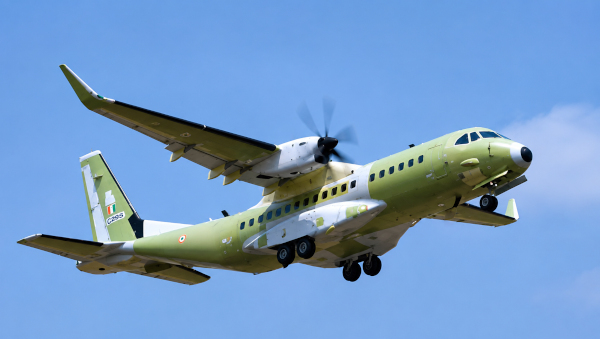
India’s defence aviation industry has crossed an important milestone with the maiden test flight of the first Made-in-India C-295 military transport aircraft from the Final Assembly Line in Vadodara, Gujarat. The aircraft has been assembled by Tata Advanced Systems Limited in partnership with Airbus, marking a major step in India’s effort to build complex military aircraft within the country through private-sector participation.
The C-295 programme is not just an aircraft delivery project. It is a shift in India’s defence manufacturing model. For decades, India depended heavily on foreign suppliers for military aircraft platforms. The Vadodara line now shows that India is moving from simple assembly and component supply toward full-scale aircraft manufacturing, testing, integration and delivery.
The Indian Air Force is acquiring 56 C-295 transport aircraft. The first 16 aircraft are being supplied from Spain, while the remaining 40 are to be built in India. The aircraft that has now completed its maiden test flight is the first of these Indian-built platforms. Its successful flight is a key step before delivery to the Indian Air Force.
The C-295 will replace the ageing Avro transport aircraft in IAF service. It is a modern tactical airlifter designed for troop movement, cargo transport, para-dropping, medical evacuation and operations from semi-prepared airstrips. This makes it especially useful for India’s forward areas, island territories, high-readiness military tasks and rapid logistics missions.
The aircraft’s rear ramp allows fast loading and unloading of troops, vehicles, supplies and mission equipment. It can support quick reaction operations where time, runway availability and battlefield mobility matter. For a country with long land borders, difficult terrain and wide maritime responsibilities, such aircraft strengthen the military’s ability to move men and material quickly.
The Vadodara facility also carries wider industrial importance. The project brings together Airbus, Tata Advanced Systems and a network of Indian suppliers, including MSMEs that manufacture parts for the aircraft. This creates a domestic aerospace ecosystem around precision manufacturing, quality control, certification, systems integration and aircraft maintenance.
The first test flight is therefore more than a symbolic event. It proves that India’s private sector can participate in high-value military aviation production. It also creates a foundation for future transport aircraft, surveillance aircraft, maritime patrol variants and other specialised platforms that may be required by the armed forces.
For the Indian Air Force, the C-295 adds a reliable medium transport capability between light utility aircraft and heavier transport platforms. It can operate in roles where larger aircraft may be unnecessary or unsuitable. This improves flexibility and allows the IAF to use the right aircraft for the right mission.
The programme also supports Atmanirbhar Bharat in a practical way. Indigenous defence capability is built through factories, trained workers, supply chains, testing facilities and long-term production experience. Each Indian-built C-295 will add to that experience and help India climb the aerospace manufacturing ladder.
The maiden flight of the first Made-in-India C-295 is a strong signal that India’s defence aviation sector is entering a new stage. It brings together operational need, industrial ambition and global partnership. As more aircraft roll out from Vadodara, the programme can become a landmark example of how India can build advanced military platforms at home while strengthening its air power and industrial base together.
You may also like
-
India Flags Off First LNG-Powered Train as ₹1,472 Crore Railway Projects Open in Ahmedabad
-
Three Indian Women-Led Startups Win Asia Tracks at TiE Women Summit 2026
-
ARAI Starts UAS Certification Services, Expanding Support for India’s Drone Manufacturers
-
Fujiyama Power Systems to Build 1.2 GW TOPCon Solar Cell Plant in Madhya Pradesh
-
IndoWings Unveils STRIKE Loitering Munition Concept for MBRL Launchers
