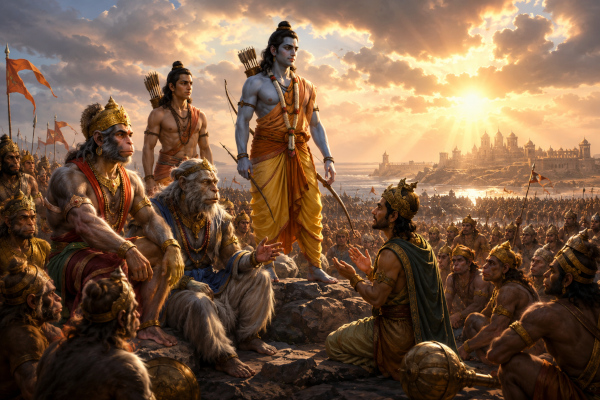
War is fought with weapons, formations, intelligence and logistics, yet every battlefield finally turns on the spirit of the soldiers who stand inside the storm. The Ramayana understands this truth with remarkable clarity. In the Lanka campaign, morale becomes a battlefield system. Rama, Lakshmana, Sugriva, Hanuman, Jambavan and Vibhishana repeatedly revive confidence when the Vanara army faces shock, confusion, fear and exhaustion. Their leadership shows that an army with courage can recover from battlefield reverses, while an army that loses heart begins to break from within.
The war in Lanka places Rama’s forces under extreme psychological pressure. The Vanara army crosses the ocean, enters enemy territory, faces a fortified island capital and fights Rakshasa warriors skilled in deception, night combat and magical weapons. The soldiers face unfamiliar weapons, terrifying battlefield sounds, sudden attacks and repeated moments of uncertainty. In such a campaign, morale becomes as important as physical strength. A shaken soldier sees danger everywhere. A confident soldier sees a mission, a leader and a path forward.
Rama’s greatest strength as a commander is emotional steadiness. He carries grief, duty and anger, yet his presence gives direction to others. When the army looks toward him, it sees purpose. Rama does not lead through loud display. He leads through clarity, restraint and dharmic conviction. His cause gives the army moral power. The soldiers know they are fighting to rescue Sita, punish adharma and restore rightful order. This transforms the war from a campaign of revenge into a campaign of justice. A morally convinced army stands longer under pressure because it believes the battle has meaning.
Lakshmana strengthens morale through loyalty and battlefield discipline. He represents the soldier who stands beside the commander through every trial. His presence beside Rama gives the army a visual symbol of unity. When troops see the command structure steady, they gain confidence. Lakshmana also shows the importance of controlled aggression. He channels anger into combat focus. In modern military terms, he represents the fighting spirit of the officer corps: close to the commander, close to the men and ready to absorb pressure at the front.
Sugriva’s role in morale management is political and organisational. The Vanara army is a coalition force drawn from different groups, regions and leaders. Sugriva holds this force together through authority, alliances and personal commitment to Rama’s mission. His presence assures the Vanaras that their king stands inside the same danger as his soldiers. This matters greatly in war. Troops fight harder when leadership shares risk. Sugriva’s command turns a tribal fighting force into a campaign army with a common objective.
Hanuman is the greatest morale multiplier in the Ramayana war. His courage spreads through the army like fire. Before the war, his leap to Lanka proves that the impossible can be crossed. His discovery of Sita gives the campaign certainty. His destruction inside Lanka proves that Ravana’s fortress can be penetrated. During the war, his strength, speed and devotion repeatedly lift the spirits of the troops. Hanuman gives soldiers a living example of fearless action. An army needs such figures because morale rises when soldiers see one warrior break the mental barrier of fear.
Jambavan performs another crucial function. He is the elder strategist who restores memory, patience and inner strength. His famous encouragement of Hanuman before the leap to Lanka is one of the clearest examples of morale management in the epic. Hanuman has the power, yet he needs to be reminded of it. Jambavan understands that warriors sometimes forget their own capacity under stress. His role shows that morale is also a matter of awakening dormant strength. A good commander tells soldiers what to do. A great guide reminds them who they are.
Vibhishana contributes to morale through intelligence and reassurance. He understands Lanka, Ravana’s commanders, the enemy’s methods and the psychological habits of the Rakshasas. His knowledge reduces uncertainty. Fear grows in darkness; intelligence brings shape to the threat. When Vibhishana explains enemy strengths, rituals, weapons and vulnerabilities, Rama’s side gains confidence. This is a major principle of warfare. Troops remain steadier when they understand the enemy. Knowledge turns terror into a manageable problem.
The war also shows how quickly morale can fall. When Indrajit uses deception and powerful astras, the Vanara army is shaken. The sight of fallen heroes, sudden reverses and strange weapons creates panic. These moments are vital because they reveal the battlefield as a psychological arena. Soldiers can survive physical danger and still lose fighting power when their minds collapse. The Ramayana presents this with great realism. Fear spreads fast in a mass army. Confidence must be restored faster.
Rama’s leadership during such moments creates emotional recovery. He anchors the army through composure and purpose. Hanuman brings action. Jambavan brings wisdom. Vibhishana brings clarity. Sugriva brings cohesion. Lakshmana brings fighting resolve. Together, they form a complete morale architecture. This is the deeper military lesson. Morale is managed through many channels: supreme command, battlefield heroism, veteran counsel, intelligence support, political unity and personal example.
The Sanjeevani episode is one of the strongest morale lessons in the war. When Lakshmana falls, the army faces a severe emotional blow. The commander’s brother and chief warrior lies wounded, and despair threatens the entire force. Hanuman’s mission to bring the life-restoring herb becomes more than a medical mission. It becomes a morale mission. His flight to the mountain, his return and Lakshmana’s revival restore the army’s fighting spirit. The episode shows that casualty recovery, medical support and visible rescue efforts directly affect battlefield confidence. Soldiers fight with greater resolve when they believe their wounded will be saved.
A powerful modern Indian parallel is the BHISHM Cube, developed under Project BHISHM, or Bharat Health Initiative for Sahyog Hita and Maitri. It is a portable emergency medical system built for rapid deployment in disasters, remote terrain and battlefield-like crisis zones. Each unit carries modular mini-cubes packed with essential medicines, trauma-care tools and life-saving equipment, allowing medical teams to create a quick field-care capability near the point of need. Its importance goes beyond treatment. For soldiers, the knowledge that advanced trauma support can reach them quickly becomes a morale booster. It tells the fighting man that the nation has planned for his survival, evacuation and recovery. In the same way Hanuman’s Sanjeevani mission restored the spirit of Rama’s army by saving Lakshmana, modern systems like the BHISHM Cube strengthen battlefield confidence by showing that casualty care is part of combat power itself. An army fights with greater heart when it knows that its wounded will be reached, treated and brought back with urgency.
Morale also depends on trust. Rama’s army trusts its leaders because they act with courage and fairness. Rama trusts Hanuman. Rama accepts Vibhishana. Sugriva honours his alliance. Jambavan speaks with wisdom. Lakshmana stands with loyalty. This chain of trust creates emotional strength. A military force can carry hardship when trust flows across ranks and units. Trust converts fear into endurance.
Modern warfare follows the same principle. In the Kargil War of 1999, Indian soldiers fought in extreme high-altitude conditions against entrenched enemy positions. The terrain was harsh, the climb was steep and the enemy held tactical advantage on the heights. Indian units continued the assault because morale, regimental pride, leadership from the front and national purpose fused into fighting power. The capture of key heights became a physical victory and a psychological breakthrough. Each success lifted the next unit’s confidence. This is the same principle seen in the Ramayana: morale gained in one sector strengthens the whole campaign.
For the Indian armed forces, morale is built through training, unit identity, officer leadership, religious and cultural grounding, welfare systems, battlefield communication and faith in the mission. A soldier who feels connected to his unit and country carries greater endurance. A commander who stays visible under stress becomes a source of stability. A formation that celebrates bravery builds a memory bank of courage. These are modern forms of the same ancient principle shown by Rama’s army.
The Ramayana teaches that morale is a weapon because it decides whether an army can absorb shock and continue fighting. Weapons destroy targets. Morale preserves the will to use those weapons. Intelligence reveals the enemy. Morale gives the courage to act on that intelligence. Logistics feeds the army. Morale gives the army the desire to move forward. Leadership gives orders. Morale turns orders into action.
Rama’s campaign succeeds because his army is repeatedly restored after moments of fear. The Vanaras face powerful enemies, yet they regain confidence through leadership, faith, example and unity. The epic presents morale as a living force that must be protected, renewed and directed. This makes the Lanka war a powerful study in military psychology.
The defence lesson is clear. A commander must manage the mind of the army as carefully as he manages weapons, formations and supplies. Fear, confusion and despair can spread through troops like a battlefield disease. Courage, clarity and trust can spread with equal force. Rama’s side wins because its leaders understand the spirit of their soldiers. They keep the army’s heart alive until victory becomes possible.
You may also like
-
Astra Microwave Expands Counter-Drone Capabilities with Layered Detection and Neutralisation Systems
-
MDL Begins Development of Indigenous Lithium-Ion Battery System for Project-75(I) Submarines
-
Tarang Shakti Delegates from 28 Countries Visit HAL and BEL to Explore India’s Defence Manufacturing Ecosystem
-
India’s 114 Rafale Fighter Jet Programme Moves Towards Final Decision with Focus on Indigenous Integration
-
Embraer and Mahindra Identify Nagpur as Potential C-390 Millennium Assembly Hub in India
