Indian researchers have identified a new mechanism that could help reduce energy consumption in future computing technologies by using sound waves to generate and control spin currents. The development comes from the Institute of Nano Science and Technology, Mohali, an autonomous institute under the Department of Science and Technology. The research points towards a new direction in low-power information processing, quantum computing and next-generation communication technologies.
Modern electronic devices depend mainly on the movement of electric charge. This movement produces heat and leads to energy loss, especially as devices become smaller, faster and more powerful. To overcome this challenge, scientists are exploring spintronics, a field where information is carried through the spin of particles instead of only through electric charge. This approach can help create devices that process information with lower energy loss.
A key concept in this research is the use of magnons. Magnons are waves of magnetic disturbance inside a material. They can carry information in a way that may consume less energy than conventional electron-based systems. This makes them important for future technologies where speed, miniaturisation and energy efficiency are all critical.
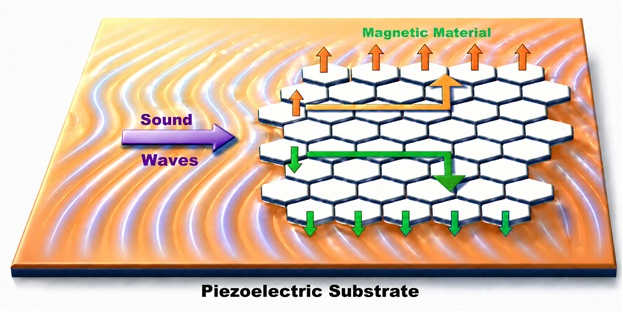
The INST team introduced a mechanism to generate and control magnon-based spin currents using surface acoustic waves, or SAWs. These are sound waves that travel along the surface of a material. In the model developed by the researchers, a two-dimensional ultrathin magnetic material with a graphene-like structure is placed over a piezoelectric substrate. Piezoelectric materials can generate electrical effects when mechanical pressure or strain is applied to them.
The research was carried out by PhD scholar Shivam Sharma and his supervisor Prof. Abir De Sarkar. They identified a gap in earlier studies, which had separately shown that surface sound waves can influence electron dynamics and that magnon movement can be shaped by quantum geometric effects. The team built a theoretical model to connect these ideas and study how surface sound waves can influence magnon transport.
Their model showed that when surface acoustic waves travel through the material, they create tiny distortions. These distortions act like effective forces, known in technical terms as pseudogauge fields. These forces influence the motion of magnons and create a new way to generate spin currents in two-dimensional magnetic materials. This means sound waves can become a tool for controlling information flow at very small scales.
The importance of this work lies in its possible application in future low-energy devices. As artificial intelligence, quantum technologies, high-speed communication and advanced computing systems expand, energy-efficient information processing will become a major scientific and industrial priority. A method that uses sound waves and magnetic excitations instead of conventional charge movement can help reduce heat generation and improve device efficiency.
The study also opens possibilities in strain-engineered devices, where mechanical deformation is used to control electronic or magnetic behaviour. This makes the research relevant for flexible electronics, advanced sensors, spintronic circuits and future computing platforms where mechanical, magnetic and electronic properties work together.
The work has been published in Physical Review B, a journal of the American Physical Society. According to PIB, the approach creates new opportunities for low-power and highly efficient technologies, especially in next-generation computing where reducing energy consumption is a central goal.
This research shows how India’s scientific institutions are contributing to foundational technologies that may shape future computing. By exploring how sound waves can control magnetic information carriers, the INST Mohali team has added a fresh pathway to the global search for faster, smaller and more energy-efficient devices.
Publication Link: https://doi.org/10.1103/4gpb-t3qh
Source: PIB
You may also like
-
New X-Ray Clues from Blazars could Provide Insights on Powering of Active Galaxies
-
A Powerful Punch by Black Hole Jets Shapes the Fate of Galaxies
-
IIT Delhi Develops India’s First Indigenous Micro-GPU for Embedded Graphics Systems
-
Beyond one: Indian Researchers’ Experiment Could Lead to A New Tool for Quantum Measurement
-
DRDO Backs Indigenous 20 mK Dilution Refrigerator in First High-Value Deep-Tech TDF Project
