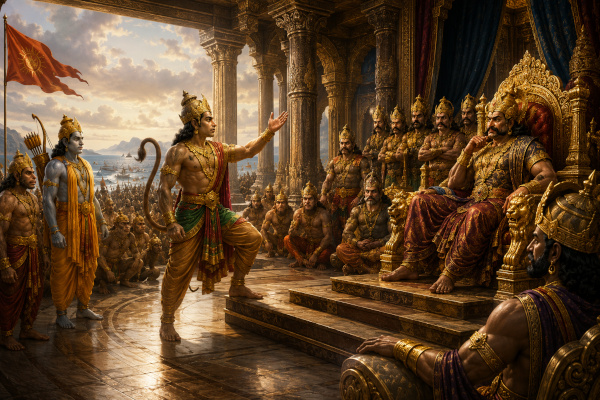
Before the final assault on Lanka, Rama makes one more move that shows the discipline of a true commander. His army has crossed the ocean. The bridge has been built. The Vanara forces have reached the island. Reconnaissance has been completed. Lanka has been observed from high ground. The gates, commanders and defensive layout of Ravana’s fortress are known. Every military condition for battle is ready. At this decisive moment, Rama sends Angada as an envoy to Ravana’s court with a final message: return Sita and preserve Lanka from destruction.
This is the moment where diplomacy and war stand side by side. Rama has the strength to attack, yet he first gives Ravana a clear choice. The message carries moral authority, political clarity and military pressure in one frame. It offers a path to peace while displaying the certainty of force. In defence terms, this is a classic pre-war ultimatum. It places responsibility on the aggressor, fixes the terms of settlement and prepares the battlefield psychologically before the first full strike begins.
Angada is a powerful choice for this mission. He is the son of Vali, a prince of the Vanaras and a warrior of high courage. Rama sends someone young, fearless and royal, carrying the dignity of an envoy and the confidence of a battlefield commander. Angada walks into Ravana’s court as a representative of Rama’s coalition, not as a frightened messenger pleading for compromise. His presence itself becomes a signal: the army outside Lanka has discipline, leadership and purpose.
The message to Ravana is simple and sharp. Sita must be returned. Ravana must recognise dharma. Lanka can still avoid ruin. This clarity is important in military communication. A strong ultimatum avoids confusion. It gives the enemy leadership one final opportunity to step back, while also preparing one’s own army for the moral legitimacy of combat. Every soldier in Rama’s camp knows that war is being entered after warning, negotiation and restraint.
This episode shows the principle of armed restraint. Rama’s side has built capability, gathered intelligence, secured logistics and positioned forces around Lanka. The military machine is ready, yet the commander still opens a final diplomatic door. Such restraint increases legitimacy. It tells allies that the war has purpose. It tells the enemy’s population that destruction can be avoided through the ruler’s decision. It tells neutral observers that the coming battle is the result of Ravana’s conduct.
Angada’s mission also works as psychological warfare. He enters the heart of the enemy’s power structure and speaks directly before Ravana’s ministers, generals and warriors. A message delivered inside the royal court has a different effect from a message shouted across a battlefield. It reaches the inner circle. It places doubt among commanders. It makes every listener confront the strength and confidence of Rama’s side. The court becomes a battlefield of will before the physical battle begins outside the walls.
The famous episode of Angada planting his foot in Ravana’s court deepens the psychological impact. He challenges the warriors of Lanka to move it. The act is more than physical bravado. It is a demonstration of confidence, balance and moral force. A single envoy stands inside the enemy capital and turns the court into a theatre of humiliation for Ravana’s pride. Lanka sees that Rama’s messenger carries the courage of an entire army.
In modern military doctrine, such an act resembles strategic signalling. Before major operations, states often send warnings, diplomatic demands, military advisories and public declarations. These signals serve many purposes. They define the red line. They give the opponent a final exit route. They prepare domestic opinion. They influence international perception. They also test the enemy leadership’s willingness to de-escalate. Rama’s ultimatum carries all these features in an ancient battlefield setting.
The mission also protects command ethics. A commander who goes to war after exhausting peaceful options commands with a stronger moral centre. Rama’s army fights for the recovery of Sita and the punishment of adharma. The ultimatum makes this purpose visible. The Vanaras are not marching for loot, expansion or conquest. They are moving under a stated objective. In military terms, this is the political aim of war expressed before combat begins.
Ravana’s rejection of the message seals Lanka’s fate. His pride turns diplomacy into a final record of responsibility. This is a critical feature of ultimatums in war. When the aggressor refuses a fair demand, the coming action gains sharper justification. Rama’s side has offered terms. Ravana has chosen battle. The moral burden moves fully onto the ruler who refuses correction.
A modern Indian parallel can be seen during the Kargil War of 1999. India identified the intrusion across the Line of Control, demanded withdrawal and combined military action with diplomatic pressure. The objective remained clear: evict the intruders and restore the sanctity of the Line of Control. The Indian response carried both military resolve and political restraint. Air power, artillery and infantry assaults were used with a defined aim, while diplomacy worked to isolate Pakistan internationally. Like Rama’s message to Ravana, India’s position was direct, limited and anchored in restoration of rightful order.
Angada’s mission also reveals how envoys function in conflict. An envoy is a carrier of message, intelligence and perception. By entering Ravana’s court, Angada observes mood, arrogance, fear, discipline and internal confidence. The enemy’s reaction becomes useful information. In modern terms, diplomatic contact before war can reveal leadership psychology, decision-making style and the level of internal cohesion. Every word in the court, every insult, every attempt to intimidate the envoy becomes a clue about the opponent’s mindset.
A sharper modern parallel appears in the Modi government’s doctrine after years of peace outreach and repeated cross-border terror. India opened doors for dialogue, regional stability and normal relations, yet Pakistan’s terror machinery kept choosing violence as an instrument of policy. After the Pahalgam attack, India’s message became a strategic ultimatum: terror would carry the cost of war, talks would centre only on terrorism and Pakistan-occupied Kashmir, and any reckless escalation would invite a firm response. Operation Sindoor expressed this doctrine with precision. India struck terror infrastructure with measured force, kept the action focused, and placed responsibility on Pakistan’s military-terror ecosystem. This carries the same rhythm as Rama’s message through Angada. Peace stood available through rightful conduct. The aggressor chose escalation. The commander then moved with moral clarity, prepared strength and decisive purpose.
The episode further shows the importance of narrative control. Rama’s side frames the conflict before Ravana can shape it differently. The issue is Sita’s return. The cause is justice. The warning is destruction through refusal. The path to peace is available. This narrative clarity strengthens the army and weakens the enemy’s moral standing. In modern warfare, narrative often shapes international support, alliance behaviour and public endurance during conflict. Rama understands this instinctively.
Angada’s courage also reflects the psychology of a confident coalition. Rama’s force includes Ayodhya’s princes, Sugriva’s Vanaras, Hanuman’s intelligence network, Vibhishana’s inside knowledge and a wide field army gathered for a single objective. Sending Angada shows that every part of this coalition has absorbed Rama’s mission. The envoy speaks with the weight of a united command structure. The enemy sees unity before seeing assault.
The ultimatum also creates tempo. It is placed at the edge of battle, after deployment and before full engagement. This timing matters. An early warning without force behind it can sound weak. A final warning after complete military preparation carries power. Ravana hears the message while Rama’s army stands ready outside Lanka. Diplomacy becomes sharper because force is already assembled. This is the essence of coercive diplomacy: a peaceful exit is offered under the visible shadow of military consequence.
Rama’s conduct gives the article its central defence lesson. A righteous commander prepares fully, communicates clearly and strikes decisively when the final warning is rejected. Power gains depth when guided by discipline. Diplomacy gains force when backed by credible capability. War gains legitimacy when entered with a clear aim, a fair warning and controlled purpose.
Angada’s mission is therefore one of the finest strategic moments before the battle of Lanka. It is a final diplomatic door, a psychological operation, a test of Ravana’s judgment, a statement of moral authority and a battlefield signal sent before the assault. Rama’s army stands ready with strength, yet Rama first sends words. When those words are rejected, the war that follows carries the full force of justice, preparation and command clarity.
You may also like
-
India and US Bring Advanced Counter-Drone Warfare Into Yudh Abhyas 2026
-
Digantara Expands Bengaluru Space Hardware Capability With New Cleanroom
-
Armenian Military Delegation Visits Indian Air Force Station as India–Armenia Defence Ties Deepen
-
Abhira in the Mahabharata: The Pastoral People of Western India and the Northern Deccan
-
FAS Estimates India’s Nuclear Stockpile at Up to 190 Warheads as Strategic Forces Modernise
