India’s economy is expected to remain one of the strongest performers among major economies, with growth projected at 6.3% in FY2026-27 and 6.4% in FY2027-28. The projection comes at a time when the global economy is facing pressure from the continuing West Asia conflict, rising energy costs, supply disruptions and renewed inflationary risks. The figure is important because it shows that India’s growth story is moving on a steady track even when many advanced and emerging economies are entering a more uncertain phase.
The central reason behind India’s resilience is the strength of domestic demand. India’s economy is powered by consumption, services, infrastructure spending, credit expansion and a large internal market. This gives the country a buffer when export markets slow down or global trade becomes unstable. While higher energy prices can affect inflation, transport costs and industrial inputs, India’s broad-based demand engine allows growth to continue at a healthy pace.
The global setting is far more difficult. The OECD has warned that the Middle East conflict has become a major force shaping the world economy, mainly through its impact on energy prices, commodity flows and inflation. Under its time-limited disruption scenario, global growth is expected to slow from 3.4% in 2025 to 2.8% in 2026, before recovering to 3.1% in 2027. Under a prolonged disruption scenario, global growth could weaken further to 2.1% in 2026 and 1.8% in 2027, creating deeper stress for energy-importing economies and developing countries.
India’s projected growth of above 6% therefore stands out sharply. It places the country in a relatively stronger position compared with advanced economies where growth is expected to remain modest. The OECD projects the United States to grow at 2.0% in 2026 and 1.8% in 2027, while the euro area is projected at 0.8% in 2026 and 1.2% in 2027. China’s growth is also expected to slow to 4.5% in 2026 and 4.3% in 2027.
For India, the key challenge will be inflation management. Energy shocks usually travel through the economy in stages. First, fuel and import costs rise. Then freight, fertiliser, electricity-linked production and food distribution costs begin to feel the pressure. Finally, households experience the effect through prices of food, transport and daily consumption items. The OECD has noted that inflationary pressure may rise as favourable food-price base effects fade, and it expects a temporary policy-rate increase of around 25 basis points by the end of the first quarter of FY2026-27 to keep inflation expectations anchored.
The Reserve Bank of India’s role becomes central in this phase. Monetary policy must protect price stability while allowing growth momentum to continue. DD News reported that the OECD noted RBI’s policy rate had moved from 6.5% in January 2025 to 5.25% in February 2026, bringing policy to a broadly neutral stance. Average lending rates have softened, and non-food bank credit expanded by 15.9% year-on-year in March, showing that credit flow to the productive economy remains active.
Fiscal policy will also carry a delicate responsibility. The Union Budget for FY2026-27 targets a reduction in the fiscal deficit from 4.4% of GDP in FY2025-26 to 4.3%, but energy-support measures could widen the deficit by around 0.4 percentage points compared with the budgeted path. Such support can protect households and consumption in the short term, while the medium-term goal remains debt reduction and fiscal discipline. Public debt is projected to decline to 54.7% of GDP by FY2027-28.
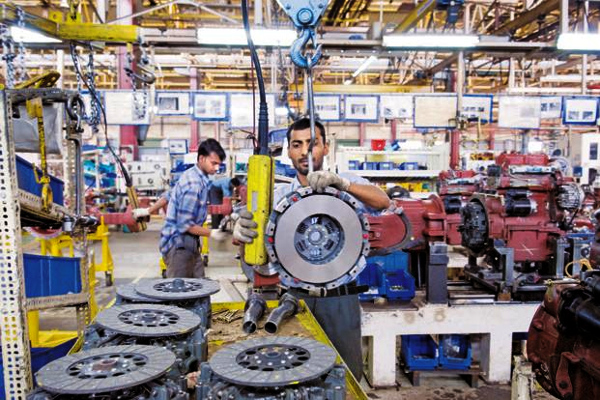
The larger message is that India is entering a phase where stability itself becomes a strategic economic advantage. In a world shaped by oil shocks, geopolitical tension, supply-chain uncertainty and weak external demand, a 6%-plus growth rate signals confidence in India’s domestic economy. Infrastructure investment, digital growth, manufacturing expansion, services exports, financial inclusion and rising consumption will continue to form the main pillars of this momentum.
The OECD has also underlined the importance of productivity, better business conditions, improved skills and the use of transformative technologies such as artificial intelligence for stronger long-term growth. For India, this means the next leap will depend not only on headline GDP numbers but also on better jobs, wider skill development, logistics efficiency, energy security and deeper private investment.
India’s growth forecast of 6.3% in FY27 and 6.4% in FY28 is therefore more than a statistical projection. It reflects the country’s ability to absorb external shocks, maintain domestic momentum and remain a leading growth centre in a slowing global economy. The coming challenge will be to convert this resilience into durable prosperity through stable prices, disciplined fiscal management, strong infrastructure, industrial depth and skilled employment.
You may also like
-
US Hosts 91% of Overseas Unicorns Built by Founders Who Grew Up in India, Prosus-Dealroom Report Finds
-
India Approves Pioxaniliprole, Indigenous Insecticide Molecule Developed by PI Industries
-
India Overtakes Hong Kong to Become Asia’s Fourth-Largest REIT Market
-
Banaras Langda Aam — Kashi’s Green-Skinned Summer Treasure and the Mango Heritage of the Gangetic Plain
-
ONGC Strikes Gas in Mahanadi Deepwater Basin Off Odisha Under Samudra Manthan Campaign
