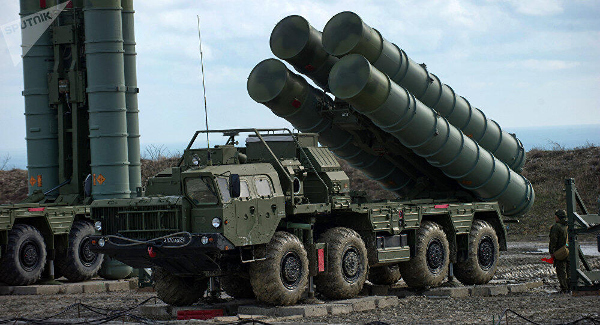
India’s long-range air defence grid has received a major reinforcement with the arrival of the fourth Russian-origin S-400 “Sudarshan” squadron. The system has reportedly reached India by sea and is expected to move into an operational deployment area soon, strengthening the country’s ability to monitor, track and destroy hostile aerial threats before they reach sensitive targets. This delivery is part of the 2018 India-Russia agreement for five S-400 squadrons, under which three units had already joined service while the remaining deliveries faced delay due to disruptions linked to the Russia-Ukraine conflict.
The S-400 is valuable because it changes the geometry of air defence. A conventional air defence system protects a point or a small area; a long-range system like the S-400 creates a wide defensive bubble around strategic zones, air bases, command centres, industrial corridors and border sectors. Its presence forces an adversary to think about distance, altitude, radar exposure, aircraft survivability and missile engagement envelopes before attempting an air operation. In modern warfare, this psychological pressure is as important as the missile itself.
Russia’s Rosoboronexport describes the S-400 as a mobile, multi-channel, long-range air defence missile system with high mobility and survivability. Its strength lies in layered engagement: it can use different missiles for different ranges and target types, allowing the same system to deal with aircraft, drones, cruise missiles and certain ballistic threats. The longest-range interceptor associated with the S-400 family is widely reported at around 400 km, while other missiles serve medium and shorter engagement bands, creating depth inside the shield.
For India, the fourth squadron has significance beyond numbers. Air defence becomes more powerful when coverage overlaps. Every additional squadron helps India thicken its surveillance and interception grid across multiple theatres. The western front, northern borders, key air bases, nuclear-linked infrastructure, naval assets and major cities all benefit from a wider sensor-and-shooter network. A single squadron can protect an important sector; four squadrons begin to shape a national-level defensive architecture.
The timing also matters. After Operation Sindoor, India’s air defence posture gained sharper attention. Indian Air Force chief Air Chief Marshal A.P. Singh publicly stated in 2025 that India shot down five Pakistani fighter aircraft and one large military aircraft during the May 2025 clashes, with the large aircraft reportedly engaged at around 300 km. Reuters reported India’s claim as well as Pakistan’s denial, making the episode a disputed but strategically important marker in South Asian air power discourse.
The lesson from that episode is clear: long-range air defence is now part of offensive strategy as well as defensive security. A system like the S-400 allows India to protect its own airspace while also restricting the adversary’s freedom to use high-value airborne platforms such as surveillance aircraft, electronic intelligence aircraft, airborne early warning systems and standoff command nodes. These aircraft are the eyes and ears of modern air warfare. When they are pushed back, the opponent’s fighters, drones and missiles operate with reduced coordination.
The fourth S-400 squadron also strengthens India’s deterrence against two-front pressure. China has advanced aircraft, missiles and electronic warfare capabilities; Pakistan has increasingly relied on drones, standoff weapons and networked air operations. India’s answer is a layered system that combines long-range assets like the S-400 with Akash, Barak-8, MRSAM, QR-SAM, anti-drone systems, fighter patrols, airborne sensors and the Integrated Air Command and Control System. The S-400 sits at the outer ring of this arrangement, giving commanders early engagement options.
India is also preparing the next phase. Reports say the fifth and final squadron under the original deal is expected in the coming months, completing the first five-unit acquisition. At the same time, India has reportedly moved toward acquiring five more S-400 squadrons, while the Defence Acquisition Council cleared defence proposals worth about ₹2.38 lakh crore in March 2026.
The long-term story, however, is not only Russian supply. India is building its own long-range air defence capability under Project Kusha, a DRDO-led indigenous programme aimed at creating an extended-range surface-to-air missile system with engagement ranges reportedly reaching up to 350–400 km in its highest tier. This is the crucial second track: import proven capability for immediate security, then build sovereign capability for future independence.
This two-track model suits India’s defence doctrine. The S-400 gives India a ready shield today. Project Kusha gives India design control, domestic production, upgrade freedom, software sovereignty and lifecycle independence tomorrow. When both mature together, India’s air defence will move from platform acquisition to architecture dominance.
The arrival of the fourth S-400 squadron therefore marks more than another delivery from Russia. It signals India’s transition into a missile-age air defence power, where the protection of national airspace depends on radar depth, command speed, interceptor reach and industrial resilience. In a region shaped by drones, cruise missiles, stealth aircraft, surveillance platforms and rapid escalation, the Sudarshan shield gives India a wider sky, a longer arm and a stronger deterrent.
You may also like
-
JCBL Receives DRDO Technology for Indigenous 20-Tonne Heavy Drop System for C-130J and C-17
-
DRDO Moves 30 kW Laser Weapon Towards Production, Industry Partner Selection Planned Within Six Months
-
IG Defence Validates KAL Long-Range Strike Drone’s Integrated Systems in Pokhran Trial
-
Vajra Air Defence Warriors Validate AKASHTEER Sensor-to-Shooter Network in Day-Night Firing Drills
-
INS Sahyadri and INS Kulish Reach Philippines for ADMM-Plus Maritime Cooperation
