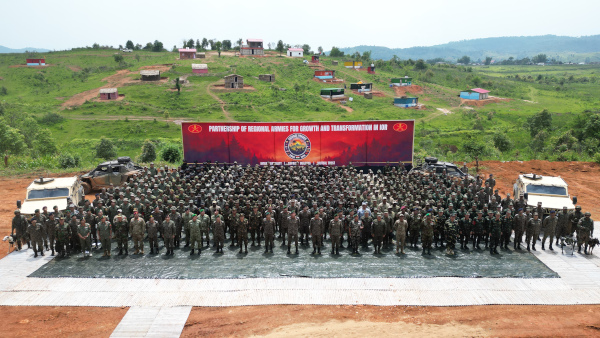
The maiden edition of Multilateral Exercise PRAGATI 2026 concluded at Umroi Military Station in Meghalaya with a demanding 72-hour validation exercise, bringing together soldiers and senior military leadership from across the Indian Ocean Region and Southeast Asia. The exercise highlighted India’s growing role as a defence partner, training hub and strategic convener for regional armies facing common security challenges.
PRAGATI stands for Partnership of Regional Armies for Growth and Transformation in the Indian Ocean Region. The 2026 edition brought together more than 400 troops from India, Bhutan, Cambodia, Malaysia, Maldives, Myanmar, Nepal, Philippines, Seychelles, Sri Lanka, Vietnam, Indonesia and Laos. The closing event was attended by six Vice Chiefs and over 40 senior military officials from the 13 participating friendly foreign countries, with Lieutenant General Dhiraj Seth, Vice Chief of the Army Staff, hosting the dignitaries.
The exercise was designed as a practical military platform where regional armies could train together, learn from each other and improve operational coordination. Its focus on counter-terrorism operations in semi-mountainous and jungle terrain made the training highly relevant for the security conditions faced by many participating countries. The terrain of Umroi gave the troops a realistic environment for movement, surveillance, reaction drills and tactical coordination.
The training covered a wide range of battlefield skills. Participating troops practiced rock craft, ambush and counter-ambush drills, slithering, jungle lane shooting, room intervention, bus intervention, IED detection, casualty evacuation and other specialised operations. Mixed teams from different countries trained together, creating direct soldier-to-soldier understanding and improving interoperability at the ground level.
The 72-hour validation exercise served as the final test of the training cycle. After lectures, demonstrations, practice sessions and special-skill modules, the troops applied their learning in a continuous field environment. Such validation exercises are important because they convert classroom knowledge and controlled training into practical operational confidence. They also show how different armies can function together under pressure.
PRAGATI 2026 also carried a strong diplomatic message. India used the exercise to build military trust through equality, friendship and mutual respect. For countries across the Indian Ocean Region, shared training creates a common language of tactics, procedures and emergency response. This kind of defence cooperation becomes valuable during counter-terror operations, disaster response, humanitarian assistance and regional security coordination.
A major highlight of the exercise was the camaraderie among soldiers. Troops from different nations lived, trained and operated together in demanding field conditions. Such bonding has long-term value because professional military relationships are often built through shared hardship, field discipline and mutual respect rather than formal meetings alone. Cultural exchanges and informal interactions added another layer to the exercise, strengthening personal and institutional ties.
The Indian Army also used the occasion to showcase India’s growing indigenous defence ecosystem. In collaboration with FICCI, the Army organised a defence equipment display for the participating partner nations. The Army Design Bureau and Indian defence industry presented indigenous equipment and niche technologies, while the Indian Army displayed select new-generation systems already in service.
This equipment display gave PRAGATI 2026 an industrial and strategic dimension beyond field training. It projected India’s defence manufacturing capabilities under Atmanirbhar Bharat and created an opportunity to promote defence exports, industry partnerships and technology collaboration with friendly countries. For India, such exercises are also platforms to connect military diplomacy with defence production and regional capability building.
On the sidelines of the exercise, the Vice Chief of the Army Staff held bilateral meetings with representatives of participating countries. These discussions helped deepen defence cooperation, improve mutual understanding and strengthen military-to-military relationships among regional partners.
Exercise PRAGATI 2026 has therefore emerged as more than a training event. It has combined counter-terrorism preparation, jungle warfare skills, regional military diplomacy, defence industry promotion and trust-building into one platform. As the first edition concludes, it lays the foundation for future editions that can further strengthen collective readiness and security cooperation across the wider Indian Ocean Region.
Source: PIB
You may also like
-
PRAHAAR: India’s First National Counter-Terrorism Policy and Strategy
-
Takshak Heavyweight Torpedo: How India’s Indigenous Submarine Weapon Compares With the World’s Leading Torpedoes
-
Embraer Builds Dual Aerospace Strategy in India Through C-390 Military and E175 Regional Aircraft Programmes
-
NextLeap Tests Indigenous Jet Engine for Long-Range Stryker Kamikaze UAV
-
Côte d’Ivoire Military Delegation Visits HAL, Shows Interest in India’s Indigenous Aerospace Platforms
