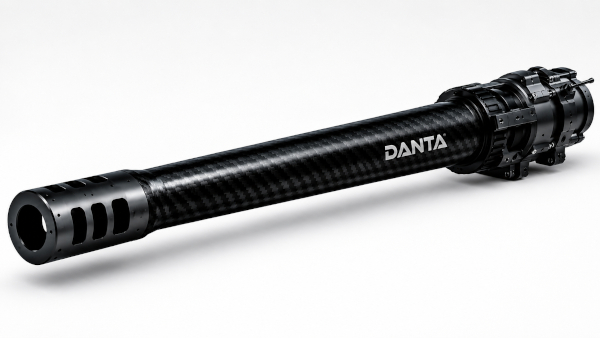
India’s artillery modernisation story has so far been dominated by heavy metal: the 155mm/52 calibre ATAGS, the K9 Vajra-T self-propelled gun, upgraded Dhanush variants and new mounted gun systems. Into this landscape has come a striking claim from Bengaluru-based DANTA Innovations: a 155mm/52 calibre composite artillery barrel that could cut the weight of a conventional steel barrel by nearly 70%, from around 1,400 kg to roughly 420 kg.
In artillery, the barrel is one of the most demanding components of the entire gun system. It must withstand chamber pressure, recoil shock, thermal stress, propellant gas erosion, projectile friction, vibration, repeated firing cycles and battlefield handling. Making such a component lighter while preserving safety, accuracy and barrel life is a major materials-engineering challenge.
DANTA describes its barrel as a filament-wound composite structure for a 155mm/52 calibre artillery system. Publicly available descriptions say the design uses multiple engineered layers, including an erosion-resistant inner liner, carbon-fibre hoop layers, a thermal barrier layer and an integrated fibre-optic sensor network for structural health monitoring. DANTA’s own LinkedIn post claims the barrel is designed for 3,000+ Effective Full Charge cycles, chamber-pressure handling up to 700 MPa working pressure and 1,050 MPa proof pressure, and a sustained firing rate of 8–10 rounds per minute across a temperature band of -40°C to +150°C.
The “all-composite” label needs careful explanation. StartupPedia’s coverage says the barrel architecture is under development as a hybrid thermoplastic composite system with a metallic inner liner, rather than a fully monolithic composite barrel. That detail matters because the bore and chamber area of an artillery barrel face extreme heat, erosion and pressure. A metallic or erosion-resistant liner is expected in such designs because the projectile and propellant gases interact directly with the inner surface.
The main military value of such a barrel would be mobility. Modern artillery survives by firing quickly, shifting position and avoiding counter-battery fire. A lighter barrel reduces the overall burden on the gun carriage, recoil system, elevation mechanism, turret or vehicle platform. In mountains, deserts, islands and narrow roads, every kilogram matters. DANTA itself frames the technology around high-mobility operations, especially in difficult terrain such as the LAC, where heavy artillery movement, road classification, bridge load limits and airlift constraints affect deployment.
This aligns with India’s larger artillery direction. The Ministry of Defence signed major procurement pacts in March 2025 for 155mm/52 calibre ATAGS, saying the system would replace vintage and smaller calibre guns and strengthen the Army’s long-range precision firepower. The MoD also signed a ₹7,628.70 crore contract with Larsen & Toubro in December 2024 for additional 155mm/52 calibre K9 Vajra-T self-propelled tracked artillery guns under the Buy (Indian) category. This shows that India’s artillery future is clearly moving towards 155mm/52 calibre systems, making any lighter barrel technology strategically relevant if it matures.
The composite barrel idea also fits the “shoot-and-scoot” logic of modern warfare. Artillery units are increasingly exposed to drones, counter-battery radars, loitering munitions, satellite surveillance and precision fires. A gun that can deploy faster, traverse easier, reposition quickly and place less mechanical strain on its platform gains survivability. Weight reduction is therefore about more than transport convenience; it can directly affect battlefield life expectancy.
Another interesting feature is DANTA’s claim of embedded fibre-optic structural health monitoring. If such a system works reliably, it could allow real-time tracking of strain, fatigue, heat damage and structural stress. Traditional steel barrels are inspected through scheduled maintenance, bore measurement, visual examination and life-cycle calculations. A sensorised barrel could give commanders and maintainers better insight into barrel condition, firing history and potential failure risk. Indian Defence News describes this as a predictive-maintenance advantage over conventional steel barrels.
The technology could also help future platform design. A 155mm gun with a lighter barrel could be integrated more easily into wheeled self-propelled guns, towed systems, truck-mounted artillery, naval gun mounts or experimental high-mobility platforms. DANTA-linked coverage says the barrel is being positioned for compatibility across self-propelled guns, towed artillery, wheeled platforms and naval systems.
The real engineering question is barrel life. A 155mm gun tube is not merely a pipe. It is a precision pressure vessel that must keep accuracy after repeated firing. A lighter composite structure must maintain bore alignment, rifling stability, thermal behaviour, bonding integrity, liner support, muzzle consistency and recoil tolerance under punishing conditions. Differential thermal expansion between liner, composite layers and thermal barrier materials will be a major test area.
Sustained fire is another challenge. Artillery barrels heat rapidly during high-rate fire. Heat affects accuracy, barrel wear and structural safety. Steel barrels already face erosion and fatigue under intense firing. A composite barrel must prove that its resin or thermoplastic matrix, bonding layers and fibre architecture can survive repeated heat cycles without delamination, softening, cracking, creep or dimensional distortion. The claimed operating envelope of -40°C to +150°C is impressive, but artillery firing can create much harsher transient thermal conditions at the bore surface, which makes independent testing crucial.
The pressure numbers also need validation through trials. A 155mm artillery system generates enormous internal pressure during firing, and proof pressure testing is essential before any military acceptance. Claims of 700 MPa working pressure and 1,050 MPa proof pressure indicate an attempt to match artillery-class structural demand, but operational qualification would require repeated firing with different charges, ammunition types, elevation angles, climates and firing schedules.
There is also the issue of integration with existing guns. A barrel interacts with the breech, recoil system, muzzle brake, cradle, equilibrators, fire-control assumptions and platform balance. Reducing barrel weight by hundreds of kilograms changes mass distribution, recoil dynamics and mechanical loading. That could be an advantage, but it also means each host artillery system would need engineering validation rather than a simple drop-in replacement.
For India, the most realistic near-term pathway would be controlled testing, not immediate fielding. First, the design would need static pressure tests, material coupon tests, thermal cycling, bore erosion studies and non-destructive inspection. Then it would need instrumented firing trials with progressive charge levels. After that would come accuracy evaluation, barrel-life measurement, failure-mode study and compatibility trials with Indian 155mm ammunition. Only then could it be considered for integration with systems such as ATAGS-type platforms, mounted gun systems or other indigenous artillery projects.
The Make-in-India significance is still important even at the R&D stage. India has already built strong momentum in artillery through ATAGS, Dhanush, K9 Vajra localisation, Pinaka rockets and private-sector defence manufacturing. A domestic composite barrel project would push the ecosystem into advanced materials, filament winding, thermal barriers, sensorised structures and high-pressure defence composites. Those technologies have applications beyond artillery — in missile canisters, rocket motor cases, launch tubes, UAV structures, naval systems and aerospace components.
DANTA is described in start-up coverage as a Bengaluru-based company working on carbon-fibre reinforced polymer composite solutions for defence and aerospace, including UAVs, missile systems, launch canisters, rocket launcher tubes and artillery-related structures. StartupPedia says the firm was founded by Jateen Singhania and Hitesh Singhaniya, and that the artillery barrel is under active R&D and prototype development.
This is where the story should be framed carefully. Headlines calling it the “world’s first all-composite artillery barrel” are exciting, but the available public record does not yet show a completed military qualification cycle, army acceptance, MoD procurement, DRDO certification or live-fire validation data. At present, the strongest factual framing is: DANTA Innovations has announced/developed a prototype or R&D-stage 155mm/52 calibre composite artillery barrel concept that claims major weight reduction and smart monitoring advantages.
If the technology succeeds, the effect could be substantial. A 70% barrel-weight reduction could make heavy artillery easier to move in mountain sectors, reduce the burden on wheeled platforms, simplify air-transport planning and support faster deployment. It could also open the door to lighter next-generation gun systems where barrel mass no longer dictates the size of the entire platform.
If the technology struggles, the likely reasons would be the classic artillery-barrel problems: heat, erosion, liner life, bonding, fatigue, manufacturing consistency, cost, proof safety and integration complexity. These are not small hurdles. A gun barrel failure can be catastrophic, so military qualification standards will be extremely demanding.
The deeper importance of DANTA’s claim is that Indian defence innovation is beginning to move from assembling platforms to rethinking core components. A barrel is the heart of a gun. If Indian start-ups can enter such hard engineering areas, even at prototype stage, it shows the defence ecosystem is maturing into materials science, embedded sensing and platform-level redesign.
In simple terms, DANTA’s composite artillery barrel is a bold Make-in-India attempt to make the heaviest and most stressed part of a 155mm gun lighter, smarter and more mobile. It is not yet an inducted battlefield product based on available public evidence. But as a research direction, it is exactly the kind of high-risk, high-reward innovation India needs if it wants future artillery systems that are lighter, faster to deploy and better suited to drone-saturated, counter-battery-heavy battlefields.
You may also like
-
PRAHAAR: India’s First National Counter-Terrorism Policy and Strategy
-
Takshak Heavyweight Torpedo: How India’s Indigenous Submarine Weapon Compares With the World’s Leading Torpedoes
-
Embraer Builds Dual Aerospace Strategy in India Through C-390 Military and E175 Regional Aircraft Programmes
-
NextLeap Tests Indigenous Jet Engine for Long-Range Stryker Kamikaze UAV
-
Côte d’Ivoire Military Delegation Visits HAL, Shows Interest in India’s Indigenous Aerospace Platforms
