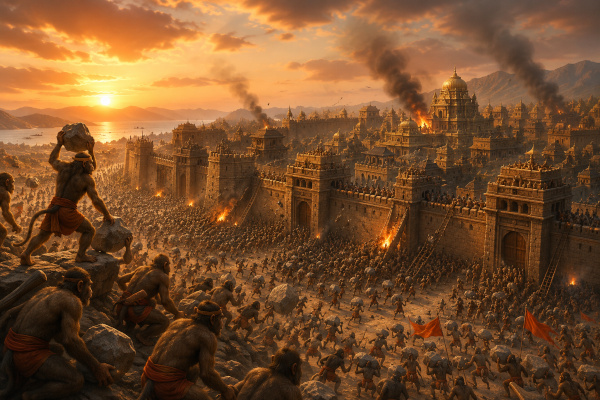
The siege of Lanka is one of the most disciplined military episodes in the Ramayana. Rama’s army has crossed the sea, reached enemy territory, studied the fortress, identified the major gates, understood Ravana’s command structure and prepared for a full assault on the island capital. The attack that follows carries a clear operational logic. Rama’s forces advance against multiple gates of Lanka at the same time, compelling Ravana to distribute his strength across the city’s defensive perimeter. This is the essence of a multi-axis assault: pressure from several directions, coordinated movement across separate fronts, and a deliberate effort to stretch the defender’s attention, manpower and reserves.
Lanka is described as a powerful fortified city with guarded gates, high walls, towers, armed Rakshasa formations and commanders positioned at key points. Such a city cannot be treated like an open battlefield. A fortress has depth, chokepoints, protected approaches, internal routes, gatehouses, watchpoints and reserves. A direct crowding of all attacking strength at one gate would give the defender a clear focus. Rama chooses a wider design. The Vanara army surrounds Lanka and presses different gates, turning the entire fortress into a battlefield. The city is forced to breathe through every wall, every tower and every entrance under pressure.
This is where the Ramayana shows a sophisticated understanding of battlefield geometry. Rama’s army uses space as a weapon. The attackers create multiple points of contact across Lanka’s perimeter. The defender must now watch, signal, reinforce, supply and command several sectors at once. Ravana’s captains can no longer treat the war as a single clash in front of one gate. Each gate becomes a crisis. Each wall becomes a contested line. Each reserve unit inside Lanka becomes valuable because movement toward one sector leaves another sector exposed to pressure.
Modern warfare follows the same principle in a more technological form. A multi-front assault aims to overload the defender’s command system. The attacker creates simultaneous dilemmas across land, sea, air, electronic and information domains. Armoured units may push on one axis, infantry may fix the defender on another, artillery may suppress command posts, drones may observe rear movement, electronic warfare may disturb communication, and special forces may create pressure in depth. The purpose is clear: the defender must divide reaction, decision and movement across several urgent demands.
Rama’s plan before Lanka carries the same mental structure. He does not merely send warriors into combat. He assigns commanders to sectors. He matches leadership with terrain and enemy deployment. He understands that Ravana’s city has a northern gate, southern gate, eastern gate, western gate and inner defensive core. When each gate faces pressure, Ravana loses the luxury of calm concentration. His leadership must read reports from different directions, judge which sector is under greatest threat, move reserves through the city and maintain morale among troops who hear battle sounds from every side.
In siege warfare, a gate is more than an entrance. It is a symbol of control. The gate decides who enters, who exits, where supplies move and where commanders concentrate men. By attacking several gates, Rama’s army attacks the psychology of the fortress. The Rakshasas standing on the walls see movement across multiple approaches. War cries rise from different directions. Dust, drums, stones, trees, arrows and close combat turn the city’s outer ring into a circle of pressure. The defenders feel the battlefield closing around them.
A single-axis attack gives the defender a clean mental picture. A multi-axis assault creates a complex picture filled with uncertainty and urgency. This is the difference Rama’s deployment creates around Lanka. Ravana’s commanders must ask which gate needs reinforcement, which sector faces a breakthrough, which unit can be shifted, which messenger carries accurate information and which sound from the battlefield signals a real danger. War becomes a struggle of decisions as much as weapons.
Modern commanders describe this as creating multiple dilemmas for the enemy. A dilemma is stronger than a simple threat because every response carries a cost. If the defender reinforces the east, the west becomes thinner. If the reserve moves north, the southern gate waits longer for support. If the commander holds troops at the centre, each gate commander feels isolated. If the defender sends elite units outward, the inner citadel loses its protective depth. Rama’s multi-gate assault creates exactly this kind of pressure.
The Ramayana’s battlefield also shows the value of fixing and striking. Some attacking formations can hold enemy forces in place while other formations search for weakness. In modern warfare, this appears when one unit fixes a defender through fire and movement while another manoeuvre group penetrates from a flank. Around Lanka, the Vanara formations at different gates keep Rakshasa troops tied to their sectors. Ravana’s commanders must fight where they stand. The ability to rush all strength to one decisive point becomes difficult inside a city under pressure from every direction.
This is a powerful lesson in operational art. Victory comes from shaping the whole battlefield. Rama shapes the siege before the decisive duels unfold. He surrounds the enemy, assigns sectors, sustains pressure, protects his own command position and keeps his forces active across the fortress. The grand heroic battles of the Ramayana rise from this disciplined arrangement. The war is poetic, but the structure beneath the poetry is military.
The northern gate becomes especially important because Ravana himself is associated with that sector. Rama and Lakshmana face the strongest symbol of Lanka’s command authority. This is another sharp feature of the plan. The supreme commander does not hide behind the army. Rama places himself where the enemy king’s presence carries the greatest weight. This creates moral pressure on both sides. The Vanaras know their leader stands in the most dangerous sector. The Rakshasas know Ravana’s own gate is under direct challenge.
At the other gates, Rama’s commanders maintain intensity. The distribution of trusted leaders gives the assault discipline. Each sector has authority, identity and purpose. In modern command language, this resembles mission command: leaders receive a clear objective, understand the larger plan and act with initiative within their assigned zone. Such decentralised energy is essential in a wide battle. A commander at the centre can guide the campaign, but each front needs local leadership capable of reading the fight.
The Vanara army’s natural fighting style also suits this multi-axis assault. They move with speed, climb, leap, carry trees and stones, swarm walls and create shock through mass and mobility. Against a fortified city, such movement becomes valuable. Their bodies become assault tools. Their agility turns walls and elevation into contested spaces. Their numbers create noise, dust and pressure. In a modern army, this role would be performed through infantry assault groups, engineers, breaching teams, drones, fire support and armour. In the Ramayana’s world, the Vanaras create the same effect through raw mobility, courage and physical adaptation to terrain.
The defender’s problem grows deeper inside the city. A fortress under pressure from several gates must preserve internal movement routes. Commanders need corridors to shift troops. Messengers need safe paths. Supply points must feed multiple sectors. Medical care must handle casualties from different fronts. Reserves need clear orders. Confusion inside a fortress can spread faster than fire. A multi-axis assault targets this inner nervous system. Lanka’s walls may be strong, but the mind of the city must process too many shocks at once.
This is why modern warfare places great importance on tempo. Tempo means the rhythm and speed of operations. An attacker with high tempo forces the defender to respond again and again, often before earlier decisions mature. Rama’s assault creates tempo through simultaneity. Battle erupts across Lanka’s gates, and Ravana’s commanders must keep pace with events. The army outside the walls controls the rhythm. The army inside the walls struggles to match it.
The same principle appears in contemporary combined-arms operations. A modern force may use artillery to suppress one sector, drones to reveal movement in another, cyber tools to disrupt control systems, aircraft to strike logistics nodes, naval forces to control approaches and ground forces to press selected axes. The aim is to make the defender feel surrounded by events. The battlefield becomes a storm of linked pressures. Rama’s siege achieves this in epic form through commanders, gates, terrain, morale and simultaneous contact.
A multi-axis assault also protects the attacker from predictability. When pressure appears across many sectors, the defender must keep guessing about the decisive blow. Every gate under attack could be the main effort. Every movement may conceal a deeper plan. Every dust cloud may signal an approaching formation. This uncertainty weakens confidence. Commanders begin to conserve troops, hesitate during movement and demand more reports. The attacker gains advantage because the defender’s decision cycle grows heavier.
Rama’s plan carries this psychological weight. Lanka, once proud and enclosed, is made to feel surrounded. The sea behind the Vanaras has already been crossed. The island’s isolation has been broken. The city’s gates now face warriors who have turned geography into opportunity. The bridge across the ocean brought the army to Lanka; the multi-gate assault turns arrival into pressure. This sequence matters. Logistics brings the force. Reconnaissance reads the target. Deployment surrounds the fortress. Multi-axis assault begins the breaking of the defender’s confidence.
The strategy also reveals Rama’s restraint and clarity as a commander. He does not depend only on personal heroism. He builds alliance, gathers intelligence, crosses the sea, studies the fortress, arranges his formations and assigns sectors. This is the full chain of warfare. The duel with Ravana becomes the climax, but the path to that duel is paved by planning. The Ramayana honours courage, yet it also respects preparation. The attack on Lanka proves that righteous war still demands professional military thought.
In modern Indian strategic thinking, the same idea can be seen in the emphasis on jointness and integrated theatre operations. A future battlefield will rarely be decided by one arm acting alone. Land forces, air power, naval reach, space-based observation, cyber capabilities, electronic warfare, logistics and special operations must create pressure together. The point is the same as Rama’s design around Lanka: the enemy must face pressure across depth, width and decision space. A country that can coordinate multiple axes gains the power to shape the battle before the final strike.
The Lanka assault also shows the relationship between physical fronts and mental fronts. A gate is physical. Fear is mental. Command delay is organisational. Reserve movement is logistical. Information flow is cognitive. A true multi-axis assault touches all these layers together. Rama’s forces attack the gates, but they also attack Ravana’s certainty. They attack the walls, but they also attack command balance. They attack the outer city, but they also attack the confidence of an empire that believed the sea itself was protection.
This makes the episode timeless. The weapons have changed, the principle has endured. Modern armies speak of multi-domain pressure, distributed manoeuvre, battlefield tempo and enemy-system paralysis. The Ramayana presents these ideas through the image of Lanka surrounded by warriors, banners, roars, commanders and sectoral assaults. The ancient story uses epic language, but the battlefield logic is precise.
The multi-axis assault on Lanka teaches that a fortress falls first in its command structure, then in its walls. A defender stretched across many fronts spends strength on reaction. An attacker who coordinates many directions gains initiative. Rama’s forces understand this as they surround the city. They transform Lanka from a protected capital into a pressured battlespace. They make Ravana defend everywhere, decide quickly, reinforce carefully and fight under the sound of war from every gate.
In that moment, the Ramayana becomes a manual of operational pressure. The assault on Lanka is a study in how to stretch a defender, divide his attention and create decisive conditions before the final blow. Rama’s army wins through courage, but courage is arranged through strategy. The multi-axis assault shows the warrior’s heart guided by the commander’s mind. That is why the siege of Lanka remains one of the most powerful military episodes in India’s epic imagination.
You may also like
-
Former DRDO Chief Samir Kamat Confirms Akash Missile Exports to Tajikistan and Turkmenistan
-
MoD Signs ₹586 Crore Contract for Indigenous Auxiliary Power Units for T-72 and T-90 Tanks
-
India–Mongolia Joint Military Exercise Nomadic Elephant 2026 Begins in Pithoragarh
-
Agni-5 Heavy Penetrator Concept Emerges as India Studies Long-Range Bunker-Busting Capability
-
DRDO Gives Private Industry Greater Freedom to Refine Secondary Designs and Subsystems
