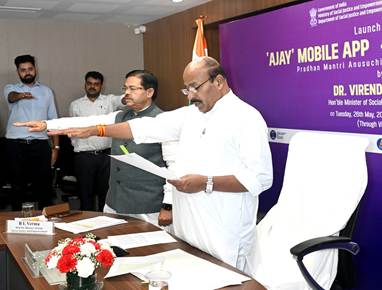
India’s welfare delivery architecture for Scheduled Caste communities has taken a significant digital step with the launch of the PM-AJAY Portal and AJAY Mobile App by Union Minister for Social Justice and Empowerment Dr. Virendra Kumar. The new digital system is designed to move the implementation of the Pradhan Mantri Anusuchit Jaati Abhyuday Yojana from paper-based processes to real-time digital monitoring, planning and reporting.
The core purpose of the platform is straightforward: make welfare implementation faster, more transparent and easier to track from the village level to the national level. PM-AJAY covers major components linked to Scheduled Caste welfare, including Adarsh Gram development, Grants-in-Aid for skilling and employment, and the Hostel component. By bringing these under a unified digital framework, the government is trying to reduce administrative delays and improve coordination among ministries, states, districts, implementing agencies and field officers.
The AJAY Mobile App is particularly important because it takes the scheme closer to the field. Welfare programmes often depend on village-level surveys, local planning, physical inspections, beneficiary identification and progress verification. When these steps remain paper-heavy, implementation can become slow and difficult to monitor. The new app allows field functionaries to carry out planning, reporting, inspections, photo uploads and updates through a mobile interface, giving administrators a clearer view of what is happening on the ground.
One of the most practical features is the integration of geo-tagging, mobile inspections, dashboard reporting, notifications, photo-based documentation and role-based access control. These tools can make a real difference in welfare governance. Geo-tagging can help verify whether development work is actually linked to the intended village or facility. Photo uploads can create visual proof of progress. Dashboards can help officials detect delays early. Role-based access ensures that different users — from ministry officials to hostel administrators — can access the information relevant to their responsibility.
The portal functions as the central command system for PM-AJAY. Under the Adarsh Gram component, it will provide national, state and district-level dashboards to monitor model village development across 50 socio-economic indicators spread over 10 developmental domains. This is a crucial detail because it shows that the platform is not limited to file movement. It is meant to track actual development outcomes in villages, from planning to milestone completion.
The milestone-linked fund flow system is another major reform. Once a Village Development Plan is digitally approved, the portal can automatically track progress against approved milestones. This links funding more closely to implementation status, helping ensure that public money follows verified progress rather than remaining trapped in slow manual procedures. For a scheme focused on socio-economic advancement, such a system can improve both accountability and speed.
The Grants-in-Aid component will also benefit from the new digital mechanism. This part of PM-AJAY deals with skilling, employment and livelihood-related interventions. The portal will act as a centralised planning and management information system, allowing state-level data to be aggregated and used for tracking financial outlays, funding allocations and livelihood outcomes. In a country where employment-linked welfare requires close coordination between Centre, states and implementing bodies, such an MIS can make planning more evidence-based.
The Hostel component is equally significant. Hostels play a direct role in expanding educational access for students from Scheduled Caste communities, especially those who need safe and affordable residential support to continue their studies. Bringing hostel administration into the digital framework can help monitor facilities, inspections, reporting and administrative follow-up more systematically.
The larger meaning of the PM-AJAY Portal and AJAY Mobile App lies in the shift from welfare announcement to welfare execution. India has many large social-sector schemes, but their impact depends heavily on last-mile delivery. A digital system that tracks planning, approvals, inspections, fund flow and progress can help reduce gaps between policy intent and field reality.
The presence of state and Union Territory officials during the launch through virtual participation also underlines the federal character of the scheme. PM-AJAY cannot succeed through central monitoring alone. It needs active participation from state departments, district officials, implementing agencies, inspection teams and grassroots functionaries. The new platform gives all these actors a shared operating system.
This launch also fits into a broader governance trend in India: the growing use of digital public infrastructure for welfare delivery. From direct benefit transfers to real-time dashboards, government platforms are increasingly being built to reduce leakages, improve monitoring and create more transparent decision-making. PM-AJAY’s digital transition brings the same logic into Scheduled Caste welfare administration.
For beneficiaries, the success of this initiative will be measured through visible outcomes: better village infrastructure, stronger livelihood support, smoother access to skilling programmes, improved hostel facilities and more responsive administration. For officials, it offers a tool to monitor, correct and accelerate implementation. For policymakers, it creates a data-backed view of how welfare funds are translating into development.
The PM-AJAY Portal and AJAY Mobile App therefore represent more than a routine technology launch. They mark an attempt to modernise the machinery of social justice delivery. If used effectively, the system can help make Scheduled Caste welfare schemes more transparent, better monitored and more closely connected to real outcomes on the ground.
You may also like
-
India Advances Trade Diplomacy at G20 Ministerial in Milwaukee
-
Kokasa Launches to Build Indigenous Mission-Critical Systems for Su-30MKI, MiG-29 and T-72
-
Tata Projects and MDS Aero Partner to Build Advanced Aero-Engine Test Infrastructure in India
-
Flying Wedge Defence Partners With Portugal’s Keydef to Manufacture Kaal Bhairava and YAMA Drones in Europe
-
Armenia Conducts Live-Fire Exercise With Indo-French TRAJAN 155 mm Howitzers Manufactured in India
