
Indian researchers have developed a cost-effective, high-performance thermal energy storage material that could improve the efficiency of thermal batteries used in concentrated solar power plants and industrial waste heat recovery systems. The development, announced by the Ministry of Science and Technology, marks an important step in India’s effort to build indigenous clean-energy technologies that are scalable, efficient and affordable.
The research has been carried out at the International Advanced Research Centre for Powder Metallurgy and New Materials, or ARCI, an autonomous institution under the Department of Science and Technology. The team, led by Dr. Mani Karthik, has developed a scalable process to produce spinel nanocomposite phase change material, or PCM, for thermal energy storage applications.
Thermal energy storage is a critical requirement for the next generation of clean energy systems. Solar power is abundant, but its generation varies with sunlight availability. Industrial plants also release large amounts of heat that often goes unused. Efficient thermal batteries can store this heat and release it when needed, improving the overall energy efficiency of power plants, factories and renewable energy systems.
The key innovation in this research lies in the use of spinel-type metal oxide nanoparticles. ARCI researchers used a simple co-precipitation method to produce these nanoparticles with controlled particle size. According to the PIB release, the nanomaterials demonstrated excellent thermal stability and uniform dispersion, making them suitable for high-performance nanocomposite PCM systems.
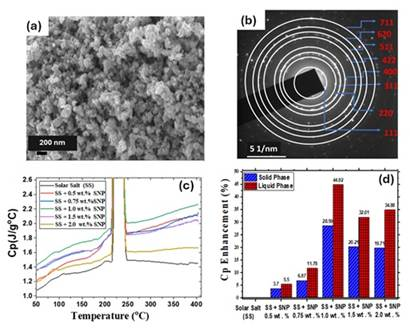
Diffraction (SAED) pattern of spinel nanoparticles, (c) Differential Scanning
Calorimetry (DSC) profile, (d) Cp enhancement of Spinel-PCM nanocomposite
The results are significant. By adding only 1% spinel oxide nanoparticles to the phase change material, researchers achieved an increase in specific heat capacity of up to 45% compared with the base PCM without nanocomposites. Specific heat capacity is the ability of a material to store thermal energy. In simple terms, the improved material can store more heat in the same amount of mass.
This improvement can have practical industrial value. If a thermal storage material can hold more energy per unit mass, the storage system can become smaller and more efficient. Smaller storage tanks mean lower use of construction materials, reduced capital cost and lower operational expenses. For large-scale solar thermal plants and heat recovery systems, such improvements can make clean energy infrastructure more commercially attractive.
The science behind the improvement is linked to better nanoparticle dispersion inside the PCM. When the spinel nanoparticles are uniformly distributed, they increase the specific surface area of the material. This leads to the formation of a stable spinel oxide layer at the interface, raising surface energy and improving the material’s heat-storage performance. The result is a nanocomposite PCM with higher thermal capacity than the original material.
The development is important for India’s clean-energy transition because energy storage remains one of the biggest challenges in renewable power adoption. Batteries are often discussed in the context of electricity storage, but thermal batteries are equally important for solar thermal plants, industrial heat management, process industries and future decarbonisation strategies. A material that can store heat more efficiently and at lower cost can help industries reduce energy waste and improve sustainability.
The breakthrough also fits into the larger Aatmanirbhar Bharat vision. Instead of relying only on imported advanced materials, Indian scientists are building indigenous expertise in next-generation energy storage materials. This is especially important as global demand rises for clean-energy technologies, high-efficiency materials and low-cost storage systems.
The research has been published in Materials Today Chemistry, an Elsevier journal. According to the Ministry, the superior thermal capacity of the developed material can support more compact, high-performance and cost-efficient thermal energy storage systems.
Overall, the ARCI development is a promising example of how materials science can directly support India’s clean-energy future. By improving the performance of thermal batteries through a cost-effective and scalable process, Indian researchers have opened the door to more efficient solar power systems, better industrial heat recovery and more affordable clean-energy storage infrastructure.
Publication link: https://doi.org/10.1016/j.mtchem.2025.103282
You may also like
-
IISc Develops Engineered Nanobody Antivenom With Broad Protection Against Indian Cobra Venoms
-
Self-assembly of Organic Molecules Opens a New Path to Green Hydrogen Production
-
Bi-layered Single-piece Dental Implant Reduces the Need for Surgical Unterventions
-
NASA Invites ISRO Into Moon Base Programme as US Opens Door Wider to Indian Space Startups
-
ISRO Successfully Completes Final EOS-05 Orbit-Raising Manoeuvre
