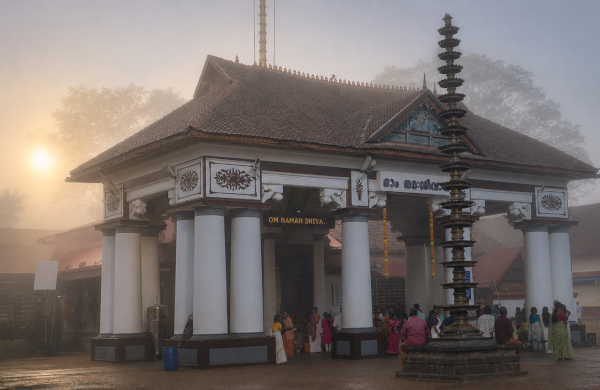
Vaikom Mahadeva Temple in Kottayam district is one of Kerala’s most revered Shiva shrines, a temple where faith, architecture, legend, festival culture and social history meet in a uniquely powerful way. Located in Vaikom, north of Alappuzha and close to the Vembanad backwater region, the temple is dedicated to Lord Shiva, worshipped here with deep affection as Vaikkathappan, the Lord of Vaikom. Kerala Tourism describes it as an ancient Shiva temple and one of the oldest temples in Kerala, while the temple’s official account says the Shiva Linga is traditionally believed to belong to the Treta Yuga and that worship has continued without interruption from ancient times.
Vaikom is often called the Kasi of the South, not merely because it is an important Shiva kshetra, but because the temple carries the spiritual atmosphere of an old pilgrimage centre. Unlike many shrines known only to one sectarian tradition, Vaikom Mahadeva Temple is held in reverence by both Shaivites and Vaishnavites, giving it a wider devotional identity in Kerala’s sacred geography.
The temple also forms part of Kerala’s famous Shiva trinity of Vaikom, Ettumanoor and Kaduthuruthy. Traditional belief holds that devotees who worship at these three temples before the midday Ucha Puja receive special blessings. In this sacred circuit, Vaikom is not just one temple among many; it is a central pillar of Shiva worship in central Kerala.
Sacred Origin and the Legend of Vyaghrapada
The spiritual memory of Vaikom is closely tied to the sage Vyaghrapada Maharshi. According to the temple tradition, ancient Sanskrit texts such as the Bhargava Purana and Sanalkumara Samhita identify this region as Vaiyaghra Geham and Vaiyaghra Puram. The name is connected with Vyaghrapada, the great devotee of Shiva who is believed to have had a divine encounter with Lord Shiva here. Over time, the name Vaiyaghra is said to have evolved into Vaikom.
This legend gives the temple its deeper sacred personality. Vaikom is not remembered merely as a place where an idol was installed; it is remembered as a place where divine grace revealed itself to a sage through penance, devotion and surrender. That is why Vaikathappan is worshipped not only as a powerful deity, but also as a compassionate presence who receives devotees with the dignity of a father, teacher and protector.
The festival of Vaikathashtami is also linked to this legend. The Kottayam district administration notes that Vaikathashtami is celebrated on Krishna Ashtami and commemorates the belief that Lord Shiva and Goddess Parvati appeared before Vyaghrapada after his long prayer. The festival extends for twelve days, with the twelfth day celebrated as Vaikathashtami.
Architecture: Kerala Style with a Rare Oval Sanctum
Vaikom Mahadeva Temple is a classic example of Kerala temple architecture, but it also has features that make it architecturally special. Kerala Tourism notes that although the Sreekovil appears circular from outside, it is regarded as the only temple in Kerala with an oval-shaped Sreekovil. The first chamber is built using stone and single-piece wood, while the sanctum sanctorum itself is built in stone, including the roof.
The temple’s official architecture description gives a vivid picture of the inner sacred layout. After entering through the temple space, the devotee encounters the golden flagstaff, the Balikkalpura, the Namaskara Mandapa and the great Nandi. The roof of the Namaskara Mandapa carries sculptural depictions from the Ramayana, showing how temple architecture in Kerala often combines ritual function with narrative art.
The sanctum has two chambers. The Mukha Mandapa is built with shaped stone and strong wooden elements, while the Garbha Griha is fully made of stone. The Shiva Linga of Vaikkathappan is placed on a platform in the sanctum and is described by the temple as a black-stone Linga adorned with sacred ornaments and lit by oil lamps, ghee lamps and camphor.
One of the most symbolic features of the temple is the presence of six steps leading towards the darshan. The temple tradition interprets these six steps as reminders of the six inner impurities — kama, krodha, lobha, moha, mada and matsarya: desire, anger, greed, attachment, pride and jealousy. In another interpretation, they also represent the inner spiritual chakras. The devotee, in crossing them, symbolically moves from ordinary emotion towards inner purification.
Vaikathappan: Lord Shiva as Compassionate Protector
The deity of Vaikom is worshipped with a very personal name: Vaikkathappan. The word carries affection. It does not present Shiva only as a distant cosmic power, but as the Lord who belongs to Vaikom and to the devotees who come to Him. The temple’s official material describes Vaikom as one of the main pilgrim centres of South India and notes that the shrine is famous for Vaikathashtami celebrations in November/December.
The mood of worship at Vaikom is therefore both grand and intimate. On one side, the temple belongs to the great Shiva tradition of Kerala; on the other, devotees approach Vaikkathappan as a living guardian of the land. The atmosphere is shaped by lamps, woodwork, stone, chanting, prasadam, the scent of temple oil, the sound of bells and the slow rhythm of Kerala temple rituals.
Vaikathashtami: The Great Festival of Vaikom
The most famous festival of Vaikom Mahadeva Temple is Vaikathashtami, celebrated in the Malayalam month of Vrischikam, usually corresponding to November/December. Kerala Tourism identifies Vaikathashtami as the temple’s annual festival, while the district administration notes that it is a twelve-day festival culminating on the twelfth day.
Vaikathashtami is one of the major temple festivals of central Kerala. It brings together devotion, ritual procession, elephant pageantry, traditional arts and public participation. Kerala Tourism also notes that the temple is famous for elephant pageants and traditional art performances, making the festival not only a religious event but also a major cultural gathering.
During the festival season, Vaikom becomes a pilgrimage town in full expression. Devotees arrive from different parts of Kerala, lamps fill the temple space, processions create a majestic rhythm, and the deity’s presence is celebrated through ritual beauty. The festival’s emotional centre remains the legend of Shiva’s appearance before Vyaghrapada, reminding devotees that sincere tapas and prayer are never wasted.
Vaikom and Kerala’s Social Reform Memory
Vaikom Mahadeva Temple also occupies an important place in Kerala’s modern social history because of the Vaikom Satyagraha of 1924–25. The movement was centred on the demand for equal access to the roads around the temple, which had been restricted under caste-based practices. A Kerala Public Relations Department document records that the Vaikom Satyagraha challenged caste-based restrictions on movement and made Vaikom the epicentre of a civil-rights struggle.
The satyagraha lasted 603 days and became one of Kerala’s landmark movements against untouchability and social exclusion. The same official account notes that discriminatory boards near the west and south gates were removed in 1925, opening movement regardless of caste or religion, and that the struggle inspired later reform movements in Kerala.
This history gives Vaikom a rare dual identity. It is a sacred Shiva temple of ancient devotion, and it is also a place associated with the modern struggle for dignity, access and human equality. In that sense, Vaikom is not only a pilgrimage site for worshippers; it is also a landmark in Kerala’s journey towards social reform.
How to Reach Vaikom Mahadeva Temple
Vaikom Mahadeva Temple is situated in Vaikom, Kottayam district, around 31 km from Kottayam according to Kerala Tourism. It is convenient for travellers coming from Kottayam, Ernakulam, Alappuzha and Kumarakom. The temple’s location near the Vembanad Lake region also makes Vaikom part of Kerala’s scenic backwater belt, where temple culture and village life exist close to waterways and green landscapes.
For visitors from Alappuzha, Vaikom lies to the north, making it a meaningful addition to a central Kerala temple and backwater travel route. One can combine Vaikom with nearby sacred and cultural destinations such as Ettumanoor, Kaduthuruthy, Kumarakom and Kottayam town. The best experience is usually during the early morning or evening hours, when the temple atmosphere is calmer and the traditional Kerala architecture appears most beautiful under the glow of lamps.
Conclusion
Vaikom Mahadeva Temple is one of those sacred places where Kerala’s spiritual personality can be felt in full depth. Its deity is ancient, its legends are rooted in the memory of sages, its architecture reflects the disciplined beauty of Kerala temple design, and its festival culture brings together devotion and public celebration. At the same time, Vaikom carries the memory of one of Kerala’s most important social reform movements, making it a place where worship and social conscience stand side by side.
To visit Vaikom is to stand before Vaikkathappan, but also to stand inside a larger story — a story of Shiva bhakti, temple art, sacred geography, civilisational continuity and Kerala’s long struggle to make sacred spaces more humane and inclusive. For devotees, historians, travellers and lovers of Kerala culture, Vaikom Mahadeva Temple remains one of the essential temples of the state.
You may also like
-
Suhma — The River-and-Forest Country of Southwestern Bengal
-
Gauda — The Western Bengal Country of the Bhagirathi and the Rise of Karnasuvarna
-
Pundra — The Northern Bengal Kingdom of the Karatoya and the Ancient City of Pundranagara
-
Vanga — The River Kingdom of the Bengal Delta and the Eastern Sea
-
Kishkindha — The Boulder Kingdom of Pampa, Rishyamukha and the Tungabhadra
