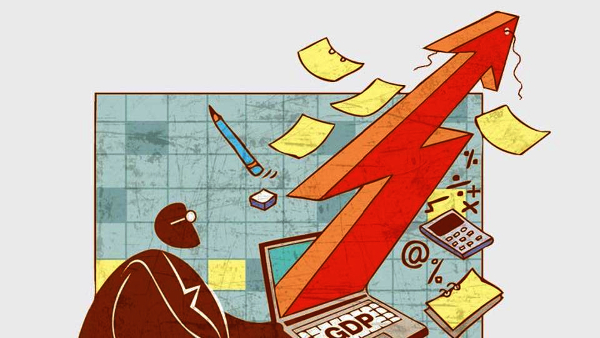
India’s growth story has received another vote of confidence at a time when the world economy is facing uncertainty from geopolitical tensions, trade disruptions, energy-price pressures and uneven demand across major markets. Union Commerce and Industry Minister Piyush Goyal said India’s GDP outlook has been upgraded from 6.4% to 6.5%, describing it as a reflection of the capability and confidence of 1.4 billion Indians. He made the remarks while addressing AMCHAM’s Annual Leadership Summit in New Delhi.
The significance of this upgrade lies not merely in the 0.1 percentage point revision, but in the timing. Many economies are dealing with slower trade, higher uncertainty and external-sector pressures. Against this background, India’s ability to retain a strong growth forecast reinforces its position as one of the world’s most resilient large economies. The IMF’s India country page also lists India’s projected real GDP growth for 2026 at 6.5%, underlining the broad confidence around India’s medium-term economic momentum.
Goyal’s message was that India is no longer approaching global engagement from a position of hesitation. Instead, the country is building trade, investment and industrial partnerships with greater self-assurance. This confidence comes from a combination of domestic demand, expanding manufacturing capability, digital infrastructure, growing services exports, improved policy coordination and a stronger focus on supply-chain resilience. In a world looking for trusted partners, India is increasingly presenting itself as a stable, democratic and scale-driven growth engine.
The World Bank’s April 2026 India Development Update also places India’s performance in a wider context. It noted that India remained the fastest-growing major economy in FY26, with growth accelerating to 7.6% from 7.1% in FY25. The same update projected FY27 growth at 6.6%, while also warning that external headwinds, including the Middle East conflict and energy-market uncertainty, could weigh on the outlook.
This is why the GDP upgrade carries a positive policy message. India is not insulated from global shocks, but it is better placed than many economies to absorb them. A large domestic market gives the country a natural cushion when exports face pressure. Stronger tax collections, infrastructure investment, formalisation of the economy, digital payments, logistics upgrades and production-linked industrial policies have created a broader growth base. Even when external demand weakens, domestic consumption and investment can continue supporting economic activity.
At the same time, the government is conscious of the risks. Goyal also referred to the current account deficit and said that various arms of the government are working in coordination to manage the situation. This is important because a widening current account deficit can put pressure on the currency, import costs and external balances. For an energy-importing country like India, global crude oil prices and shipping disruptions remain key concerns.
The positive side is that India’s policy response has become more coordinated in recent years. Trade policy, industrial incentives, infrastructure development, export promotion, digital public infrastructure and financial-sector monitoring are increasingly being treated as connected parts of the same economic strategy. This matters because modern economic resilience is not built by one ministry or one reform. It comes from a system that can respond quickly to shocks while keeping long-term growth priorities intact.
India’s growth confidence is also linked to its changing role in global supply chains. As companies look to diversify manufacturing and technology operations, India is positioning itself as a trusted alternative with scale, skilled manpower, a large consumer base and improving infrastructure. The AMCHAM platform is particularly relevant in this context because India-US business ties are becoming central to sectors such as electronics, semiconductors, defence production, clean energy, artificial intelligence, data centres and advanced manufacturing.
The GDP upgrade from 6.4% to 6.5% may appear modest on paper, but for a large economy, even a small upward revision represents substantial additional output, investment confidence and employment potential. It also sends a signal to investors that India’s growth is not merely a short-term rebound but a sustained structural trend.
India’s challenge now is to convert this macroeconomic confidence into deeper industrial strength. That means boosting exports, improving MSME competitiveness, strengthening logistics, reducing import dependence in critical sectors, expanding skilling, and ensuring that growth reaches smaller towns and rural production clusters. The next stage of India’s economic rise will depend not just on headline GDP numbers, but on how widely the benefits of growth are distributed.
In the middle of a difficult global environment, India’s upgraded growth forecast offers an important message: the country’s economic fundamentals remain strong, its domestic market remains energetic, and its global partnerships are expanding. If India manages external risks carefully while continuing reforms, the 6.5% growth outlook can become more than a forecast. It can become another milestone in the country’s long march toward becoming a leading global economic power..
You may also like
-
India Advances Trade Diplomacy at G20 Ministerial in Milwaukee
-
Kokasa Launches to Build Indigenous Mission-Critical Systems for Su-30MKI, MiG-29 and T-72
-
Tata Projects and MDS Aero Partner to Build Advanced Aero-Engine Test Infrastructure in India
-
Flying Wedge Defence Partners With Portugal’s Keydef to Manufacture Kaal Bhairava and YAMA Drones in Europe
-
Armenia Conducts Live-Fire Exercise With Indo-French TRAJAN 155 mm Howitzers Manufactured in India
