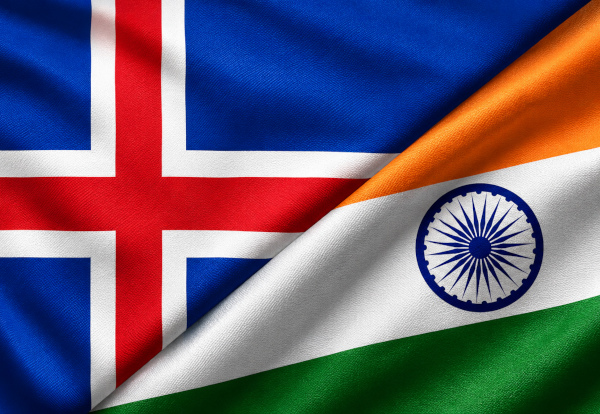
Prime Minister Narendra Modi held a bilateral meeting with Iceland Prime Minister Kristrún Frostadóttir in Oslo on the margins of the 3rd India-Nordic Summit, giving fresh momentum to India’s engagement with one of the key Nordic partners in Europe. The meeting marked the first interaction between the two leaders since Frostadóttir assumed office, with Prime Minister Modi congratulating her on becoming the youngest Prime Minister in Iceland’s history.
The discussion focused on strengthening India-Iceland relations at a time when the India-European Free Trade Association Trade and Economic Partnership Agreement is opening new possibilities for trade, investment and manufacturing collaboration. Iceland, as part of the EFTA grouping along with Norway, Switzerland and Liechtenstein, is now positioned to play a larger role in India’s economic outreach to the Nordic and wider European region.
Both leaders agreed that the TEPA framework can help unlock the real potential of bilateral economic ties. For India, the agreement provides another channel to attract investment, expand industrial cooperation and build stronger links with advanced economies that have niche strengths in technology, clean energy, marine resources and innovation. For Iceland, India offers a large market, a fast-growing manufacturing base and opportunities in sectors where Icelandic expertise can be valuable.
The two Prime Ministers reviewed cooperation in geothermal energy, fisheries, innovative technologies, the creative economy, culture, tourism, mobility and people-to-people exchanges. Geothermal energy is especially significant because Iceland is globally known for its use of geothermal resources, while India is exploring cleaner and more diversified energy options as part of its long-term energy transition. Fisheries and marine cooperation also carry strategic value, given India’s expanding blue economy ambitions and Iceland’s experience in sustainable fisheries management.
Another important area discussed was Arctic research. India has been steadily expanding its polar research profile, and Iceland’s geographic position and scientific ecosystem make it a useful partner for collaboration in climate science, glaciology, ocean studies and Arctic-linked environmental research. The conversation fits into the wider India-Nordic framework, where clean technology, sustainability, innovation and scientific cooperation have become recurring themes.
Prime Minister Modi also invited Prime Minister Frostadóttir to visit India at a mutually convenient time. Such a visit, if finalised, could provide a platform to convert the Oslo discussions into more concrete sectoral cooperation, particularly in clean energy, tourism, mobility, fisheries, technology and Arctic science.
The meeting underlines how India’s Nordic diplomacy is moving beyond broad political engagement into sector-specific partnerships. With Iceland, the most promising areas are not necessarily large-volume trade alone, but high-value cooperation in geothermal energy, marine resources, research, innovation and people mobility. In that sense, the Modi-Frostadóttir meeting adds another focused layer to India’s wider effort to build practical, technology-driven and future-oriented partnerships with the Nordic region.
You may also like
-
PM Modi Meets Nigerian Vice President Kashim Shettima, Reviews Strategic Partnership at BRICS Summit
-
PM Modi Meets African Union Chairperson Évariste Ndayishimiye, Calls for Early India-Africa Forum Summit
-
India and Kazakhstan Agree to Deepen Cooperation in Defence, Energy, Critical Minerals and Emerging Technologies
-
India and Uganda Seek Deeper Technology, Investment and Capacity-Building Partnership at BRICS Summit
-
India and Philippines Agree to Deepen Defence, Trade, Space and Fintech Cooperation at BRICS Summit
