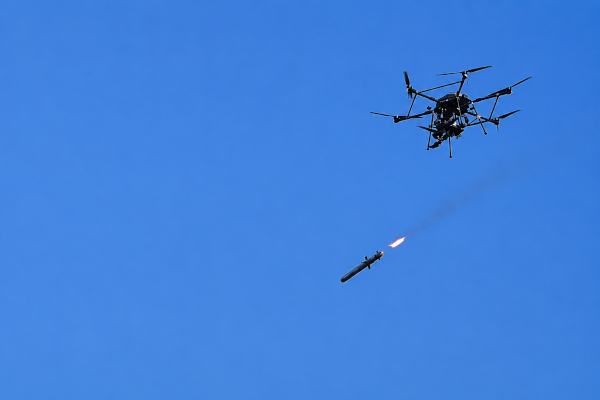
India’s indigenous defence ecosystem has recorded another important milestone with the Defence Research and Development Organisation completing the final development trials of the Unmanned Aerial Vehicle Launched Precision Guided Missile-V3, or ULPGM-V3, in both air-to-ground and air-to-air modes. The trials were conducted at the DRDO test range near Kurnool in Andhra Pradesh, confirming the weapon’s readiness in its final deliverable configuration.
The ULPGM-V3 is significant because it gives unmanned aerial platforms the ability to engage multiple categories of targets with precision. In the air-to-ground role, the missile has been validated for anti-tank missions. In the air-to-air role, it is designed to engage drones, helicopters and other airborne targets, making it relevant for both battlefield strike missions and counter-air threats in the lower airspace.
The trials were carried out using an integrated Ground Control System, which commanded and controlled the ULPGM weapon system during the test campaign. According to the Ministry of Defence, the GCS uses advanced technologies to automate readiness and launch operations, an important feature for UAV-based weapons where fast reaction, remote control and launch sequencing are crucial.
The missile has been developed by Research Centre Imarat, Hyderabad, which served as the nodal laboratory. Other DRDO laboratories involved in the programme include Defence Research and Development Laboratory, Hyderabad, Terminal Ballistics Research Laboratory, Chandigarh, and High Energy Materials Research Laboratory, Pune. This indicates that the project draws on India’s wider missile, propulsion, warhead, ballistics and energetic-material expertise.
A major industrial highlight of the programme is the participation of Indian production partners. DRDO has partnered with Bharat Dynamics Limited, Hyderabad, and Adani Defence Systems & Technologies Limited, Hyderabad, for the development and production of the missiles. For the current trials, the system was integrated on UAVs developed by Newspace Research and Technologies, Bengaluru.
The Ministry of Defence stated that the missile has been produced entirely through the Indian defence ecosystem, involving a large number of MSMEs and other industries. The successful trials also confirmed that the domestic supply chain has matured and is equipped for immediate serial mass production. This is especially important because precision-guided munitions are increasingly required in large numbers for modern conflicts, where drones, loitering systems, helicopters, armour and mobile targets may all appear in compressed time windows.
Defence Minister Rajnath Singh congratulated DRDO, defence public sector units, production partners and industry for the achievement, describing the successful ULPGM-V3 trials as a strategic milestone towards Aatmanirbharta in Defence. DRDO Chairman Dr Samir V. Kamat also congratulated the teams involved in the programme.
The completion of ULPGM-V3 development trials shows how India’s unmanned warfare ecosystem is moving beyond surveillance and reconnaissance into armed precision capability. A UAV-launched missile that can operate in both air-to-ground and air-to-air roles gives future Indian unmanned platforms a more flexible combat profile. It also strengthens the domestic defence manufacturing chain by linking DRDO laboratories, public sector production units, private industry, start-ups and MSMEs into a single weapon-development ecosystem.
For India, the larger message is clear: the next phase of battlefield capability will depend not only on drones, but on the weapons they can carry, the control systems that can launch them, and the industrial base that can produce them at scale. The ULPGM-V3 programme fits directly into that shift.
You may also like
-
PRAHAAR: India’s First National Counter-Terrorism Policy and Strategy
-
Takshak Heavyweight Torpedo: How India’s Indigenous Submarine Weapon Compares With the World’s Leading Torpedoes
-
Embraer Builds Dual Aerospace Strategy in India Through C-390 Military and E175 Regional Aircraft Programmes
-
NextLeap Tests Indigenous Jet Engine for Long-Range Stryker Kamikaze UAV
-
Côte d’Ivoire Military Delegation Visits HAL, Shows Interest in India’s Indigenous Aerospace Platforms
