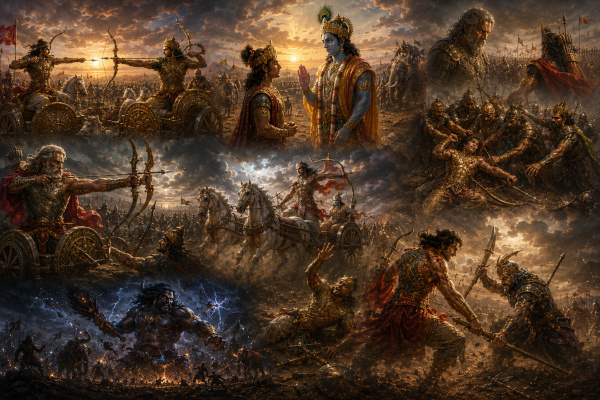
Kurukshetra begins with ceremony, conches, standards and warriors facing one another under a code. The armies are vast, but the war is still imagined as a Dharma Yuddha — a righteous war governed by restraint. Warriors are expected to fight equals, honour the disabled, spare the unarmed, respect the rhythm of day and night, and treat combat as a grave duty rather than uncontrolled slaughter. As the eighteen days pass, that ethical world begins to crack. By the end, the Mahabharata has become one of the world’s most powerful warnings about what happens when war loses its moral centre.
The epic’s rules of war are strikingly mature. The Shanti Parva says a warrior should fight an equal opponent, abandon combat when the opponent becomes disabled, and avoid striking one who is frightened, defeated, wounded, weaponless, or deprived of his vehicle. It also says wounded opponents should receive treatment from skilled surgeons, and that victory gained through unrighteous means brings moral injury to the victor. The Lieber Institute at West Point summarises the Bhishma Parva’s war code in similar terms: equal combat, warning before attack, protection for those leaving battle, and restraint toward the unarmed, unsuspecting, afflicted, inattentive, armourless, charioteers, weapon-carriers, drummers and conch-blowers.
Modern international humanitarian law follows a related moral instinct through different legal language. The ICRC explains that the choice of weapons and methods of warfare is limited, and that hostilities are regulated by distinction, proportionality and precaution. It also says attacks should be directed at combatants and military objectives, while civilians and civilian objects receive protection. The Mahabharata’s battlefield ethics arose from a kshatriya honour code rather than treaty law, yet the underlying concern is familiar: even in war, power requires limits.
Dharma Yuddha: The Ideal Code of Battle
Dharma Yuddha in the Mahabharata is built on the idea that war may become necessary, but cruelty should never become the spirit of war. The warrior is judged by courage, restraint, skill and fairness. He should face a comparable opponent, avoid striking the helpless, and preserve dignity even in violent conflict. This is why the early war under Bhishma feels different from later phases. Bhishma is fierce, but his command still carries the authority of an older moral order.
The code also reflects practical battlefield wisdom. When chariots fight chariots, elephants face elephants, and armed warriors face armed warriors, the war remains structured. When those boundaries dissolve, battle turns into predation. The ancient rule therefore protected both honour and order. It prevented the battlefield from becoming a place where any method could be justified by victory.
Modern comparison comes naturally. Today, rules of engagement, the Geneva Conventions, command responsibility and military law perform the role that dharma performed in epic imagination. A modern soldier is trained to distinguish combatants from civilians, respect surrender, protect medical personnel, avoid unnecessary suffering and use proportionate force. The vocabulary has changed from dharma to law, but the central question remains the same: how does a fighting force preserve discipline when violence becomes extreme?
When Rules Collapse: From Bhishma’s Command to Total War
The Mahabharata’s ethical power comes from its gradual decline. The war begins with restraint, then moves into vengeance, tactical desperation and moral compromise. The Lieber Institute notes that during Bhishma’s first ten days as general, major breaches of the military laws are absent, while after Bhishma’s fall the Kauravas lose their main arbiter of dharma. This is a crucial defence lesson: a commander is also a moral stabiliser. When such a figure falls, the army loses more than a tactician; it loses a living boundary.
After Bhishma, Drona brings greater tactical sharpness but also a colder battlefield mood. Formations grow more complex, pressure increases, and the death of Abhimanyu becomes a turning point. Once Abhimanyu is surrounded and killed, Arjuna’s grief becomes a vow of vengeance. The next day becomes a time-bound mission to kill Jayadratha. War has now shifted from ordered combat toward retaliation.
The decline continues through Drona’s death, Karna’s death and Duryodhana’s final duel. Each episode carries tactical logic, but each also leaves moral unease. The Mahabharata never allows victory to look clean. It shows that when one side breaks the code, the other side begins to answer with its own hard necessity. Modern wars show similar escalation patterns: one atrocity fuels retaliation, one unlawful tactic invites another, and battlefield morality collapses step by step.
This is the epic’s warning against total war. Total war begins when the objective consumes the code. Once victory becomes the only measure, wounded enemies, night restrictions, equal combat, truthful speech and proportionate conduct all begin to appear inconvenient. The Mahabharata teaches that such victory carries a hidden cost: the winner survives, yet the moral world that made victory meaningful suffers deep damage.
Abhimanyu and the Ethics of Encirclement
Abhimanyu’s death is the Mahabharata’s most painful study of battlefield imbalance. He enters the Chakravyuha with extraordinary skill, breaks through a formation many seasoned warriors fear, and fights with dazzling courage. Yet he is isolated when the supporting Pandava warriors are held back. The text describes him piercing the impenetrable circular array and later being encountered by six heroes together before he falls to Duhsasana’s son.
Yudhishthira later tells Arjuna that Jayadratha checked the Pandavas, while Drona, Kripa, Karna, Ashwatthama, Kritavarman and others surrounded Abhimanyu and deprived him of his car. This is followed by Arjuna’s grief and his vow to kill Jayadratha the next day. The emotional force of the episode lies in the contrast between Abhimanyu’s youth and the seniority of the warriors surrounding him. His courage is individual; the force against him is collective.
In modern legal terms, numerical superiority alone does not automatically create an unlawful attack against a combatant. Armies regularly concentrate force at decisive points. The ethical issue becomes sharper when the combatant is disabled, weaponless, surrendering, wounded or otherwise hors de combat. ICRC customary law states that attacking persons recognised as hors de combat is prohibited. The Mahabharata’s own code is stricter in honour terms: many senior warriors overwhelming a young, isolated, chariotless fighter becomes a sign that the battlefield’s moral balance has broken.
The defence lesson is powerful. Encirclement can be tactically brilliant, yet honour depends on how it is used. A trapped enemy who continues to fight remains a military threat. A disabled or helpless enemy becomes a test of the victor’s discipline. Abhimanyu’s death turns the Chakravyuha from a tactical formation into a moral wound. It teaches that battlefield success gained through unfair concentration can produce strategic anger, morale shock and long-term legitimacy damage.
Karna’s Death and the Question of Battlefield Fairness
Karna’s death is one of the epic’s most morally debated moments because it comes after a chain of earlier violations. His chariot wheel sinks into the earth, his memory of key weapons fails, and he asks Arjuna to wait while he frees the wheel. The Karna Parva describes the earth swallowing one of Karna’s wheels and Karna appealing to Arjuna to pause until the wheel is lifted.
Krishna then urges Arjuna to act, reminding him through the larger moral history of the war. Soon after, Karna is vulnerable, and Arjuna releases the fatal weapon. The text says Krishna told Arjuna to cut off Karna’s head before he could regain the chariot, and Arjuna then struck Karna’s standard and prepared the Anjalika weapon. This scene sits at the centre of the Mahabharata’s hardest question: does previous injustice justify harsh action in the present?
A simple heroic reading says Karna received the consequence of participating in earlier wrongs, including Abhimanyu’s death and Draupadi’s humiliation. A strict Dharma Yuddha reading says the killing of a chariotless warrior repeats the very collapse that the Pandavas suffered earlier. The epic leaves room for both responses. That is why the scene has survived for centuries as moral drama rather than mere combat report.
Modern military ethics would frame the problem around status, threat and immediate necessity. A temporarily disabled combatant can remain dangerous if he continues fighting or intends to resume combat. A person clearly surrendering, unconscious, severely wounded or incapable of resistance receives protection. Karna’s case is ethically difficult because he is still a great warrior in an active duel, yet his appeal invokes the older rule of fair combat. The Mahabharata uses this ambiguity to show how difficult clean morality becomes after prolonged escalation.
The defence-level lesson is this: once battlefield rules are repeatedly violated, later decisions become morally contaminated. Commanders start arguing from precedent rather than principle. Karna’s death is therefore both tactical resolution and ethical symptom. It shows the cost of a war where dharma has already been wounded many times.
Night War and the Death of Ghatotkacha
The death of Ghatotkacha brings another dimension into the series: night warfare, irregular capability and the use of a special battlefield asset. The Drona Parva describes fighting at dead of night, with troops throwing down torches and both sides suffering confusion. Ghatotkacha and other rakshasa warriors use illusion, sudden movement, fear and shock to disrupt the Kaurava host.
This episode has a very modern flavour. Night changes the battlefield. Visibility drops, identification becomes harder, fear multiplies, formations loosen and troops become vulnerable to panic. Ghatotkacha thrives in this environment. The text describes his illusions, aerial movement, terrifying appearances, showers of weapons and the Kaurava army wandering in pain and fear.
Modern comparison can be drawn with night operations, special operations forces, electronic warfare, drone swarms, psychological shock and irregular units trained for terrain or conditions that conventional troops find difficult. Night-fighting units with thermal optics, night-vision devices, drones, suppressors, navigation systems and special training can create the same kind of disproportionate effect: the battlefield becomes unfamiliar to one side and natural to the other.
Krishna’s use of Ghatotkacha is also strategic. Karna possesses the divine dart given by Indra, held for Arjuna. By pushing Ghatotkacha into the decisive night battle, Krishna forces Karna to spend that weapon. The text explicitly says Vasudeva caused Ghatotkacha to be slain by Karna because the fatal dart would otherwise threaten Arjuna, and that its use on Ghatotkacha rendered it fruitless for Karna’s larger objective.
This is cold but brilliant operational planning. Ghatotkacha becomes a special asset used to absorb an enemy’s strategic weapon. Modern parallels include decoys that draw missiles, unmanned systems used to reveal air defences, electronic bait to trigger radars, and sacrificial manoeuvres designed to force the enemy to expend a scarce precision weapon. The episode is tragic because Ghatotkacha dies; it is strategic because Arjuna survives.
The Mahabharata’s Military Ethics and Modern Defence
The Mahabharata’s rules of war section gives the defence series unusual depth because it shows the moral architecture beneath military action. Armies need formations, weapons and commanders, but they also need limits. Limits protect civilians, wounded enemies, disabled combatants, medical personnel, messengers, and the honour of the force itself. A force that abandons all limits may win ground and still lose legitimacy.
Modern international humanitarian law exists for the same reason. The ICRC explains that IHL seeks to impose limits on destruction and suffering in armed conflict, and that the right of belligerents to injure the enemy is limited. The Mahabharata, through its own civilisational vocabulary, reaches a similar conclusion: war may test righteousness, but war without righteousness consumes everyone.
The positive power of these episodes lies in their honesty. The epic does not pretend that heroes remain perfect. Bhishma’s fall creates moral instability. Abhimanyu’s death wounds the code. Drona’s killing bends truth. Karna’s death raises fairness questions. Ghatotkacha’s sacrifice reveals the harsh mathematics of war. Duryodhana’s final fall completes the cycle of vengeance. Through all this, the Mahabharata teaches that dharma is most valuable precisely when it becomes hardest to preserve.
For modern defence readers, this is the central lesson: battlefield superiority must be joined with ethical discipline. Rules of engagement, legal advice, command accountability, training, proportionality, protection of the helpless and restraint under anger are not decorative ideas. They are part of combat power because they preserve the legitimacy and inner cohesion of the force. Kurukshetra shows that when rules collapse, even victory becomes heavy.
Reference:
Lieber Institute, West Point — Dharma and Ancient Indian Military Laws in the Mahabharata
https://lieber.westpoint.edu/dharma-ancient-indian-military-laws-mahabharata/
The Mahabharata, Book 12: Shanti Parva — rules of righteous combat
https://sacred-texts.com/hin/m12/m12a094.htm
The Mahabharata, Book 7: Drona Parva — Abhimanyu enters the circular array
https://www.ibiblio.org/sripedia/ebooks/mb/m07/m07031.htm
The Mahabharata, Book 7: Drona Parva — Yudhishthira narrates Abhimanyu’s encirclement and Arjuna’s vow
https://sacred-texts.com/hin/m07/m07070.htm
The Mahabharata, Book 8: Karna Parva — Karna’s chariot wheel sinks
https://sacred-texts.com/hin/m08/m08090.htm
The Mahabharata, Book 8: Karna Parva — Arjuna kills Karna
https://sacred-texts.com/hin/m08/m08091.htm
The Mahabharata, Book 7: Drona Parva — Ghatotkacha’s night battle
https://sacred-texts.com/hin/m07/m07171.htm
The Mahabharata, Book 7: Drona Parva — Ghatotkacha’s illusions and Karna’s fatal dart
https://sacred-texts.com/hin/m07/m07176.htm
The Mahabharata, Book 7: Drona Parva — Krishna’s strategy behind Ghatotkacha’s death
https://sacred-texts.com/hin/m07/m07179.htm
ICRC — What is International Humanitarian Law?
https://www.icrc.org/sites/default/files/document/file_list/what_is_ihl.pdf
ICRC — Customary IHL Rule 47: Attacks against persons hors de combat
https://ihl-databases.icrc.org/en/customary-ihl/v1/rule47
You may also like
-
India Advances Project-75(I) and Submarine Modernisation Plans to Strengthen Underwater Warfare Capability
-
Kokasa Launches to Build Indigenous Mission-Critical Systems for Su-30MKI, MiG-29 and T-72
-
Flying Wedge Defence Partners With Portugal’s Keydef to Manufacture Kaal Bhairava and YAMA Drones in Europe
-
ASEAN Diplomats Visit BrahMos Facility as India Showcases Defence Engineering Capabilities
-
India and UAE Agree to Expand Army Cooperation and Desert Cyclone Participation
