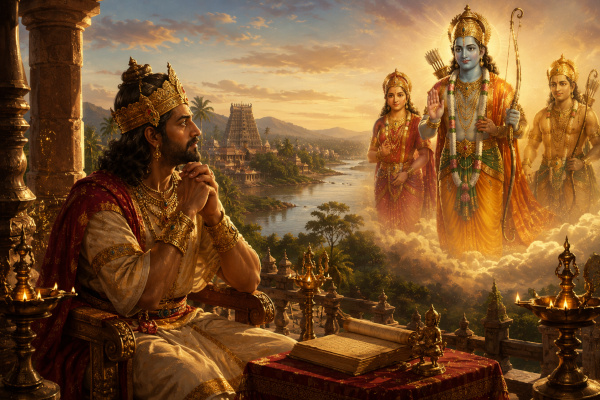
Kulasekhara Alvar stands at a rare meeting point in South Indian history: he is remembered as a king, poet, devotee, patron and saint. In Kerala’s historical imagination, he belongs to the world of the Chera Perumals, the medieval rulers associated with Mahodayapuram or Kodungallur. In the Sri Vaishnava tradition, he is revered as one of the twelve Alvars, the poet-saints whose devotional hymns helped shape the emotional and literary world of Vishnu bhakti in South India. This double identity makes him one of the most fascinating royal figures of the early medieval period: a ruler whose memory survived less through conquest than through surrender, less through military monuments than through poetry, temple devotion and the spiritual authority of bhakti.
This careful article on Kulasekhara has to keep two layers together. The first is the historical Kulasekhara, connected with the Chera Perumal line of Kerala. The second is the devotional Kulasekhara Alvar, preserved in Vaishnava hagiography as a king who became so absorbed in Rama and Vishnu that worldly kingship eventually appeared small before divine service. Some historians identify him with Sthanu Ravi Kulasekhara, a Chera ruler of the 9th century, while literary discussions also connect a royal Kulasekhara Varman of Kerala with Sanskrit drama and devotional literature. The identification is important, but it should be handled with maturity because the historical, literary and hagiographical traditions overlap rather than always giving one neat biography. A Kerala archaeology journal notes the scholarly identification of Sthanu Ravi, dated roughly c. 844–883 CE, with Kulasekhara Alvar, one of the twelve Vaishnava Alvars.
The Alvars were South Indian Vishnu devotees whose hymns transformed temple worship into intensely emotional poetry. Britannica describes the Alvars as mystics active between the 7th and 10th centuries, moving from temple to temple and singing ecstatic hymns in praise of Vishnu. Their Tamil devotional world later became canonised in the Nalayira Divya Prabandham, the “Collection of 4,000 Songs,” gathered in the Sri Vaishnava tradition. Kulasekhara’s importance lies in the fact that he entered this tradition as a kingly voice. He did not speak like a distant court poet describing gods from outside. His poetry enters the emotional centre of the Ramayana and Krishna tradition, turning devotion into dramatic identification.
Tradition places Kulasekhara in Chera Nadu, the western land of mountains, rivers, ports and temples that corresponds broadly with Kerala. Sri Vaishnava tradition says he was born in the Chera country, came to the throne after his father, and became deeply devoted to Sri Rama. The Koyil Divya Prabandham tradition associates him with Thiruvanjikkalam, presents him as a Chera king, and remembers him as a ruler whose mind moved constantly towards Rama, Srirangam and the service of Vishnu. The traditional biography even says that when he heard the Ramayana narrated, he reacted as if the events were happening before his eyes. This is the key to understanding him: for Kulasekhara, sacred memory was not literature alone; it was living presence.
Historically, Kulasekhara belongs to the moment when Kerala’s Chera Perumal polity was developing around Mahodayapuram. This was a world of temple institutions, land grants, Brahmin settlements, maritime trade, Sanskrit learning, Tamil bhakti and regional kingship. The same Kerala archaeology source notes that the early later Chera rulers Rama Rajashekhara and Sthanu Ravi are connected respectively with Shaiva and Vaishnava saintly identities, and that family temples dedicated to Shiva and Vishnu emerged around the capital region. It specifically links Sthanu Ravi / Kulasekhara Alvar with Tirukkulasekharapuram, a Vishnu temple near the Chera capital. This gives Kulasekhara’s memory a strong Kerala base: he was not merely adopted into Tamil devotional tradition; he also remained rooted in the sacred geography of the west coast.
His greatest Tamil work is Perumal Tirumozhi, a set of 105 pasurams arranged in ten decads and included in the Divya Prabandham tradition. The Koyil Divya Prabandham site describes Perumal Tirumozhi as a work of 105 pasurams by Kulasekhara Alvar, forming part of the Mudhal Ayiram section of the canon. The work is especially loved for its emotional nearness to Rama and Krishna. Kulasekhara does not approach Vishnu with abstract theology alone. He wants to be near the Lord in any form possible: as a servant, a bird, a stone step, a devotee at the temple threshold, or a participant in the divine story. His poetry has the simplicity of longing and the grandeur of royal renunciation.
One of Kulasekhara’s most powerful traits is his Rama-bhakti. In the traditional imagination, he was so moved by the suffering of Rama, Sita, Lakshmana and Dasharatha that the boundary between listener and participant disappeared. He did not merely hear the Ramayana; he entered it. When Rama was in danger, Kulasekhara wanted to send his army. When Sita was abducted, he responded like a king whose own queen had been seized. This gives his devotion a royal flavour: he brings the instinct of protection, honour and loyalty into bhakti. He is not a passive devotee; he is a warrior-king whose heart has been conquered by Rama.
His Krishna devotion is equally tender. Kulasekhara’s poetry often moves into the emotional worlds of the mothers, lovers and devotees around Krishna. He can imagine the pain of separation, the wonder of divine childhood and the sweetness of surrender. This is why he belongs comfortably among the Alvars: their poetry often dissolves the rigid boundary between devotee and divine drama. The soul does not remain outside the story. It becomes mother, lover, servant, friend and witness.
Kulasekhara is also associated with the Sanskrit devotional hymn Mukundamala, though scholarship discusses its authorship with care. WisdomLib’s discussion of Sanskrit sources of Kerala history notes that Mukundamala is a short devotional lyric attributed to king Kulasekhara, while also recording that different scholars have debated whether its author is Kulasekhara Alvar, Kulasekhara Perumal or the royal dramatist Kulasekhara Varman. This uncertainty should not reduce his stature. Rather, it shows how powerful the Kulasekhara memory became: multiple streams of Kerala and Vaishnava literary tradition preserved him as a royal devotee whose name naturally attached itself to Sanskrit and Tamil works of bhakti.
The figure of Kulasekhara Varman, the royal dramatist of Kerala, adds another fascinating layer. Literary sources describe a king of Kerala with his capital at Mahodayapuram, presenting himself as a descendant of the Kerala family and a patron of refined Sanskrit culture. WisdomLib’s discussion of Kulasekhara Varman’s dramas notes that the prologue to his work identifies him as a Kerala king based at Mahodayapuram, and also connects him with literary works such as Tapatisamvaranam and Subhadradhananjayam. Some traditions and scholars connect this dramatist-king with Kulasekhara Alvar, while others keep them distinct. For a modern reader, the safest conclusion is that the name Kulasekhara became attached to a brilliant royal-cultural world in Kerala where kingship, Sanskrit drama, temple culture and Vishnu devotion intersected.
As a ruler, Kulasekhara’s importance lies not in a long list of campaigns, but in the ideal of kingship he represents. The Chera Perumal period was marked by temple-centred social organisation, regional authority and interaction with wider South Indian religious currents. Kulasekhara’s memory suggests a ruler who understood that royal power had to serve dharma, temple culture and public moral order. His devotional transformation does not make him politically weak; it makes him civilisationally powerful. He becomes an example of the king who sees sovereignty as stewardship.
His connection with Srirangam is central to Sri Vaishnava memory. Tradition says he longed to visit Srirangam, spent time there, supported temple structures, and even symbolically offered his daughter to the deity. The Koyil tradition preserves this devotional association, including his desire for Srirangam and his service to the temple. Whether every detail is read as history or sacred tradition, the message is clear: Kulasekhara’s kingship culminated in temple service. He moved from throne to sanctum, from sceptre to surrender.
This is why Kulasekhara’s life has such article value for Dharmakshethra. He is not simply “a king who became a saint.” He represents a South Indian model of cultural kingship, where literature, devotion, temple patronage and political identity flowed together. In him, Kerala’s Chera memory meets Tamil Vaishnava bhakti. Sanskrit court culture meets Tamil sacred song. Royal authority meets humility. The result is a personality who belongs equally to historians, devotees, literary scholars and cultural readers.
Kulasekhara’s legacy also has a beautiful modern relevance. In today’s world, leadership is often measured by expansion, wealth, visibility and control. Kulasekhara offers another model: a leader remembered because his power softened into devotion, because his poetry outlived his palace, because his faith made him intimate with ordinary devotees. His greatness lies in the fact that he made kingship kneel before bhakti without making kingship appear small. He showed that a ruler’s finest crown may be the ability to recognise something higher than himself.
The Chera ruler, the Alvar saint, the Tamil poet, the possible Sanskrit author, the temple servant and the Rama-bhakta all come together in Kulasekhara. His life may contain debated historical layers, but his cultural identity is luminous. He stands as one of Kerala’s most evocative royal spiritual figures: a king whose memory travelled beyond inscriptions into song, beyond court into temple, and beyond time into living devotion.
You may also like
-
Suhma — The River-and-Forest Country of Southwestern Bengal
-
Gauda — The Western Bengal Country of the Bhagirathi and the Rise of Karnasuvarna
-
Pundra — The Northern Bengal Kingdom of the Karatoya and the Ancient City of Pundranagara
-
Vanga — The River Kingdom of the Bengal Delta and the Eastern Sea
-
Kishkindha — The Boulder Kingdom of Pampa, Rishyamukha and the Tungabhadra
