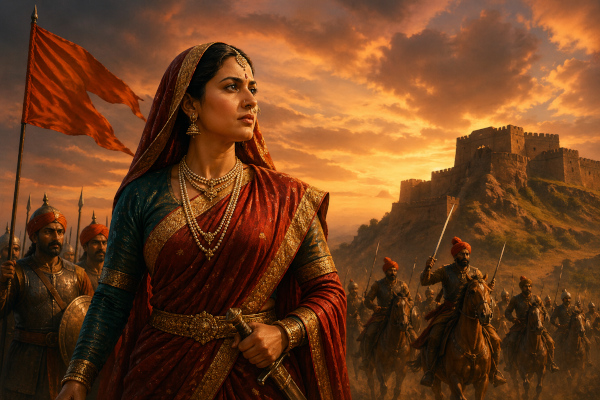
Maharani Tarabai Bhonsle stands among the most formidable women in Indian political and military history. She was born in 1675, only a few months after Chhatrapati Shivaji Maharaj had formally established the Maratha state, and she entered history at a moment when the Deccan was turning into the great battlefield of India. Cambridge historian Richard M. Eaton, in A Social History of the Deccan, 1300–1761, describes the anti-Mughal resistance of the western Deccan as a movement led by Tarabai, calling her “one of the most remarkable women in Indian history.”
Tarabai was born into the powerful Mohite clan of the Marathas. Her father was Hambirrao Mohite, one of the most important Maratha commanders and the Sarnobat, or commander-in-chief, under Chhatrapati Shivaji Maharaj. This meant Tarabai did not come from a soft palace background alone; she was born into a military household where warfare, cavalry movements, fort strategy and Deccan politics were part of daily life. Her lineage also connected her deeply to the Bhonsle royal house, becausWarrior queen at duske Hambirrao Mohite’s sister Soyarabai was one of Shivaji Maharaj’s queens and the mother of Rajaram.
Tarabai married Rajaram Bhonsle, the younger son of Chhatrapati Shivaji Maharaj. Through this marriage, she became both the daughter of a great Maratha military commander and the daughter-in-law of the founder of the Maratha state. Rajaram later became Chhatrapati after the brutal Mughal capture and execution of Sambhaji Maharaj in 1689. The Maratha state at that point was under extreme pressure: Aurangzeb had personally moved into the Deccan, Sambhaji was dead, Shahu was in Mughal captivity, and the Mughal empire was throwing its enormous manpower and treasury into crushing Maratha resistance. Britannica notes that after Sambhaji’s execution, Rajaram ascended the Maratha throne while Aurangzeb continued the Deccan war.
When Rajaram died in March 1700, the Maratha state seemed to be on the edge of collapse. But Tarabai moved with astonishing speed. She declared her young son Shivaji II as Rajaram’s successor and took charge as regent. This was not a ceremonial regency. She became the political brain, military organiser and symbolic centre of Maratha resistance. In a world where kingship was normally imagined as male, Tarabai stepped into command not as a widow seeking protection, but as a sovereign mind directing war.
Her greatest contribution was keeping the Maratha resistance alive during the most dangerous phase of Aurangzeb’s Deccan campaign. From 1700 to 1707, she coordinated Maratha war efforts against the Mughal empire at a time when Aurangzeb was personally present in the Deccan and determined to destroy Maratha power. Instead of fighting the Mughals only in conventional set-piece battles, the Marathas used speed, fort networks, cavalry raids, supply-line attacks and strategic dispersal. Tarabai understood the Maratha strength: the empire could lose forts and still survive if the army, countryside networks, commanders and mobile resistance remained alive.
The Mughal emperor captured important forts, including Satara, but Tarabai’s resistance ensured that territorial conquest did not become political victory. This was the genius of her strategy. Aurangzeb could occupy strongholds, but the Marathas kept reappearing elsewhere. They cut supply lines, struck Mughal detachments, moved into Mughal-held regions and forced the imperial army into an exhausting, expensive, endless war. By the early 1700s, Maratha forces were not merely defending Maharashtra; they were pushing into Mughal territories in the Deccan, Malwa and Gujarat zones, showing that Tarabai’s resistance had shifted from survival to counter-pressure.
Her notable war, therefore, was not a single battle but a full theatre campaign: the Maratha-Mughal struggle in the Deccan during Aurangzeb’s final years. She resisted the greatest imperial army in India at that time and helped convert Aurangzeb’s Deccan campaign into a long imperial drain. Aurangzeb died in 1707 after spending the last decades of his life in the Deccan, and by then the Marathas had not been destroyed. In fact, they had survived the worst storm and were ready to expand in the 18th century.
Another major political conflict came after Aurangzeb’s death, when the Mughals released Shahu, the son of Sambhaji, partly to divide the Maratha leadership. Shahu claimed the Chhatrapati’s seat by hereditary right, while Tarabai defended the claim of her son Shivaji II. This led to a Maratha civil conflict between the Satara line of Shahu and the Kolhapur line associated with Tarabai and Shivaji II. Shahu eventually gained the upper hand, especially after important Maratha sardars shifted to his side, but Tarabai’s resistance created the basis for the later Kolhapur branch of the Bhonsle house.
Tarabai’s career did not end with her defeat by Shahu. In 1714, she was overthrown in Kolhapur by Rajasbai, another queen of Rajaram, who placed her own son Sambhaji II on the Kolhapur throne. Tarabai and her son Shivaji II were imprisoned, showing how ruthless internal Maratha palace politics had become. Yet even after this setback, she remained a political force. Her later life was full of intrigue, especially during the rise of the Peshwas and the weakening of direct Chhatrapati authority.
In the 1740s, Tarabai again returned to the centre of Maratha politics. Since Shahu had no biological son, she presented a young man whom she claimed was her grandson, later known as Rajaram II or Ramaraja, and Shahu adopted him as heir. After Shahu’s death in 1749, Rajaram II became Chhatrapati, but Tarabai soon clashed with him and with the powerful Peshwa Balaji Baji Rao. In a dramatic turn, she imprisoned Rajaram II at Satara and later even claimed that he was not truly her grandson. This episode shows how Tarabai was not only a battlefield-era queen; she was also one of the sharpest political players of the 18th-century Maratha world.
Her final years were spent in Satara, watching the Maratha state transform from Shivaji’s compact western Deccan kingdom into a vast power spread across India, increasingly run through the Peshwa system. She lived long enough to see both Maratha glory and Maratha tragedy. In 1761, the Marathas suffered a catastrophic defeat at the Third Battle of Panipat against Ahmad Shah Abdali. A few months later, on 9 December 1761, Tarabai died at Satara at the age of about 86. Her death was not the dramatic battlefield death of a young warrior queen, but the passing of an old political lioness who had outlived Aurangzeb, Rajaram, Shahu, and an entire generation of Maratha statesmen.
Tarabai’s legacy is immense because she preserved the Maratha state at the moment when it could have disappeared. Had she failed after Rajaram’s death, Aurangzeb might have succeeded in breaking Maratha resistance before his own death. Instead, Tarabai ensured continuity. She gave the Marathas time, morale, leadership and political legitimacy when everything seemed lost. She was not merely Rajaram’s widow or Shivaji’s daughter-in-law. She was the regent who turned a crisis into resistance, resistance into survival, and survival into the foundation of later Maratha expansion.
Sources:
https://www.cambridge.org/core/books/social-history-of-the-deccan-13001761/tarabai-16751761-the-rise-of-brahmins-in-politics/047C683C223579529A84EC66D9A68F5A
https://www.cambridge.org/core/books/social-history-of-the-deccan-13001761/94B955438388C26562F08912D1B0F708
https://www.britannica.com/topic/Maratha-Empire
https://www.britannica.com/topic/Bhonsle-Dynasty
https://byjus.com/free-ias-prep/tarabai-1675-1761/
https://thebetterindia.com/121097/rani-tarabai-warrior-queen-maratha-shivaji-aurangzeb-inspiring-woman/
https://timesofindia.indiatimes.com/city/kolhapur/jain-monks-claim-about-jain-woman-queen-defeating-aurangzeb-sparks-row/articleshow/129961682.cms
You may also like
-
India Creates History with Record 114 Medals at Asian Para Games 2026, Prime Minister Modi Hails Para-Athletes
-
Shaka in the Mahabharata: Central Asia’s Steppe Peoples, Nakula’s Campaign and the Alliance with Duryodhana
-
Yavana in the Mahabharata: Greek Connections, Pandava Campaigns and the Warriors of Kurukshetra
-
India and Sri Lanka Launch SAMHiTA Manuscript Digitisation Project to Preserve Ancient Buddhist Heritage
-
ASI Uses Ground-Penetrating Radar to Investigate Ancient Buddhist Stupa at Ujjain After Nearly 90 Years
