
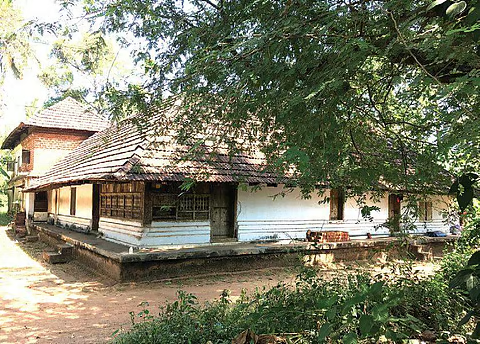
Madhava of Sangamagrama (c. 1340–1425 CE) was one of the most influential mathematicians and astronomers in pre-modern India, and is widely regarded as the founder of the Kerala School of Astronomy and Mathematics. He was born in Sangamagrama, a place generally identified with the region around present-day Irinjalakuda in the state of Kerala. While exact historical records about his family are scarce, traditional accounts suggest that he belonged to a learned Nambudiri Brahmin family, a community known for its scholarly engagement with Vedic studies, astronomy, and mathematics. However, the names of his parents and detailed biographical information about his early life have not survived in reliable historical sources, which is common for many scholars of his era.
Living during the late medieval period, Madhava inherited a rich tradition of Indian mathematics that stretched back to figures like Aryabhata and Brahmagupta, yet he went far beyond his predecessors in both depth and originality. His most remarkable contribution lies in his development of infinite series, a concept that would only emerge in Europe several centuries later. Madhava discovered that functions such as sine, cosine, and arctangent could be expressed as infinite sums, effectively laying the groundwork for what is now known as calculus. His work on infinite series for π is especially noteworthy; he derived a series equivalent to what later became known in Europe through Gottfried Wilhelm Leibniz, but crucially, Madhava improved its accuracy by introducing correction terms that significantly accelerated convergence. Using these methods, he was able to calculate the value of π to a high degree of precision, an extraordinary achievement for his time.
Madhava’s mathematical thinking reflects a deep understanding of approximation, limits, and the behavior of infinite processes. Although he did not formalize these ideas into a complete system as later done by Isaac Newton and Leibniz, his work clearly anticipates many of the essential concepts of calculus. He also made substantial contributions to trigonometry, producing accurate sine tables and refining computational techniques that were vital for astronomical calculations. Astronomy and mathematics were closely intertwined in his work, as precise trigonometric values were essential for predicting planetary motions and eclipses.
Much of what is known about Madhava’s work comes not from his own surviving writings, but from later texts composed by scholars of the Kerala School. His original works, such as Golavāda, Madhyāmanayanaprakāra, Veṇvāroha, and Sphuṭacandrāpti, are either lost or only partially preserved through references. Later mathematicians like Nilakantha Somayaji expanded upon his discoveries, and texts such as the Yuktibhāṣā provide detailed explanations and proofs of the methods attributed to him. Through these works, it is clear that Madhava initiated a sustained intellectual tradition in Kerala that continued to develop advanced mathematical ideas for several centuries.
The significance of Madhava’s contributions lies not only in the specific results he obtained but also in the conceptual shift he introduced. By systematically working with infinite series, he transformed mathematics from a discipline focused primarily on finite procedures into one capable of handling infinite processes with precision. This shift represents an important step toward modern mathematical analysis. While there is ongoing debate about whether his ideas influenced later developments in Europe, there is no doubt that his work stands independently as a major intellectual achievement.
Despite the gaps in our knowledge about his personal life, including the absence of confirmed details about his parents or early education, Madhava’s intellectual legacy is firmly established. He remains a central figure in the history of mathematics, particularly in India, and is often celebrated as a pioneer whose insights anticipated some of the most important developments in mathematics by nearly two centuries.
You may also like
-
India Creates History with Record 114 Medals at Asian Para Games 2026, Prime Minister Modi Hails Para-Athletes
-
Shaka in the Mahabharata: Central Asia’s Steppe Peoples, Nakula’s Campaign and the Alliance with Duryodhana
-
Yavana in the Mahabharata: Greek Connections, Pandava Campaigns and the Warriors of Kurukshetra
-
India and Sri Lanka Launch SAMHiTA Manuscript Digitisation Project to Preserve Ancient Buddhist Heritage
-
ASI Uses Ground-Penetrating Radar to Investigate Ancient Buddhist Stupa at Ujjain After Nearly 90 Years
