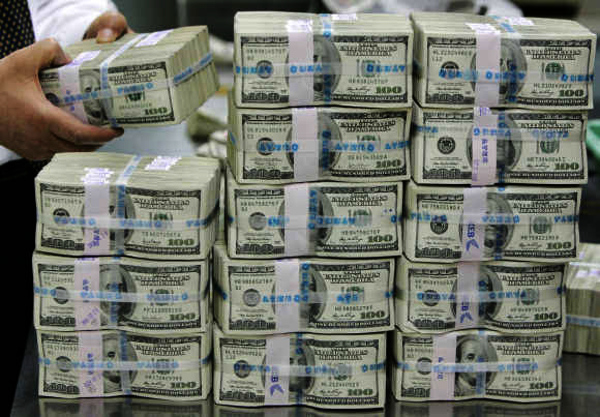
India’s foreign exchange reserves rose by $2.362 billion to reach $703.308 billion for the week ended April 17, 2026, according to data released by the Reserve Bank of India. This marks another week of recovery in the country’s forex position, after reserves had crossed the $700-billion level in the previous reporting week.
The rise was led mainly by an increase in foreign currency assets, the largest component of India’s reserves. Foreign currency assets rose by $1.481 billion to $557.463 billion during the week. These assets include the effect of movements in non-dollar currencies such as the euro, pound and yen when expressed in dollar terms.
Gold reserves also continued to strengthen, increasing by $790 million to more than $122 billion. The growth in gold holdings has become an important support factor in India’s reserve position at a time when global geopolitical uncertainty and currency volatility remain elevated. Special Drawing Rights rose by $78 million to $18.84 billion, while India’s reserve position with the International Monetary Fund edged up by $14 million to around $4.87 billion.
In the previous reporting week, India’s forex kitty had increased by $3.825 billion to $700.946 billion, meaning the latest data extends the recent upward trend. However, reserves still remain below the recent record high of $728.494 billion, touched during the week ended February 27, 2026, before West Asia tensions triggered pressure on the rupee and led to intervention by the Reserve Bank of India in the currency market.
The improvement comes at a sensitive time for the external economy. Higher reserves give the RBI more room to manage currency volatility, support confidence in external payments and cushion the economy against global shocks such as oil-price spikes, capital outflows or geopolitical instability. RBI Governor Sanjay Malhotra had recently said India’s reserve position was sufficient and not a matter of concern, with reserves adequate to cover at least 11 months of imports.
The latest rise therefore signals renewed resilience in India’s external sector. While the rupee remains exposed to global oil prices, dollar strength and foreign investor flows, the rebuilding of reserves above the $703-billion mark gives the central bank a stronger buffer to manage volatility without creating panic in the market.
You may also like
-
Indian Semiconductor Companies Propose New Manufacturing and Chip Design Investments in Madhya Pradesh
-
CSIR-CRRI Partners with Industry to Develop Advanced Indigenous Airport Runway and Pavement Materials
-
Paras Semiconductors Secures 43 Acres in Madhya Pradesh for Proposed ₹6,200 Crore Advanced Chip Packaging Facility
-
Petronet LNG Plans ₹1,200 Crore Joint Venture for Ten Compressed Biogas Plants Across India
-
India Seeks South Korean Shipbuilding Partnerships as Sarbananda Sonowal Begins Four-Day Visit to Busan
