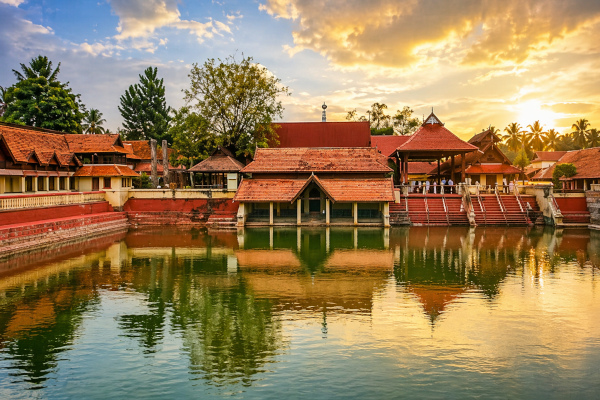
Ambalappuzha Sree Krishna Temple, located in Alappuzha district of Kerala, is one of the most beloved Krishna temples of the state and one of the great Vaishnava shrines of the old Travancore region. Set in the quiet cultural landscape of Ambalappuzha, about 14 km south of Alappuzha town, the temple is not merely a place of worship; it is a living memory-house of Kerala’s devotion, art, food tradition, royal history and temple architecture. For many devotees, Ambalappuzha is remembered through one unforgettable phrase: Ambalappuzha Palpayasam — the sweet milk-rice offering that has become almost as famous as the shrine itself.
The temple is traditionally believed to have been built between the 15th and 17th centuries by the Chembakassery ruler Pooradam Thirunal Devanarayanan Thampuran. The old Chembakassery kingdom had Ambalappuzha as an important cultural centre, and the temple became one of its great spiritual institutions. Over time, it grew into a major Krishna shrine, drawing devotees from Alappuzha, Pathanamthitta, Kottayam, Kollam, Ernakulam and beyond. The temple is also often affectionately called the “Dwarka of the South”, a title that reflects the deep Krishna bhakti associated with the place.
The presiding deity is Sree Krishna in the Parthasarathi form. This is one of the most meaningful forms of Krishna because it recalls the Mahabharata, where Krishna becomes the charioteer and guide of Arjuna. In Ambalappuzha, the deity is traditionally described as holding a whip in the right hand and a conch in the left. The whip represents the charioteer’s role, while the conch connects Krishna to divine authority, dharma and the call to righteous action. This is not the butter-stealing child Krishna alone, nor only the flute-playing cowherd of Vrindavan; this is Krishna as guide, strategist, protector and divine companion in the battlefield of life.
The temple’s most famous legend is the story behind the Palpayasam. According to tradition, Lord Krishna once appeared before the Chembakassery king in the form of a sage and challenged him to a game of chess or chaturanga. The king, known to be fond of the game, accepted. When asked what reward he wanted if he won, the sage made a seemingly modest request: place one grain of rice on the first square of the chessboard, two on the second, four on the third, eight on the fourth, and continue doubling the quantity till the sixty-fourth square. The king agreed, thinking the demand was small. But as the numbers grew, he realised the terrifying scale of the promise. The rice required would exceed the capacity of any granary. At that moment, the sage revealed himself as Krishna and told the king that the debt need not be paid at once. Instead, the king and the temple could repay it slowly by offering sweet milk-rice pudding to devotees every day. Thus, the Ambalappuzha Palpayasam came to be seen not just as prasadam, but as the continuation of a divine promise.
This legend gives the offering a special emotional depth. The payasam is not merely a sweet dish made of rice, milk and sugar. It is a symbol of humility before divine intelligence. The king loses not because he is weak, but because human pride cannot measure cosmic wisdom. The chessboard becomes a lesson in mathematics, dharma and devotion. Every serving of Palpayasam becomes a reminder that the divine does not demand wealth for itself; it transforms royal debt into public feeding, turning a king’s defeat into a devotee’s blessing.
Another important tradition connects Ambalappuzha with Guruvayoor Sree Krishna Temple. During the turbulent period of Tipu Sultan’s incursions into Malabar in the late 18th century, the idol of Guruvayoorappan is believed to have been brought to Ambalappuzha for safekeeping. This association gave the temple an even deeper devotional bond with Guruvayoor. Many devotees believe that Guruvayoorappan still comes spiritually to Ambalappuzha to accept the Palpayasam offering. Whether approached as history, legend or bhakti, this belief gives Ambalappuzha a powerful place in Kerala’s Krishna worship tradition.
The temple also has important sub-deities. Along with the main shrine of Sree Krishna, the temple tradition includes worship of Ganapathi, Ayyappan and Bhagavathi, with nearby sub-shrines connected to Ganapathi and Nagadevata worship. This is typical of Kerala temple culture, where the main deity presides at the centre, while associated deities complete the sacred field of the temple. Ganapathi is invoked for the removal of obstacles, Ayyappan represents discipline and protection, Bhagavathi brings the motherly aspect of divine power, and serpent worship links the temple to Kerala’s older ecological and fertility traditions.
Architecturally, Ambalappuzha Sree Krishna Temple follows the graceful vocabulary of traditional Kerala temple design. Unlike towering North Indian nagara temples or the massive gopurams of Tamil Nadu’s Dravidian shrines, Kerala temples are known for their sloping tiled roofs, wooden structures, enclosed courtyards, lamps, ponds and a deep harmony with the monsoon climate. The Ambalappuzha temple carries this atmosphere beautifully. Its sacred spaces are arranged around the traditional Kerala temple plan, with the sanctum, circumambulatory areas, pillared spaces and temple pond forming a calm devotional environment.
The architecture reflects Kerala’s practical genius. The sloping roofs are suited to heavy rain. The woodwork, laterite, tiled surfaces and open courtyards create a climate-sensitive sacred complex. The temple does not overwhelm the devotee with height; it draws the devotee inward through proportion, rhythm and ritual movement. The experience is not one of spectacle alone, but of quiet entry: crossing the temple grounds, seeing the lamps, hearing the bells, smelling sandalwood and ghee, and slowly approaching Krishna in the inner shrine.
The temple is also known for mural and decorative traditions associated with Kerala temples, including depictions connected to Vishnu and Krishna worship. The visual atmosphere of such temples is never separate from ritual. Lamps, oil, flowers, sandal paste, brass vessels, conch sounds, temple drums and the fragrance of payasam all become part of the architecture. In Ambalappuzha, the built form and the ritual life are inseparable.
Ambalappuzha is also important in the history of Kerala’s performing arts. The temple is closely associated with Ottanthullal, the satirical performing art form created by the great Malayalam poet and performer Kunchan Nambiar. Tradition holds that Ottanthullal was first performed in the premises of this temple. This is culturally significant because Ottanthullal brought wit, social criticism, rhythm and accessible Malayalam expression into temple-linked performance. It was sharp, humorous and deeply rooted in local life. In that sense, Ambalappuzha is not only a devotional centre but also a birthplace of Kerala’s literary and performative satire.
The temple is also associated with Ambalappuzha Velakali, a martial dance tradition performed during temple festivals. Velakali evokes the mood of warriors, battlefield movement and ritualised combat. In a Krishna temple where the deity appears as Parthasarathi, the charioteer of the Mahabharata war, the presence of a martial temple art form feels especially appropriate. It reminds devotees that Krishna’s teaching is not escape from the world, but clarity in the middle of conflict.
Another rare tradition associated with the temple is Pallipana, a ritual performance conducted once in twelve years by traditional communities. Such practices show how Kerala temples were not only priestly ritual spaces but also centres where multiple hereditary art, ritual and community traditions converged. Ambalappuzha therefore preserves layers of devotion: royal patronage, Vaishnava worship, folk ritual, classical performance, satire, martial art and sacred food.
The annual temple festival is one of the major events of Ambalappuzha. The Aarattu festival, usually falling in the Malayalam month connected with March–April, brings processions, rituals, music and a surge of devotees. The festival atmosphere transforms the temple town into a vibrant devotional space. The temple is also connected to the famous Champakulam Moolam Boat Race, one of Kerala’s oldest and most culturally important boat races. Tradition links the boat race to the installation or ceremonial bringing of the Krishna idol associated with Ambalappuzha. The arrival of the Ambalappuzha group with sacred payasam at Champakulam remains part of the ritual memory of the region.
This link between temple and boat race is deeply Kerala in spirit. Here, devotion does not remain enclosed inside the sanctum. It travels through water, community, music and movement. The snake boats, the rhythm of oars, the Pamba river, the songs, the festival gathering and the memory of Krishna all become one cultural stream. Ambalappuzha’s sacred geography therefore extends beyond its compound walls into the waterways and villages of Alappuzha.
The Palpayasam remains the temple’s most iconic offering. Devotees often speak of its special taste, texture and fragrance with deep affection. In Kerala’s religious imagination, prasadam is never just food. It is grace made edible. Ambalappuzha Palpayasam has become one of the finest examples of this idea. Its simplicity is the secret of its greatness: rice, milk and sweetness, slow-cooked into something that carries memory and devotion. In a land famous for elaborate temple offerings, this humble milk-rice pudding has achieved legendary status.
Ambalappuzha Sree Krishna Temple is also important because of its location in Alappuzha’s sacred and cultural corridor. The region is close to the backwaters, paddy fields, canals and old trade routes of Kerala. The temple can be combined with visits to Alappuzha beach, backwater regions, Champakulam, Mannarasala Sree Nagaraja Temple, Haripad and other nearby sacred sites. For pilgrims coming from Pathanamthitta or central Travancore, Ambalappuzha forms part of a beautiful devotional route linking Krishna worship, serpent worship, old river culture and Kerala’s coastal heritage.
For the devotee, Ambalappuzha offers many layers of experience. The child may remember the sweetness of payasam. The historian may remember Chembakassery. The artist may remember Kunchan Nambiar and Ottanthullal. The Vaishnava may remember Parthasarathi. The traveller may remember the calm architecture and temple pond. The cultural scholar may remember how one shrine could nourish literature, ritual, food, boat races and martial performance. That is the real greatness of Ambalappuzha: it does not exist as one thing. It is a temple, legend, kitchen, theatre, archive and sacred landscape at once.
How to Reach Ambalappuzha Sree Krishna Temple
Ambalappuzha Sree Krishna Temple is located at Ambalappuzha in Alappuzha district, around 14 km south of Alappuzha town. By road, it is easily accessible from Alappuzha through the National Highway route towards Ambalappuzha. Buses, taxis and autorickshaws are available from Alappuzha. The nearest railway access is Ambalappuzha railway station, which is very close to the temple, while Alappuzha railway station is the larger nearby railhead with better connectivity. For air travellers, Cochin International Airport is the most convenient major airport for many visitors, while Thiruvananthapuram International Airport is also an option depending on the direction of travel. From Pathanamthitta, visitors can reach Ambalappuzha by road through the central Kerala route towards Alappuzha; the journey generally takes a few hours depending on traffic and the chosen route. Pilgrims visiting Alappuzha’s backwaters can comfortably include Ambalappuzha temple as a half-day pilgrimage stop.
You may also like
-
Shaka in the Mahabharata: Central Asia’s Steppe Peoples, Nakula’s Campaign and the Alliance with Duryodhana
-
Yavana in the Mahabharata: Greek Connections, Pandava Campaigns and the Warriors of Kurukshetra
-
India and Sri Lanka Launch SAMHiTA Manuscript Digitisation Project to Preserve Ancient Buddhist Heritage
-
ASI Uses Ground-Penetrating Radar to Investigate Ancient Buddhist Stupa at Ujjain After Nearly 90 Years
-
Pahlava: The Parthian World Beyond India’s Northwestern Frontiers in the Mahabharata
