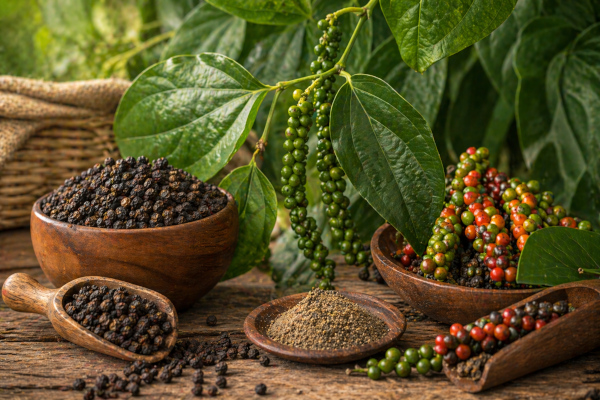
In Ayurveda, black pepper is Maricha—the dried fruit of Piper nigrum—and it is treated as far more than a table spice. Traditional Ayurvedic literature and modern institutional summaries consistently place it among the heating, pungent substances used to stimulate agni (digestive fire), reduce heaviness, and support the handling of excess kapha and sluggish digestion. Classical food-and-formulation records documented in the FSSAI Ayurveda Aahara Compendium describe maricha-containing preparations as ushna (hot), katu (pungent), often tikshna (penetrating), and useful in settings such as agnimandya (low digestive power), aruchi (poor appetite/tastelessness), and some abdominal complaints. A National Institute of Ayurveda herbal note also summarizes Maricha with the classic Ayurvedic profile of katu/tikta rasa, laghu guna, and ushna virya.
That Ayurvedic reputation matches part of black pepper’s long practical history. Britannica notes that black pepper has been used worldwide both as a condiment and, in more limited traditional medical use, as a carminative and a stimulant of gastric secretions. A widely cited PubMed review similarly reports that piperine, black pepper’s best-known pungent alkaloid, can stimulate pancreatic digestive enzymes and shorten gastrointestinal transit time in experimental settings. In Ayurvedic language, that helps explain why black pepper is so often grouped with ginger, long pepper, buttermilk, and other “agni-kindling” ingredients rather than being treated as a random spice sprinkled for heat alone.
If you want to identify the plant itself, look for a perennial evergreen woody climber, not a bush and not a chili plant. The black pepper vine climbs on support using aerial roots; Missouri Botanical Garden describes it as a stout evergreen vine with ovate to heart-shaped dark green leaves, small yellowish-green flowers borne on spikes from the leaf joints, and round fruits that ripen red. Britannica likewise describes the peppercorn as a small drupe with a single seed, harvested before full ripeness for black pepper. In simple visual terms: glossy climbing vine, neat hanging spikes, and bead-like fruits that later become the familiar wrinkled peppercorn.
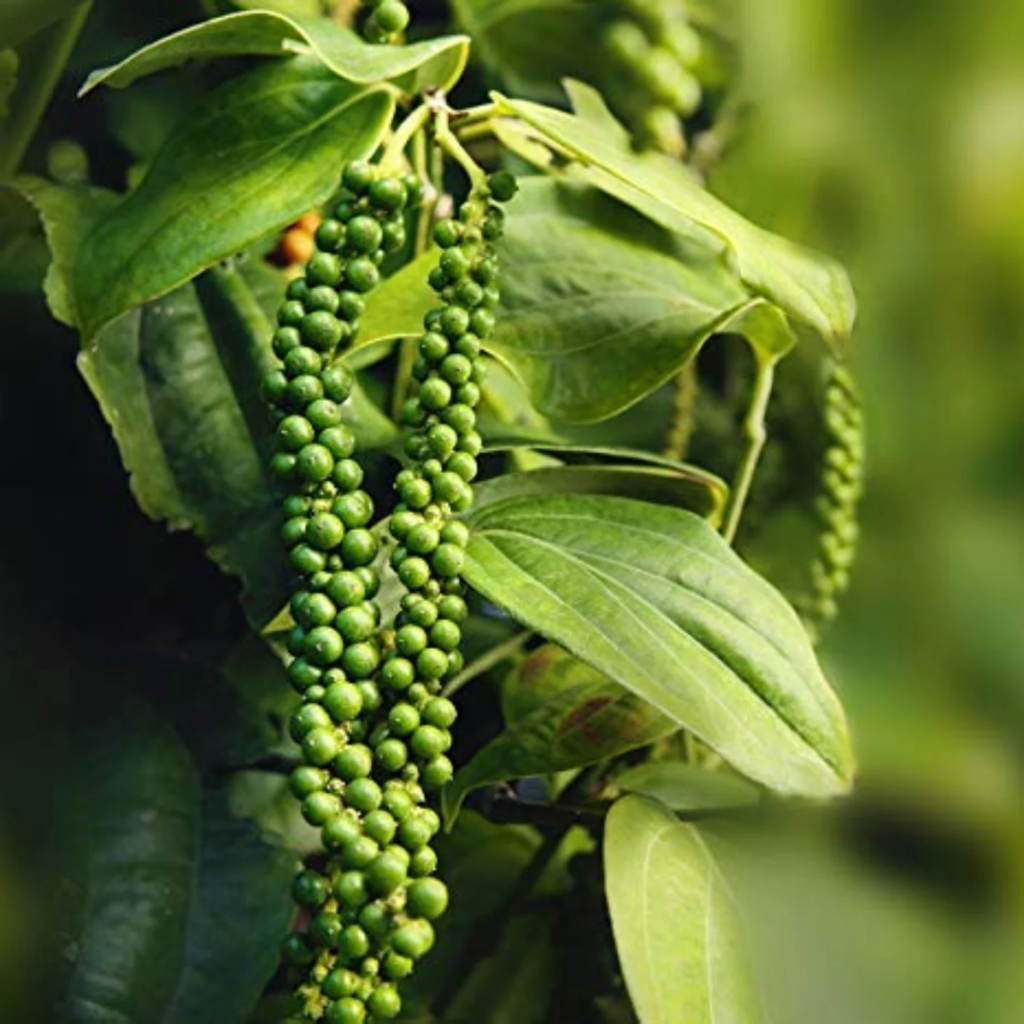
The form used in Ayurveda and cooking is the dried fruit. Britannica explains that black pepper is made from fruits harvested when they begin turning red, then briefly heated and dried until the outer layer shrinks into the familiar black, wrinkled coat. That is why black pepper differs from white pepper, which is made by removing the outer fruit layer, and from green pepper, which is preserved while still unripe. For Ayurveda, this matters because the full black peppercorn carries both pungency and aromatic outer compounds, giving it a stronger, more penetrating kitchen and pharmacy role.
In culinary settings, black pepper works best when it is treated as a warming digestive spice rather than just background heat. Traditional Indian practice uses it in rasam, pepper water, spiced buttermilk, broths, vegetable dishes, lentils, and meat gravies, especially in cool weather or with meals that feel heavy or mucus-forming. The FSSAI compendium records maricha in preparations such as Trikatu Takra with buttermilk, Vartaka Vyanjan with brinjal and asafoetida, and other spiced foods aimed at improving appetite and digestion. That pattern is completely Ayurvedic in spirit: pepper is added where the meal needs more lightness, sharper digestion, or better post-meal comfort.
From an Ayurvedic point of view, the chief traditional uses of black pepper cluster around deepana and pachana—kindling appetite and helping the body process food more efficiently. CCRAS’s Ayurvedic home-remedies material lists black pepper in relation to indigestion, loss of appetite, cough, hiccough, hoarseness of voice, and oral complaints such as bleeding gums or bad breath, showing how broadly the herb has been used in household practice. That does not mean black pepper is a stand-alone cure for every one of those conditions; it means Ayurveda has long treated it as a corrective spice-herb that helps clear stagnation, excessive mucus, and digestive dullness.
A short nutritional note is also worthwhile. Black pepper is used in small quantities, so it is not eaten for calories, but on a per-100 g basis it contains roughly 251 kcal, 10.4 g protein, 64 g carbohydrate, 25.3 g fibre, and 3.3 g fat, and it is particularly notable for manganese, while also contributing iron and calcium. In real life, people consume much less than 100 g, so the nutritional impact of a normal pinch is modest; its real importance lies in flavor, digestive stimulation, and its role as a carrier spice in larger formulations.
Where black pepper becomes especially important is in Ayurvedic compound formulations. One of the best-known is Trikatu, the classical trio of black pepper, long pepper, and dry ginger. PubMed summaries describe Trikatu as a standard Ayurvedic preparation containing those three ingredients, and the FSSAI compendium records Trikatu Takra, a buttermilk-based preparation containing shunthi, maricha, and pippali, described there as ushna, katu, tikshna, and beneficial in abdominal disorders while increasing digestive fire. This is perhaps the clearest example of black pepper’s Ayurvedic identity: it is a formula-builder, an herb that sharpens the entire blend.
Another documented preparation is Marichyadi Modaka, in which black pepper is prominent enough to give the formula its name. The FSSAI compendium lists it with Maricha and Shunthi, and describes it as jatharagni deepaka—stimulating digestive fire—with a classical indication of agnimandhya, or low appetite/digestive sluggishness. That is quintessential Ayurveda: black pepper is not merely added for taste, but selected because its heating, pungent character is expected to wake up a dull digestive system.
Black pepper also appears as part of the Vyosha/Trikatu group in other traditional preparations. The same compendium lists Sindhutthadi Modaka with Vyosha—that is, dry ginger, long pepper, and black pepper—alongside salt, asafoetida, triphala, ajwain, and jaggery, again describing the formulation as jatharagni deepaka and associating it with abdominal pain, abdominal lumps, and piles in the classical framework. Likewise, maricha appears in several Ayurvedic food formulations such as Vartaka Vyanjan and related preparations directed toward poor appetite and low digestive power. These records show that Ayurveda repeatedly places black pepper where food and medicine overlap: in the zone where appetite, digestion, assimilation, and post-meal comfort are being actively managed.
A modern scientific note adds an interesting bridge to the Ayurvedic idea that pepper “activates” a formula. NCCIH notes that piperine from black pepper can improve the bioavailability of curcumin, and broader pharmacology reviews say piperine can affect drug-metabolizing enzymes and transporters. That makes black pepper understandable in two ways at once: traditionally, it is an agni-kindler and channel-opener; scientifically, it also appears capable of changing how some compounds are absorbed and handled. It is exactly why concentrated piperine supplements deserve more caution than ordinary kitchen pepper.
For everyday use, black pepper is best seen as a small-dose, high-effect spice. In the kitchen it warms, brightens, and lightens a dish. In Ayurveda it is valued where digestion is dull, mucus is heavy, the throat feels coated, or a formulation needs more sharpness and penetration. But because its active compound can alter absorption, people using large amounts of pepper extracts or piperine supplements—especially alongside medicines—should be careful and take professional advice. In ordinary culinary amounts, though, black pepper remains one of Ayurveda’s finest examples of how food can behave like medicine without ceasing to be food.
Reference:
https://www.britannica.com/plant/black-pepper-plant
https://www.missouribotanicalgarden.org/PlantFinder/PlantFinderDetails.aspx?taxonid=285067
https://fssai.gov.in/upload/uploadfiles/files/Ayurveda%20Aahara%20Compendium.pdf
https://ccras.nic.in/wp-content/uploads/2023/06/Ayurvedic-Home-Remedies-English.pdf
https://www.nccih.nih.gov/health/turmeric
https://pubmed.ncbi.nlm.nih.gov/17987447/
https://pubmed.ncbi.nlm.nih.gov/21434835/
https://fdc.nal.usda.gov/
You may also like
-
Karanja — Ayurveda’s Bitter Oil Tree for Skin, Wounds and Kapha-Vata Balance
-
Bengaluru’s SugarStrings.ai Develops Cheek-Swab DNA Test Screening Thousands of Genetic Disorders
-
Green Pyramid Biotech Turns Sophorolipid Research Into a Natural Food-Safety Platform
-
Ashoka — Saraca asoca: Ayurveda’s Celebrated Tree for Rakta and Women’s Health
-
New Smart Technology can Make Diagnosis of Alzheimer’s disease (AD) More Accessible
