
Indian astronomers have pushed an important question in modern astrophysics a little further: can some of the smallest galaxies in the universe host central black holes? A new study by K. Aditya and Arun Mangalam of the Indian Institute of Astrophysics examined dwarf spheroidal galaxies orbiting the Milky Way and found that while current data do not require large black holes to be present, they are consistent with the possibility of smaller intermediate-mass black holes. The work was highlighted by the Ministry of Science and Technology on April 17, 2026, and published in The Astrophysical Journal.
The significance of the study goes well beyond a niche galactic puzzle. Supermassive black holes are commonly observed in large galaxies, but dwarf spheroidal galaxies are faint, poor in gas, and heavily dominated by dark matter, making any central black hole extremely hard to detect directly. That matters because understanding whether such small galaxies host black holes could help scientists trace how the earliest black holes formed and whether the familiar link between black-hole mass and stellar velocity dispersion extends all the way down to the smallest galactic systems.
To tackle the problem, the researchers built detailed dynamical models of Milky Way dwarf spheroidal galaxies using three gravitational components: stars, a dark matter halo, and a possible central black hole. They used stellar kinematic data and anisotropic orbital modelling to constrain how massive any such black hole could be. Their analysis found 95% credible upper limits below about one million solar masses, with some galaxies permitting only much smaller values. In effect, the study narrows the room available for hidden black holes in these systems, rather than claiming a definitive detection.
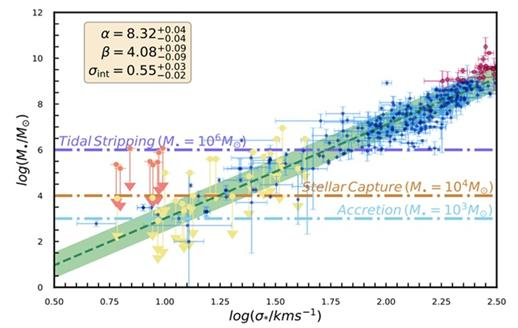
The study’s broader contribution lies in combining these dwarf-galaxy constraints with black-hole measurements and upper limits from earlier literature to build a unified black hole mass–stellar velocity dispersion relation across an enormous range, from roughly 10 to 300 kilometres per second in dispersion and spanning nearly seven orders of magnitude in black-hole mass. The authors report that the same broad scaling relation appears to connect dwarf spheroidals with much larger galaxies, though uncertainties grow at the low-mass end. That makes the result one of the more comprehensive empirical calibrations yet attempted across the galaxy mass spectrum.
The team also compared its limits with physically motivated growth scenarios. According to the researchers, momentum-driven gas accretion models naturally predict black holes of around 1,000 solar masses in dwarf spheroidals, while stellar-capture processes could raise masses to around 10,000 solar masses or more. They also examined tidal-stripping scenarios, in which today’s dwarf spheroidals may once have been larger galaxies that lost substantial stellar mass during interactions with the Milky Way. Together, these possibilities offer multiple pathways for future observations to test.
The findings arrive at a useful time for observational astronomy. PIB noted that future facilities such as the proposed National Large Optical Telescope and the Extremely Large Telescope could deliver the spatial and spectral precision needed to measure stellar motions in faint dwarf galaxies far better than before. That would allow astronomers to probe whether these tiny systems truly shelter primordial black-hole seeds or whether the lower end of the galactic population evolved differently from their massive cousins.
Paper link: https://iopscience.iop.org/article/10.3847/1538-4357/ae2d4f
Reference:
https://www.pib.gov.in/PressReleasePage.aspx?PRID=2252835®=3&lang=1
https://arxiv.org/abs/2512.14146
https://arxiv.org/pdf/2512.14146
You may also like
-
IIT Guwahati Develops Affordable Technology to Remove Arsenic and Fluoride From Drinking Water
-
BITS Pilani Goa Develops Pharmaceutical Bioink for 3D-Printed Skin Scaffolds and Customised Medicines
-
New Smart Technology can Make Diagnosis of Alzheimer’s disease (AD) More Accessible
-
Study Identifies Uniqueness of South Asian Gut Microbiome, Critical for Lifestyle Disease Treatment
-
GENESIS EIR 3.0 Offers Up to ₹10 Lakh to Turn Young Indian Innovators Into DeepTech Entrepreneurs
