
Researchers in India have reported a significant advance in the design of smart nanomaterials that can change their structure, optical behaviour and electrical performance simply through temperature variation. Announced by the Ministry of Science & Technology on April 9, 2026, the work could support future electronic devices, tunable optoelectronic systems, responsive materials and bioelectronic interfaces.
The research was carried out by a team from the Centre for Nano and Soft Matter Sciences (CeNS), Bengaluru, in collaboration with the Jawaharlal Nehru Centre for Advanced Scientific Research (JNCASR), both autonomous institutions under the Department of Science and Technology. The scientists studied naphthalene diimide, an amphiphilic molecule that can organize itself in water through supramolecular self-assembly, forming nanostructures with functional properties relevant to electronics, photonics and biomedical devices.
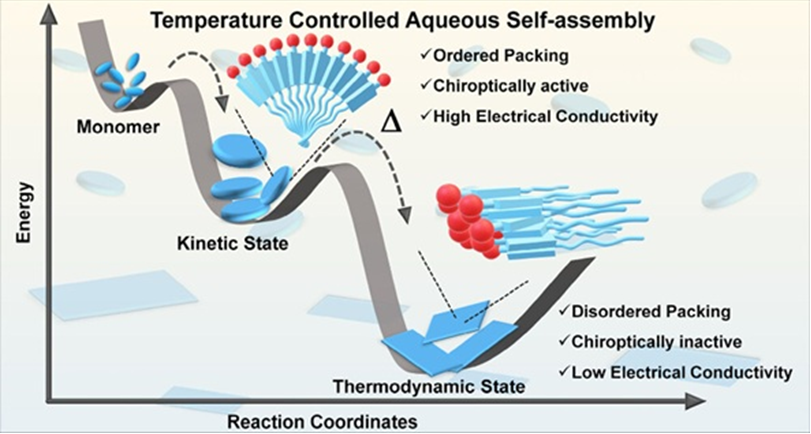
According to the release, the molecules form tiny circular nanostructures called nanodisks at room temperature. These nanodisks exhibit chiroptical activity, meaning they interact with polarized light in a distinctive manner. When heated, however, the nanodisks reorganize into two-dimensional nanosheets and lose that chiroptical activity, showing that temperature alone can switch the material between different structural and optical states.
The researchers also found a major shift in electrical performance during this transition. The nanodisks showed much higher electrical conductivity, which dropped by nearly sevenfold after conversion into nanosheets. This indicates that the material’s electrical behaviour can be tuned by controlling how the molecules self-assemble, a feature the ministry described as unusual for small organic molecules.
The ministry said this combination of temperature-controlled structural, optical and electrical tuning could open new possibilities for sensors, smart technologies and adaptive electronics. The study was published in ACS Applied Nano Materials, and the research team was led by Dr. Goutam Ghosh of CeNS, with contributions from PhD student Sourav Moyra of CeNS and collaborator Tarak Nath Das of JNCASR.
Publication link: https://doi.org/10.1021/acsanm.5c03598
Reference:
https://www.pib.gov.in/PressReleasePage.aspx?PRID=2250461®=3&lang=1
You may also like
-
IIT Guwahati Develops Affordable Technology to Remove Arsenic and Fluoride From Drinking Water
-
BITS Pilani Goa Develops Pharmaceutical Bioink for 3D-Printed Skin Scaffolds and Customised Medicines
-
New Smart Technology can Make Diagnosis of Alzheimer’s disease (AD) More Accessible
-
Study Identifies Uniqueness of South Asian Gut Microbiome, Critical for Lifestyle Disease Treatment
-
GENESIS EIR 3.0 Offers Up to ₹10 Lakh to Turn Young Indian Innovators Into DeepTech Entrepreneurs
